
Shutdown planning
How to Plan a Plant Shutdown: Process, Phases and Timeline
How to plan a plant shutdown: work backward from the start date through five phases: scope and strategy, plan and schedule, readiness, execute and restart, and close-out and review. Freeze the scope early, settle long-lead materials and contractors before the stop, and treat late work as a change request.
Planning here means everything before the stop. Execution and restart are covered in the execution guide.
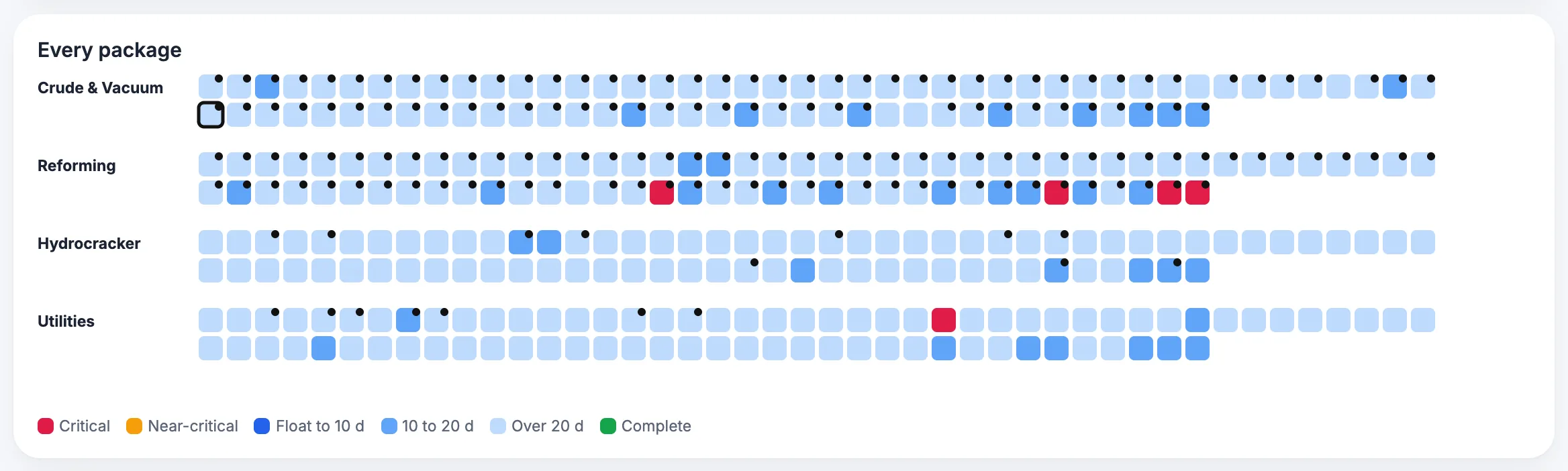
How MaintWiz helps: A 12-month plan fails when scope, schedule and readiness live in different files. The MaintWiz shutdown module puts the whole shutdown on a Gantt chart with the critical path, float and baselines, so you can see what moves the finish date. See the module · Get the Gantt template
By Jai Balachandran · Published · Last reviewed
What MaintWiz adds:Gantt with critical path and floatBaselines show what movedFloat flag at your limitOne plan from portfolio to task
Lead time
How to plan a plant shutdown: how far ahead should it start?
A large refinery turnaround may need 1 to 2 years of advance planning: EIA says turnarounds may involve that much, and AFPM says teams often begin years ahead. 1,2 There is no published figure for smaller shutdowns, so work backward from your longest lead item instead.
This guide covers the planning that comes before the stop. The work itself is shutdown maintenance; execution is covered in the execution guide.
- 1–2 yrsAdvance planning for a US refinery turnaround (EIA)
- 3–5 yrsInterval for routine turnarounds on key US refinery units (EIA)
- Weeks to monthsHow long a refinery unit is offline (EIA, AFPM)
- Spring or fallWhen US refinery turnarounds are typically scheduled (AFPM)
US refining examples. Not benchmarks for other sectors.
What sets your own lead time
Longest-lead item
The equipment, materials or specialist service that takes longest to get. Work backward from it.
Contractor availability
Specialist crews and heavy equipment are booked ahead; a late scope leaves less choice.
Inspection and legal dates
A statutory inspection or certificate date can fix the window before anything else does.
Phases
What are the phases of a shutdown plan?
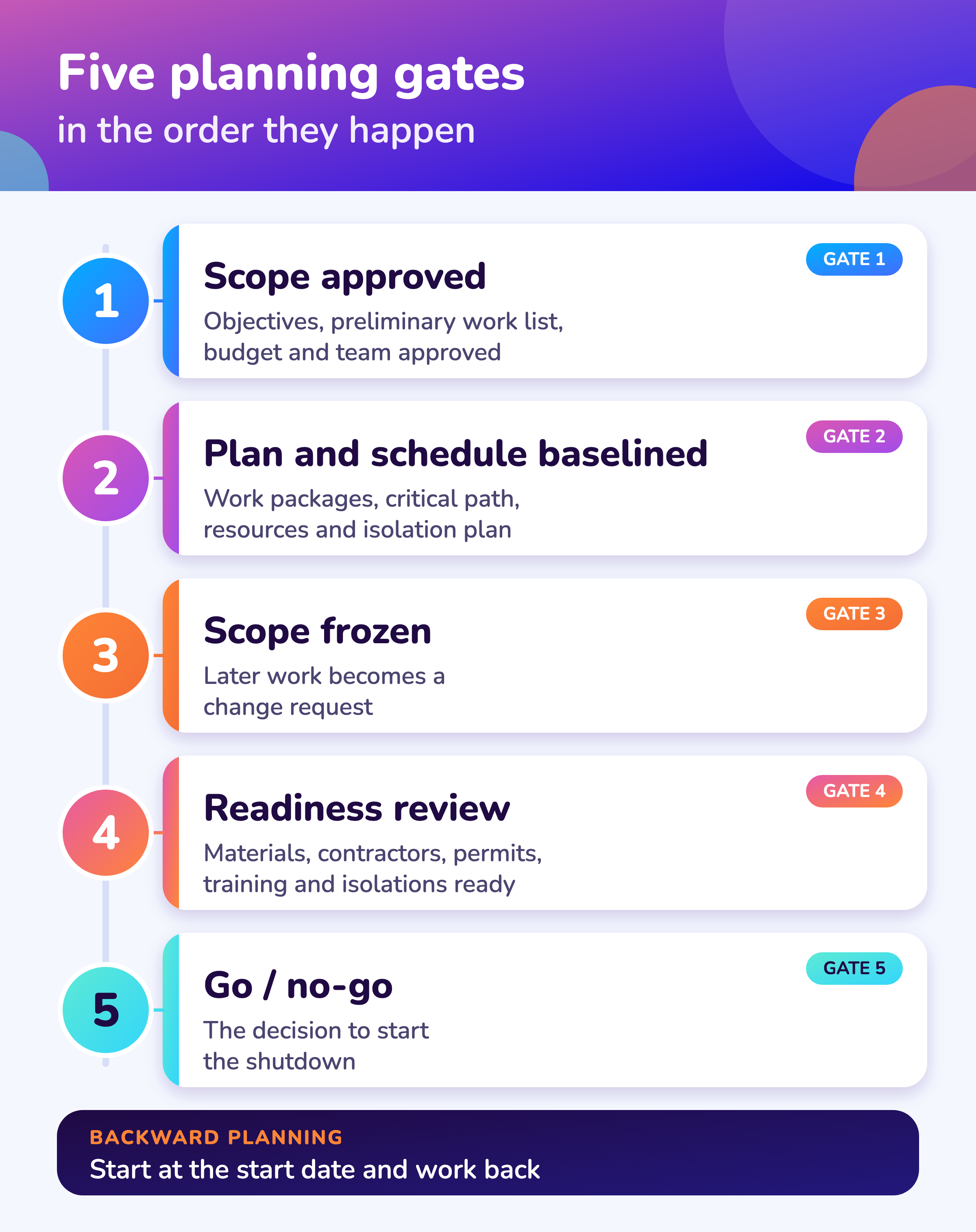
A shutdown plan has five phases, each ending in a gate decision, with project control (progress, critical path, cost, changes, risk) running through all of them. Planning is phases 1 to 3; the stop and the restart are phase 4.
Material planning is in shutdown spare parts planning. For T&I gated planning in Gulf refining, see T&I turnaround and inspection planning. Estimates need history: keep maintenance history in S/4HANA.
- 1
Scope and strategy
Collect the work list from the backlog, inspection findings and past shutdowns. Set objectives, timing and a cost estimate. Define the team and roles. Obtain approvals.
Outputs: Approved scope, budget, dates, team · Gate: Scope approved - 2
Plan and schedule
Break the scope into work packages with job plans. Sequence the work and find the critical path. Plan resources, permits, external approvals, spares, tools, logistics and isolations.
Outputs: Work packages, schedule, resource and material plan, isolation plan · Gate: Plan and schedule baselined - 3
Readiness
Freeze the scope. Confirm materials and contractors. Complete training. Prepare permits and isolations. Hold a go / no-go review.
Outputs: Readiness sign-off · Gate: Scope frozen, readiness review, go / no-go - 4
Execute and restart
Mobilize, shut down in the planned sequence, isolate, inspect, clean, repair and replace, calibrate, check quality, assess discovered work, then restart in the planned sequence.
Outputs: Completed work, inspection records, safe restart · Gate: Restart approval - 5
Close-out and review
Demobilize, close permits and contracts, reconcile cost and schedule, review performance and lessons, report to management.
Outputs: Close-out report, lessons learned, updated asset records · Gate: Close-out signed off
Software
Where do the lists of a shutdown plan live?
A shutdown plan is a set of linked lists: scope, work packages, schedule, materials, permits and budget. Keeping them in one place stops them drifting apart.
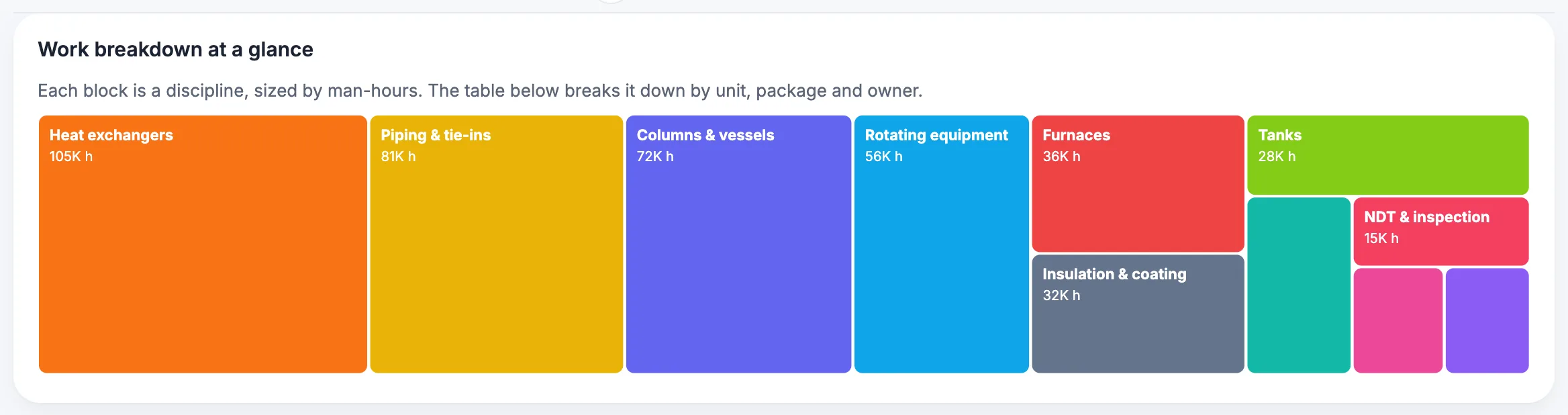
See the MaintWiz shutdown module data sheet and the shutdown management software page for what the module covers. See digital shutdown management for the order in which to digitize. To choose a tool, see shutdown software vs CMMS vs Primavera P6. For SAP PM sites see SAP PM shutdown management.
About MaintWiz. MaintWiz is an industrial AI platform with IoT, SAP integration and predictive maintenance (PdM) capabilities. Its shutdown and turnaround module helps plants plan, schedule, execute and close out shutdown work.
What the shutdown module covers
As described on the MaintWiz shutdown maintenance product page.
- Shutdown calendar and critical-path scheduling, with work order sequencing and dependencies
- Asset prioritization, so the most critical equipment is scoped first
- Resource planning for people, spares, heavy equipment such as cranes, and outsourced vendors
- Electronic permits to work, risk management and contingency plans
- Real-time progress monitoring: schedule adherence, cost variance, quality metrics and risk factors
- Step-by-step checklists, pre-restart testing protocols and post-shutdown analysis
Proof
What MaintWiz customers report
Figures as published in MaintWiz case studies on maintwiz.com. They come from maintenance management projects, not shutdowns.
Backward plan
What does a backward plan look like?
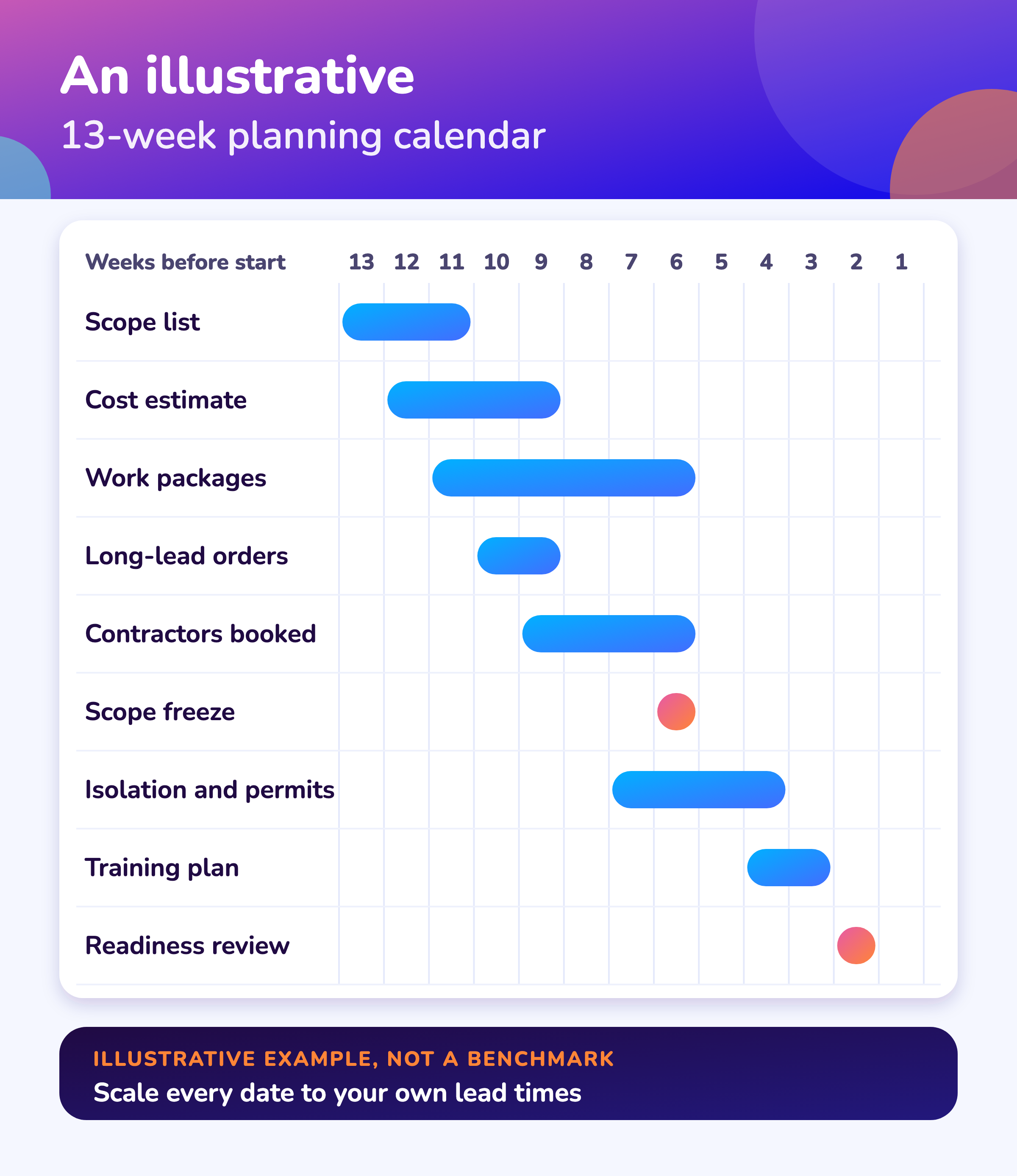
A backward plan starts from the shutdown start date and places the gates backward in order. The calendar below is an illustration for 13 weeks of planning. It is a planning framework, not a benchmark; scale every date to your own lead times.
Free Excel work list and schedule templates for this plan are in the shutdown planning templates. Check the logic of your task list with the free Excel to Gantt tool. Budget timing is in how to estimate a shutdown budget. Check each stage with the gates in turnaround readiness review and phase gates, and estimate with the classes in turnaround cost estimate and AACE classes.
The gates in the example
| Gate | Example timing | What must be true |
|---|---|---|
| Scope approved | 13 to 9 weeks before start | Objectives, preliminary work list, budget estimate and team are approved |
| Plan and schedule baselined | About 6 weeks before start | Work packages and job plans exist; critical path and resources are loaded; isolation plan drafted |
| Scope frozen | 6 weeks before start | Long-lead items are ordered and contractors priced; later work needs a change request |
| Readiness review | 2 weeks before start | Materials on site or confirmed, crews booked and trained, permits and isolations prepared |
| Go / no-go | Start of the shutdown | Decision to start, recorded |
For the sequencing and critical path of the shutdown itself, see shutdown scheduling. For when to schedule it in the year, see when to schedule shutdowns.
Try it: put your start date into the backward plan
Enter the planned shutdown start date and adjust the weeks for each gate. The starting weeks are the illustrative ones used above, not a benchmark. The dates are worked out in your browser; nothing is sent or stored.
Competing demands
What competing demands break a shutdown plan?
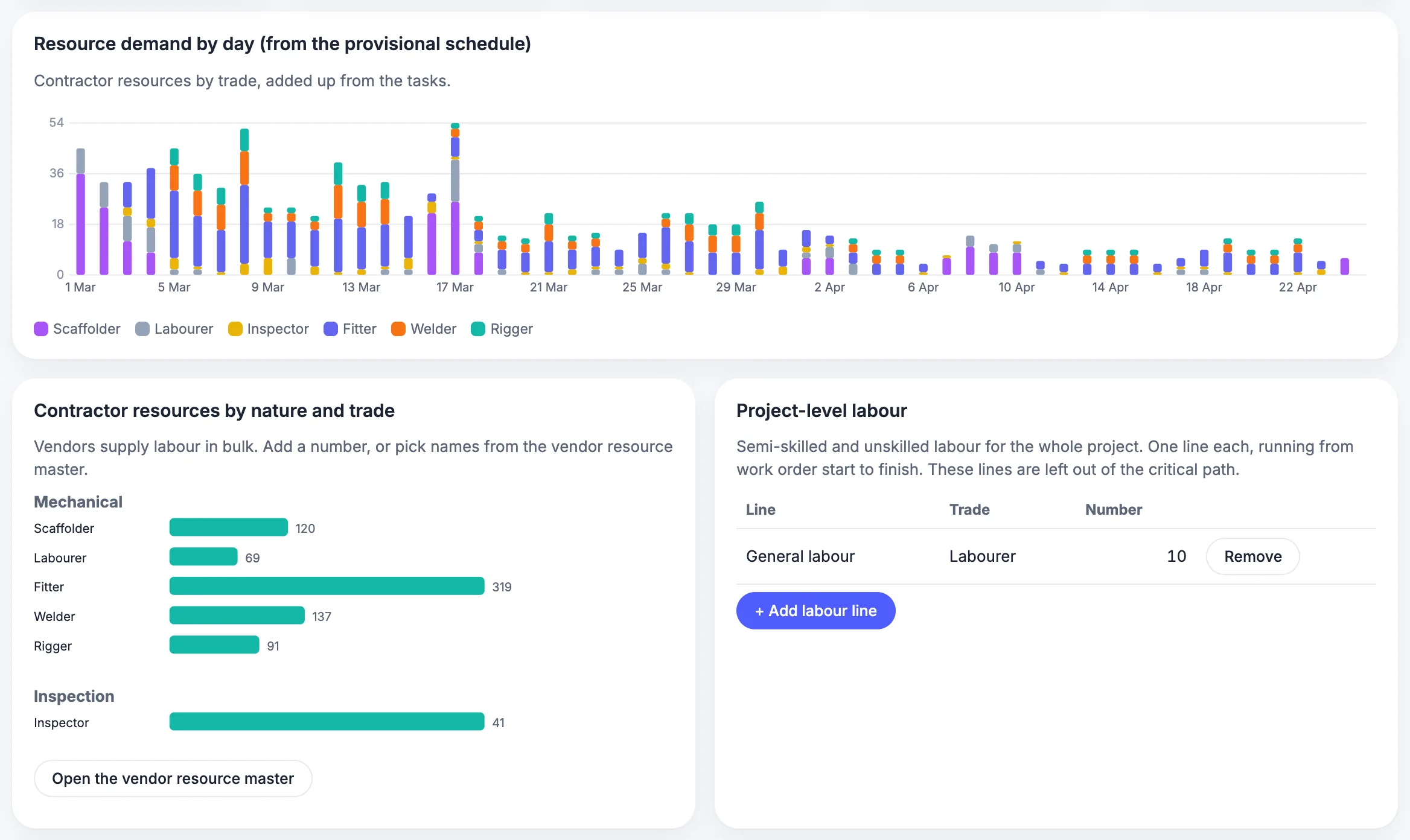
Competing demands break a shutdown plan when maintenance, contract work, modifications and operations all want the same people, equipment and time. HSE guidance lists these conflicts as work pressures that a realistic schedule must manage and resource.
Maintenance and operation
HSE guidance names competing demands between maintenance and operation as something a realistic schedule must manage. 4
Contract work and operation
The same HSE guidance names contract work against operation. Resources have to be adequate for the work. 4
Modifications and maintenance
HSE also names shutdown modifications against maintenance. Modifications add scope that needs change control. 4,6
Several units at once
When several units stop in the same period they share crews, cranes, scaffolding and the permit desk. Plan the shared resources as one calendar, and give the whole event one control point.
Roles and team structure: shutdown team roles · Contractors: contractor management · Materials: materials and logistics.
Change control
How do you handle late work after the scope is frozen?
Late work after the scope is frozen should be handled as a change request, not an informal addition. NERC's generator reporting rules make the same distinction: tasks are fixed in advance as the original scope of work, and discovery work is outside it.
Water plants: water and wastewater plant outages.
- 1
Record the request
Log the job, who raised it and why, against the frozen scope.
- 2
Assess the effect
Check safety, schedule, cost, materials and isolations, and whether it is a replacement in kind or a modification.
- 3
Approve through change control
An authorized person approves, defers or rejects it. Where OSHA's Process Safety Management standard applies, changes other than replacements in kind need written management-of-change procedures. 6
- 4
Update the plan
Add approved work to the schedule and budget and re-baseline the affected packages.
- 5
Reconcile at close-out
Compare approved changes with the frozen scope in the close-out report.
NERC treats in-scope inspection overrun as a planned extension, and repairs to damage found as forced outage time. 5 More: shutdown scope definition.
Industries
Planning by industry
The phases and gates are the same; lead times, terms and regulations differ. Pick the guide closest to your plant.
For T&I planning in Gulf refining, see T&I turnaround and inspection planning. Industry checklists are in the free shutdown templates.
Visuals
Save the planning charts
Save or share these two planning charts. Each opens full size.
FAQ
Frequently asked questions
How do you plan a plant shutdown step by step?
Work backward from the start date: set the scope and budget, build work packages and the schedule, freeze the scope and confirm readiness, run the stop and restart, then close out and review. Each phase ends in a gate decision. EIA says refinery turnarounds may involve 1 to 2 years of advance planning; smaller shutdowns need less. 1
How far in advance should a shutdown be planned?
For large refinery turnarounds EIA says 1 to 2 years, and AFPM says planning often begins years ahead. There is no published figure for smaller shutdowns; work backward from your longest lead item. 1,2
What are the phases of a shutdown plan?
Five: scope and strategy, plan and schedule, readiness, execute and restart, and close-out and review, with project control running through all of them.
When should scope be frozen?
No public source gives a date. As a rule, freeze it before long-lead items are ordered and contractors are priced, and handle later work as change requests. NERC's generator rules likewise fix tasks in advance as the original scope of work. 5
What goes into a shutdown plan?
A scope list, work packages and job plans, a schedule with the critical path, a budget, a materials and spares plan, contractor bookings, an isolation and permit plan, a risk register, a communication plan, a readiness checklist and a close-out plan.
How do you plan a shutdown with no dedicated planner?
Keep the same five phases and gates but with fewer people: one owner for scope, one for materials and contractors, one for permits and isolations, and a short weekly review. This is planning guidance, not a sourced benchmark.
How do you coordinate several units shutting down together?
Plan shared resources (crews, cranes, scaffolding, permit desk) as one calendar and give the event one control point. HSE guidance names competing demands between maintenance, contract work, operation and modifications as pressures to manage. 4
Can software plan a shutdown?
Software can hold the scope, work packages, schedule, materials, permits and budget in one place and track progress against the plan. See the MaintWiz shutdown and turnaround module.
Sources
Sources
All sourced figures come from the public sources below; the calendar and gate timings are an illustration, and the page labels them so. Confirm any figure with its source before you use it.
- U.S. Energy Information Administration, Refinery Outages: Description and Potential Impact on Petroleum Product Prices
- American Fuel & Petrochemical Manufacturers, Refinery turnarounds 101: What are turnarounds and why do we need them? (17 October 2023)
- U.S. Energy Information Administration, Seasonal maintenance helps keep power online during summer and winter peaks (22 April 2011; ISO New England data)
- UK Health and Safety Executive, The safe isolation of plant and equipment (HSG253, 2006)
- North American Electric Reliability Corporation, Generating Availability Data System (GADS) Data Reporting Instructions, effective 1 January 2026
- OSHA, 29 CFR 1910.119, Process safety management of highly hazardous chemicals
Put your shutdown schedule in one plan
Book a demo and bring your shutdown schedule. We will show how the module handles the critical path, float and baselines.