
Shutdown types
Types of Shutdown Maintenance: Planned to Statutory
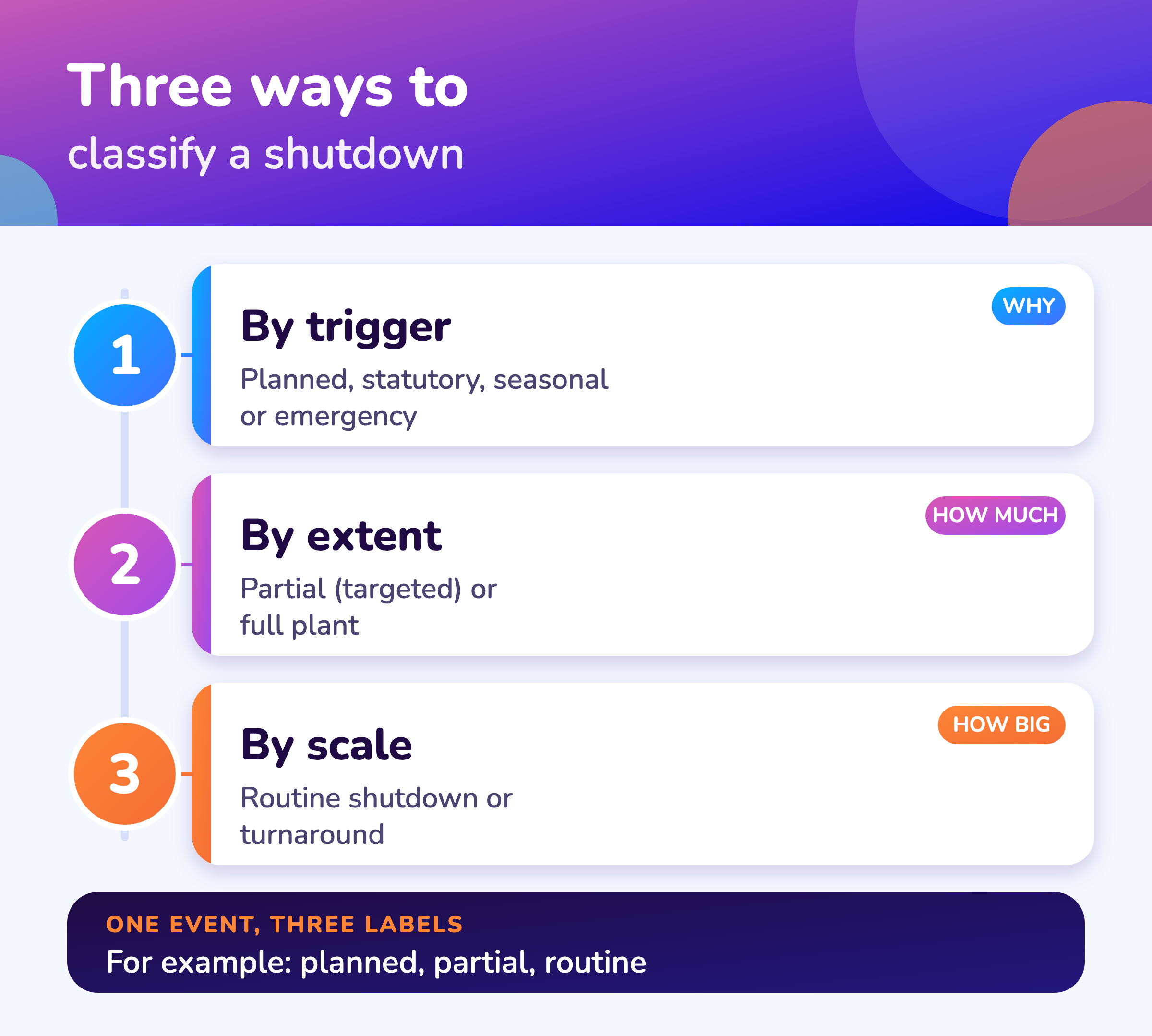
Plant shutdowns can be classified three ways: by trigger (planned, statutory, seasonal or emergency), by extent (partial or full plant) and by scale (routine shutdown or turnaround). One event has one value on each axis, for example a planned, partial, routine shutdown, or an emergency, full-plant shutdown.
A shutdown is the stop itself; shutdown maintenance is the work done during it.
How MaintWiz helps: Each type of stop needs scope, schedule, permits and parts under control. The MaintWiz shutdown module moves the plan from spreadsheets into one system with a critical path, readiness gates, permits and spares status. See the module · Get the 40-step checklist
By Jai Balachandran · Published · Last reviewed
What MaintWiz adds:Critical path and floatReadiness gatesPermits and isolationsSpares status with SAP
By trigger
What are the types of shutdown by trigger?
The types of shutdown by trigger are planned, statutory (or inspection-driven), seasonal and emergency (or forced). The trigger tells you who sets the date: management, a regulation, the demand cycle, or an event.

A planned stop is the usual setting for shutdown maintenance; the other three change how much notice you have or who controls the date.
Planned
Scheduled in advance, with scope, budget and resources set before the stop. In US refining, EIA says turnarounds may involve 1 to 2 years of advance planning. 1,3
Statutory or inspection-driven
The date is set by law or an inspection scheme. In Great Britain a written scheme of examination must be in place before qualifying pressure equipment is used, and examinations follow it. 4,5 In India a boiler certificate authorizes use for no more than twelve months (Boilers Act 2025, section 12(6)); the Act commences on a date the central government notifies. 6 The Factories Act (replaced by the OSH Code, 2020 from 21 November 2025) lets state governments make rules for examining and testing pressure plant (section 31(2)). 7
Seasonal or low-demand window
Timed for the season when demand is lowest: spring or fall in US refining, and spring and fall for generators in the New England data EIA analyzed. 2,8
Emergency or forced
Not scheduled. EIA describes emergency shutdowns where a unit or the whole refinery must come down immediately, without warning. Power generation grades forced outages by urgency; see turnaround vs shutdown vs outage. 1
What sets the date
| Trigger | What sets the date | Planning lead time | Source |
|---|---|---|---|
| Planned | Management, in line with equipment condition and the production calendar | Refinery turnarounds: 1 to 2 years of advance planning. No public figure for other sectors | EIA |
| Statutory or inspection-driven | A legal inspection or certificate date, or an inspection scheme | Known from the certificate or scheme interval, so planning can start early | HSE PSSR, Boilers Act 2025 |
| Seasonal or low-demand window | The demand cycle | Set by the season; spring or fall in US refining and generation | AFPM, EIA |
| Emergency or forced | An event: a failure, trip or hazard | None; the unit comes down immediately (emergency) or within a defined period (forced) | EIA, NERC GADS |
By extent
Partial or full-plant shutdown?
A partial shutdown stops part of the plant; a full-plant shutdown stops all of it. The difference that matters most in practice is the isolation boundary between the work area and anything still live.
Treatment plants that isolate one unit at a time are covered in water and wastewater plant outages. Planned outages at nuclear plants are covered in nuclear refueling outage planning.
Partial or targeted
One or more units, or a smaller scope, come out of service while the rest runs. EIA describes planned, targeted shutdowns of smaller scope than a turnaround. 1
Full plant
The whole plant or refinery is out of service. EIA defines a turnaround as covering one or more units, or possibly the entire refinery. 1
HSE guidance describes boundary isolation with fully rated spades or blinds at the plant boundary, typically used on maintenance shutdowns or turnarounds where hazardous inventory is removed, to prevent re-pressurization from, or ingress from, adjacent live systems. 9 In a partial shutdown, that adjacent live plant is the main hazard to plan around.
Software
Does the type of shutdown change what you need to manage it?
No, the type of shutdown does not change what you need to manage it. Each type still needs a scope, a schedule, permits, spares and a close-out. The type only changes how early you can plan.
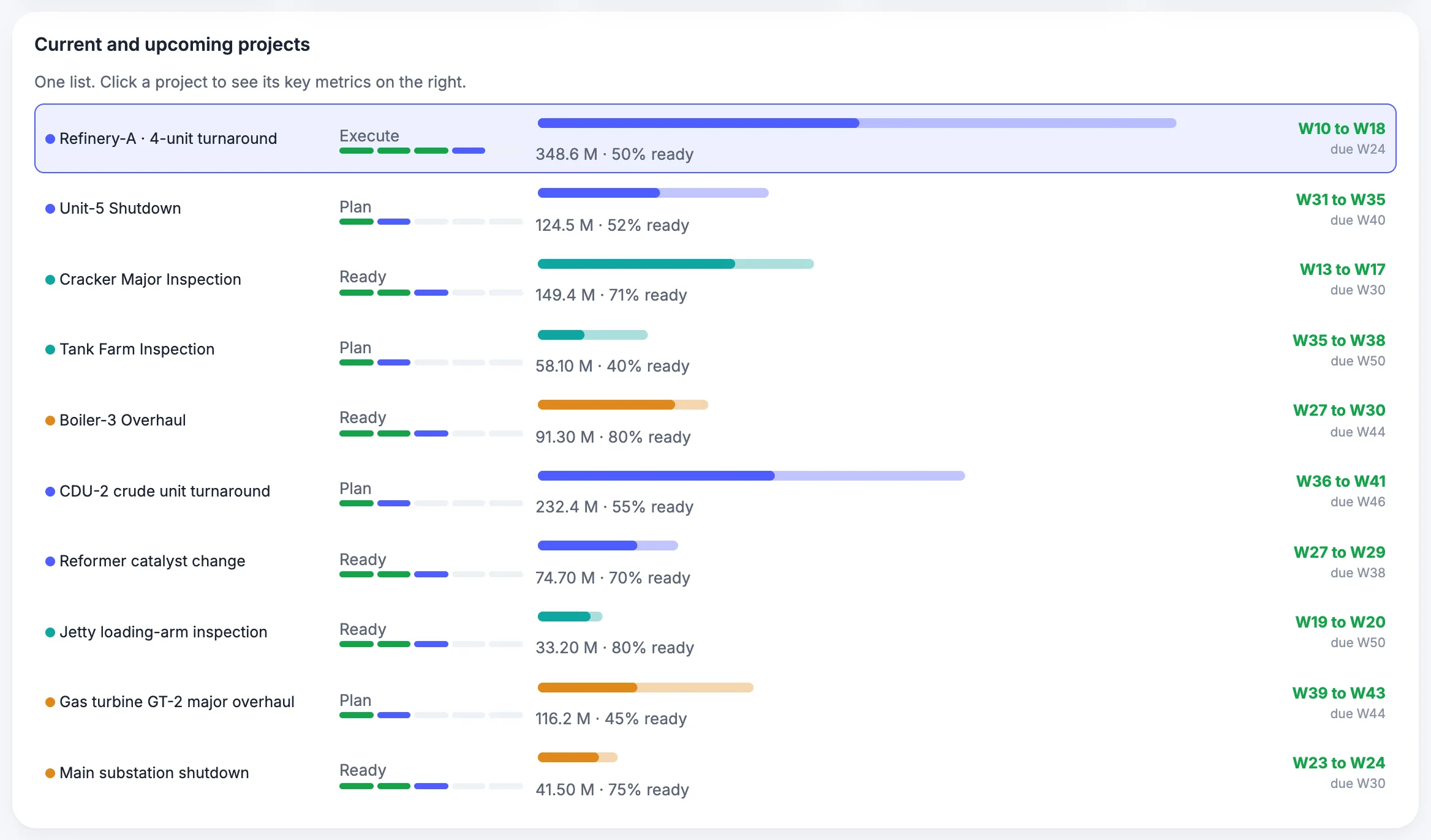
See the shutdown management software overview for portfolio and project views.
About MaintWiz. MaintWiz is an industrial AI platform with IoT, SAP integration and predictive maintenance (PdM) capabilities. Its shutdown and turnaround module helps plants plan, schedule, execute and close out shutdown work.
Also: product data sheet.
What the shutdown module covers
As described on the MaintWiz shutdown maintenance product page.
- Shutdown calendar and critical-path scheduling, with work order sequencing and dependencies
- Asset prioritization, so the most critical equipment is scoped first
- Resource planning for people, spares, heavy equipment such as cranes, and outsourced vendors
- Electronic permits to work, risk management and contingency plans
- Real-time progress monitoring: schedule adherence, cost variance, quality metrics and risk factors
- Step-by-step checklists, pre-restart testing protocols and post-shutdown analysis
Proof
What MaintWiz customers report
Figures as published in MaintWiz case studies on maintwiz.com. They come from maintenance management projects, not shutdowns.
By scale
Routine shutdown or turnaround?
A turnaround is the large, periodic, planned form of shutdown; a routine shutdown is smaller and more frequent. The published numbers come from US refining, so do not apply them to another sector.
Nuclear refueling outages, a scheduled form of turnaround, are covered in nuclear refueling outage planning.
| Question | Routine shutdown | Turnaround | Source |
|---|---|---|---|
| What is it? | A smaller planned stop; EIA calls these planned, targeted shutdowns of smaller scope | The large, periodic, planned form of shutdown | EIA, AFPM |
| How often? | No public benchmark found | US refining: routine turnarounds on key units every 3 to 5 years | EIA |
| How long? | No public benchmark found | US refining: a unit offline several weeks to several months | EIA, AFPM |
| How far ahead is it planned? | No public benchmark found | US refining: 1 to 2 years of advance planning | EIA |
Full comparison of the words, including outage and overhaul: Turnaround vs shutdown vs outage.
Classify
How do you classify a shutdown?
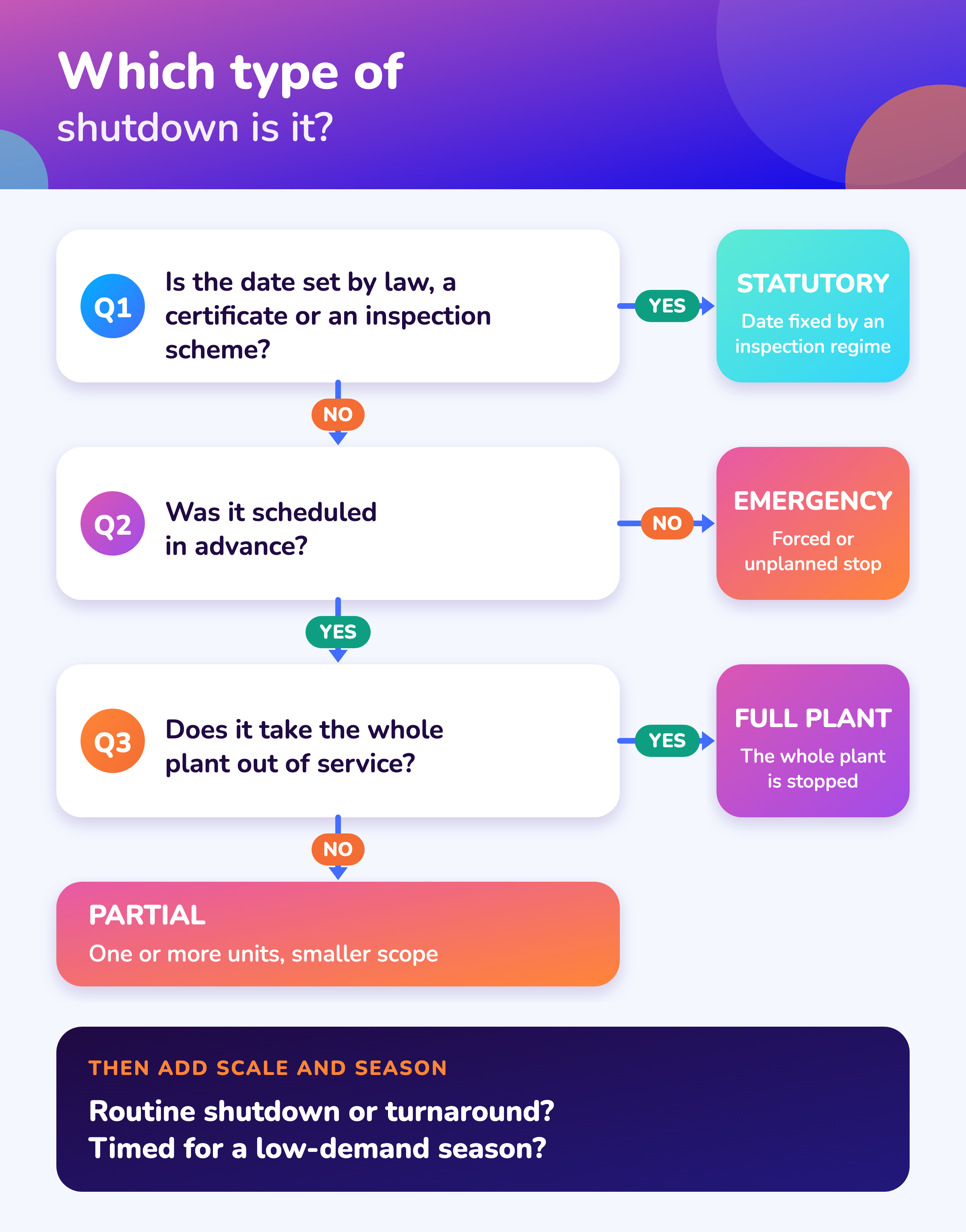
To classify a shutdown, answer three questions, then add scale (routine or turnaround) and season.
For treatment plants that cannot stop, see water and wastewater plant outages.
- Q1Is the date set by law, a certificate or an inspection scheme?YES → STATUTORYBuild the scope around the fixed dateIf no, go to Q2
- Q2Was it scheduled in advance?NO → EMERGENCY OR FORCEDThe unit comes down without a planIf yes, go to Q3
- Q3Does it take the whole plant out of service?YES → FULL PLANTThe whole plant is stoppedIf no, it is a partial or targeted shutdown
Look-alikes
Terms that are not shutdown types
Hot and cold shutdown (nuclear)
In nuclear regulation these describe reactor states. The NRC glossary describes cold shutdown as a reactor coolant system at atmospheric pressure and below 200 degrees Fahrenheit following a cooldown. They are not maintenance types. 10
The UK pressure systems regulations are explained in PSSR pressure systems safety regulations in the UK.
Opportunity maintenance
This guide uses it to mean doing deferred jobs while equipment is already stopped for another reason. No standard definition was found in the public sources reviewed, so check how your site uses the term.
Outage
An outage can be planned or unplanned, so it is not a separate type. See turnaround vs shutdown vs outage.
Planning
How does the type change the plan?
The type of shutdown changes who controls the date and how much notice you have, not whether you need a scope, a schedule, permits and a close-out. The right-hand column is planning guidance, not a sourced benchmark.
The cost effect of each type is in planned vs unplanned shutdown cost.
| Type | What changes | Guidance |
|---|---|---|
| Planned | You control the date, so scope, materials and contractors can be fixed before the stop | Freeze scope, order long-lead items, hold a readiness review. See the planning guide |
| Statutory | The date is fixed by the inspection regime, so other work gathers around it | Build the scope backward from the certificate or inspection date; add other deferred work that needs the same stop |
| Seasonal | The window is fixed by demand | Treat the window as a hard end date and size the scope to fit it |
| Emergency or forced | There is no time for a normal plan | Keep a standing list of deferred jobs and a standard isolation and permit routine so the stop is used well |
| Partial | Live plant remains next to the work | Plan the isolation boundary first |
| Turnaround | Long lead times and many contractors | Use change control for any modification, and plan restart as carefully as shutdown |
Next: How to plan a plant shutdown · When to schedule shutdowns · Shutdown scope · Planned vs unplanned shutdown cost.
Visuals
Save the classification charts
Both charts open full size when clicked, for saving or sharing.
FAQ
Frequently asked questions
What are the main types of plant shutdown?
Three ways of classifying them are common: by trigger (planned, statutory, seasonal or emergency), by extent (partial or full plant) and by scale (routine shutdown or turnaround). One event has one value on each axis. 1,2,3
What is the difference between a planned and an emergency shutdown?
A planned shutdown is scheduled in advance with its scope set beforehand. An emergency shutdown brings a unit or the whole refinery down immediately, without warning. 1,3
What is a statutory shutdown?
A statutory shutdown is one whose date is set by law or an inspection scheme, for example a boiler certificate or a pressure-system examination. In Great Britain a written scheme of examination must be in place before qualifying pressure equipment is used. 4,6
What is a partial shutdown?
A partial or targeted shutdown takes one or more units, or a smaller scope, out of service while the rest of the plant runs. The isolation boundary between the work area and live plant is the main planning concern. 1,9
Is a turnaround a type of shutdown?
Yes. A turnaround is the large, planned, periodic form of shutdown, usually covering one or more units or possibly the whole plant. 1,2
Can a shutdown be planned and statutory at the same time?
Yes. The trigger types are not exclusive: a statutory inspection date can be the reason for a planned shutdown, and the stop can also be a seasonal window or a turnaround.
What are hot shutdown and cold shutdown?
In nuclear regulation they describe reactor states, not maintenance types. The NRC glossary describes cold shutdown as a reactor coolant system at atmospheric pressure and below 200 degrees Fahrenheit following a cooldown. 10
How often does each type happen?
There is no cross-industry figure. In US refining, EIA says routine turnarounds on key units are planned every 3 to 5 years. For other sectors there is no published benchmark. 1
Sources
Sources
The figures and definitions here are taken from the public sources below. Planning guidance and illustrations are labeled as such. Check the original source before relying on any figure, as publishers update them.
- U.S. Energy Information Administration, Refinery Outages: Description and Potential Impact on Petroleum Product Prices
- American Fuel & Petrochemical Manufacturers, Refinery turnarounds 101: What are turnarounds and why do we need them? (17 October 2023)
- North American Electric Reliability Corporation, Generating Availability Data System (GADS) Data Reporting Instructions, effective 1 January 2026
- UK Health and Safety Executive, Pressure Systems Safety Regulations 2000 (PSSR)
- UK Health and Safety Executive, Written schemes of examination (INDG178, rev 2, 2012)
- Government of India, The Boilers Act, 2025 (Act No. 12 of 2025), Gazette text as published by PRS India
- Government of India, Ministry of Labour and Employment, The Factories Act, 1948
- U.S. Energy Information Administration, Seasonal maintenance helps keep power online during summer and winter peaks (22 April 2011; ISO New England data)
- UK Health and Safety Executive, The safe isolation of plant and equipment (HSG253, 2006)
- US Nuclear Regulatory Commission, Glossary: Cold shutdown
Move your shutdown plan out of spreadsheets
Book a demo and bring the spreadsheet you use today. We will show how the module covers the same ground.