
Equipment guide
Storage Tank Turnaround Planning: API 653 Out-of-Service Inspection
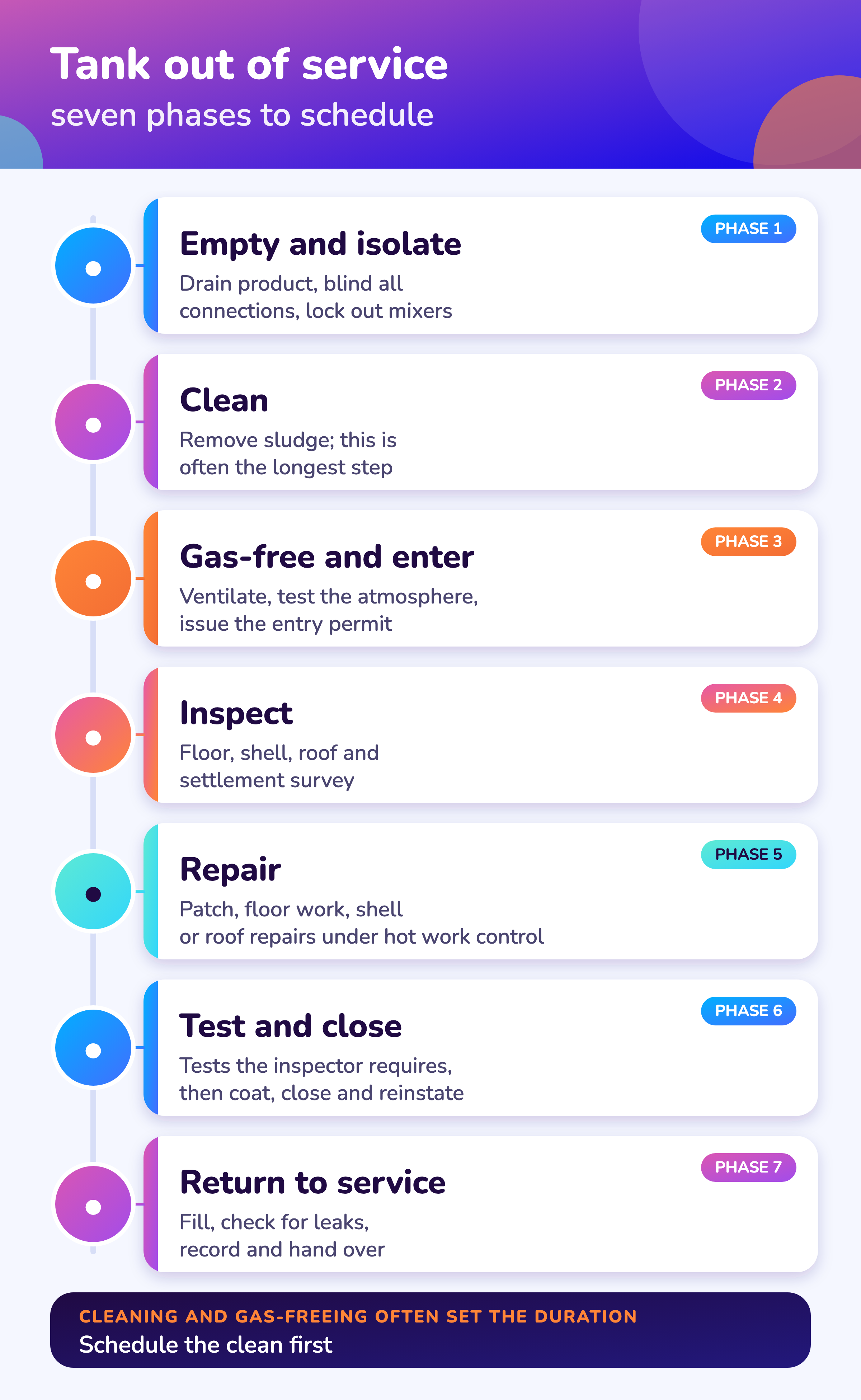
Storage tank turnaround planning takes a tank out of service through seven phases: empty and isolate, clean, gas-free and enter, inspect, repair, test and close, and return to service. The authorized inspector sets the scope under API 653, and cleaning is often the longest step, so schedule it first. MaintWiz plans each outage with permits, isolations and findings tied to work orders.
STO means shutdown, turnaround and outage. Follow the current edition of API 653, your inspector and the regulations that apply.
How MaintWiz helps: Cleaning and gas-freeing often set the length of a tank outage. The MaintWiz shutdown module gives plant teams one plan for scope, schedule, permits, spares and execution, from the first work package to close-out. See the module · Get the tank outage checklist
By Jai Balachandran · Published · Last reviewed
What MaintWiz adds:Scope, schedule and permits in one planSpares status with SAPReadiness gatesFindings to the planner
Definition
What is storage tank turnaround planning?
Storage tank turnaround planning takes an aboveground steel tank out of service to be emptied, cleaned, gas-freed, inspected, repaired and returned to service, using the inspection code, API 653, and the authorized inspector to set the scope. 1 In this guide STO means shutdown, turnaround and outage.
A tank is not a pressure vessel, but its outage is a project with the same hazards: confined space, hot work and flammable residues. Cleaning and gas-freeing often take longer than the repair, and a tank taken out of service for a planned inspection is one of the easiest outages to plan well because the date is known.
Download the free storage tank outage checklist (Excel) to track the seven phases from isolation to return to service.
When
When does a storage tank go out of service for inspection?
A tank goes out of service for an internal inspection when its measured corrosion rate, past inspections and the inspection code call for it, or earlier when a floor leak, settlement, a change of product or a repair demands it; the authorized inspector sets the interval within the limits of the standard. 1,2
- Inspection interval set from measured corrosion rates and past findings
- Floor leak or suspected floor damage
- Settlement or shell distortion found on an external inspection
- Change of service or product that needs a clean tank
- Planned repair, alteration or coating
- A regulator or insurer requirement
Check the current edition of API 653 for the limits on inspection intervals and the rules on repairs and testing. Tanks are often planned in a rolling program, so schedule several together to share contractors.
MaintWiz
How does MaintWiz plan a tank outage program?
MaintWiz plans each tank outage as a project with the phases, permits, isolations and findings tied to work orders, and compares several tanks in one view; AI agents support shutdown planning.
Bring your tank list and inspection dates to a demo and we will set up the program. Tell us how you rank tanks: plant requirements shape what we build next.
About MaintWiz. MaintWiz is an industrial AI platform with IoT, SAP integration and predictive maintenance (PdM) capabilities. Its shutdown and turnaround module helps plants plan, schedule, execute and close out shutdown work.
What the shutdown module covers
As described on the MaintWiz shutdown maintenance product page.
- Gantt chart with critical path, float and baselines
- Permits and isolations shown on each work order
- Checklists with readings and photos for technicians
- Findings from technicians sent straight to the planner
- Handover notes and as-left summary
- Contractor and trade availability by week
Proof
What MaintWiz customers report
Figures as published in MaintWiz case studies on maintwiz.com. They come from maintenance management projects, not shutdowns.
Phases
What are the phases of a storage tank outage?
A tank outage runs empty and isolate, clean, gas-free and enter, inspect, repair, test and close, and return to service, and cleaning is often the longest step, so schedule it first and book the contractor early.
- 1
Empty and isolate
Drain product, blind every connection, lock out mixers and heaters.
Isolation - 2
Clean
Remove sludge and residue; plan disposal.
Often the longest - 3
Gas-free and enter
Ventilate, test the atmosphere, issue the entry permit with attendant and rescue.
Permit - 4
Inspect
Floor, shell, roof and settlement survey by the authorized inspector.
Findings - 5
Repair
Patch, floor, shell or roof work with the inspector’s approval.
Hot work control - 6
Test and close
Tests the inspector requires, coating, blind removal.
Sign-off - 7
Return to service
Fill with a leak check, record and hand over.
Handover
Entry is a confined space and repairs often involve hot work. See permit management. 3,5 Isolation follows your procedure and the HSE guidance. 4
Inspection
What is inspected in a tank out-of-service inspection?
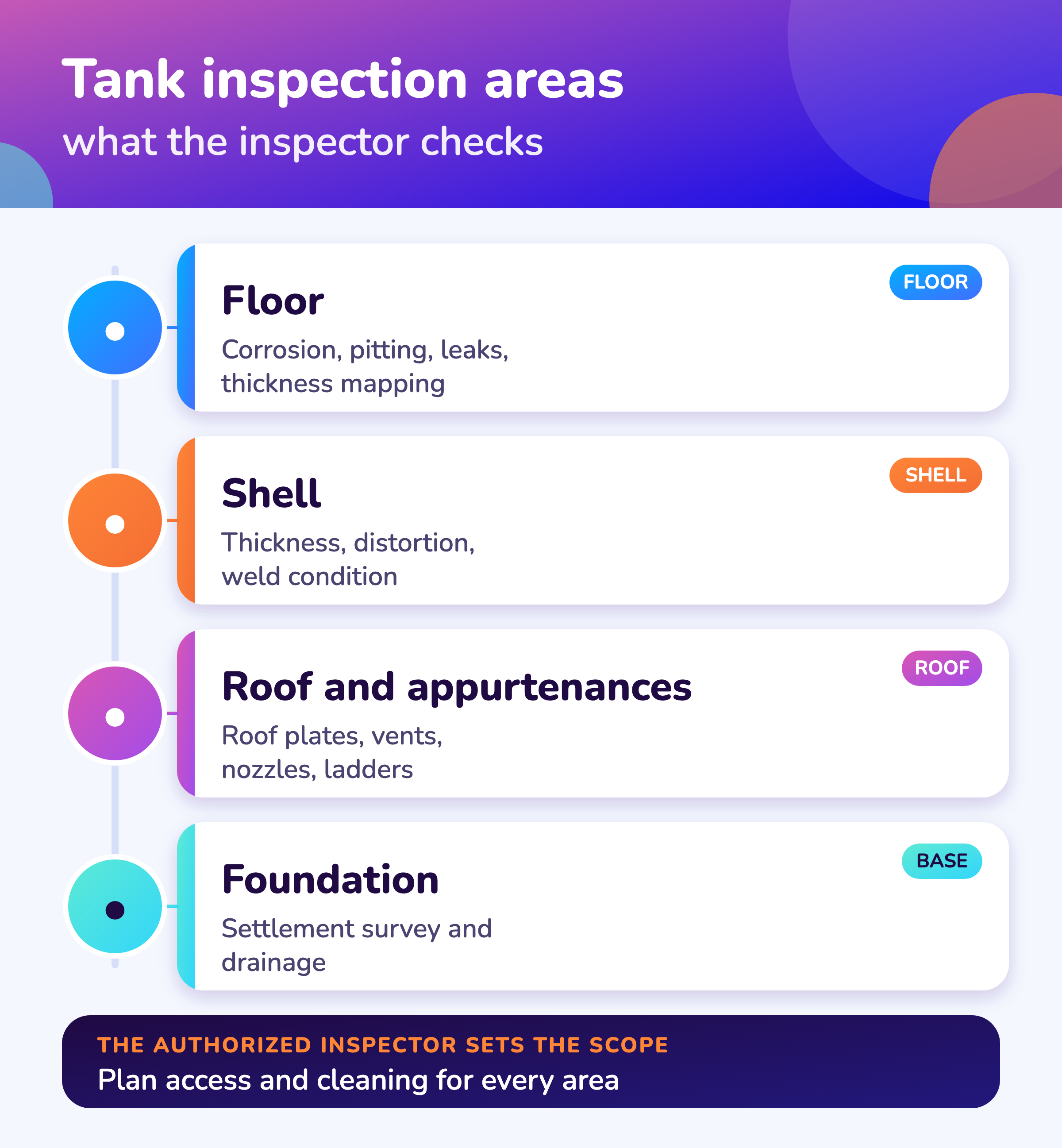
The authorized inspector checks the floor for corrosion and leaks, the shell for thickness and distortion, the roof and fittings, the foundation for settlement and the floating roof seals if fitted, and the plan must give each area clean surfaces, lighting and safe access.
| Area | What the inspector checks | Planning need |
|---|---|---|
| Floor | Corrosion, pitting, leaks, thickness mapping | Clean to bare metal; lighting; floor scanning equipment |
| Shell | Thickness, distortion, weld condition | Scaffold or rope access for tall shells; see scaffolding planning |
| Roof and fittings | Roof plates, vents, nozzles, ladders | Safe roof access and fall protection |
| Foundation | Settlement and drainage | Survey crew and benchmarks |
| Floating roof (if fitted) | Seals, supports, drains | Roof landing and clearance planned |
The inspector decides the scope and the methods. Book the inspector and the survey equipment with the cleaning plan so surfaces are ready when they arrive.
Repairs
What repairs are planned in a tank turnaround?
Typical tank repairs are floor patches or partial floor replacement, shell plate repairs, roof repairs, nozzle work, settlement correction and new coating, each needing an approved scope, hot work control and the examinations and tests the inspector requires before the tank returns to service.
Hot work
Gas testing, fire watch and permits for every cut and weld. Plan hot work after cleaning is signed off.
Approved scope
Repairs follow the inspector’s findings and an approved procedure. Order plate and fittings early.
Tests
Which examinations or tests are required after repair is set by the standard and the inspector. Plan the water and time if a fill test applies.
A fill test uses a lot of water. See hydrotest planning for the register and checks.
Visuals
Save the tank outage planning visuals
Two visuals for the tank outage team. Click either for the full-size image.
FAQ
Frequently asked questions
What is a tank out-of-service inspection?
An internal inspection of an aboveground storage tank taken out of service, empty, clean and gas-free, to check the floor, shell, roof and foundation. 1
What is API 653?
The American Petroleum Institute standard for inspection, repair, alteration and reconstruction of aboveground steel storage tanks. 1
How long does a tank turnaround take?
It depends on the tank, the residue and the repairs. Cleaning and gas-freeing are often the longest steps, so schedule them first.
Why is cleaning the critical step?
The inspector cannot enter or examine until the tank is clean and gas-free, so cleaning sets the start of everything after it.
Who decides the inspection interval?
The authorized inspector sets it within the limits of the standard, from measured corrosion rates and past findings. 1
Is a tank entry a confined space?
Yes. Entry needs the permit, atmosphere testing, attendant and rescue plan your confined space program requires. 3
Do tank repairs need a hydrotest?
The standard and the inspector decide which examinations or tests follow a repair. Plan water and time if a fill test applies.
Is there a free tank outage checklist?
Yes. The storage tank outage checklist (Excel) tracks 24 items across seven phases.
Does MaintWiz plan tank outages?
It plans each outage as a project with permits, isolations and findings tied to work orders. AI agents are part of the module. See AI shutdown planning.
Sources
Sources
API 653 is read from the API edition summary page, not the full standard. The scope, interval and test rules come from the current standard and the authorized inspector; confirm them before relying on this page.
- American Petroleum Institute, API 653 Tank Inspection, Repair, Alteration, and Reconstruction (edition summary)
- American Petroleum Institute, Standards (API 510, 570 and 653 inspection codes are listed here)
- OSHA, 29 CFR 1910.146, Permit-required confined spaces
- OSHA, 29 CFR 1910.147, The control of hazardous energy (lockout/tagout)
- eCFR, 29 CFR 1910.252(a), Fire prevention and protection in welding, cutting and brazing (read via Cornell LII)
Plan your next shutdown in one system
Book a demo and tell us about your plant. We will show how the module handles your shutdown.