
Shutdown scope
Shutdown Scope Management: Freeze Date and Emergent Work
Shutdown scope management means agreeing the work list, freezing it when the plan and materials are built on it, and handling anything added later through a documented decision. Emergent and discovery work will occur, so plan contingency for it and record each change rather than absorbing it.
No public, vendor-neutral standard sets a freeze date, so this page gives the criteria for freezing and a way to measure growth.
How MaintWiz helps: Scope grows after the freeze when added work is not visible. The MaintWiz shutdown module keeps scope, work packages and baselines in one plan and sends technician findings straight to the planner, so added work is visible. See the module · Get the scope freeze register
By Jai Balachandran · Published · Last reviewed
What MaintWiz adds:Scope and work packages in one planFindings go straight to the plannerBaselines show what movedReopen and close with a reason
Definitions
What is shutdown scope management, and what counts as scope creep?
Shutdown scope is the set of work agreed to be done in the stop, and scope creep is work added to it without an approved decision. The planned scope is fixed in advance, while emergent and discovery work arrives later and has to be handled through change control. 1

Emergent and discovery work will always occur. The aim is to plan for it with contingency, a decision rule and a record, so it is visible and not absorbed silently. The decision rule is in shutdown execution.
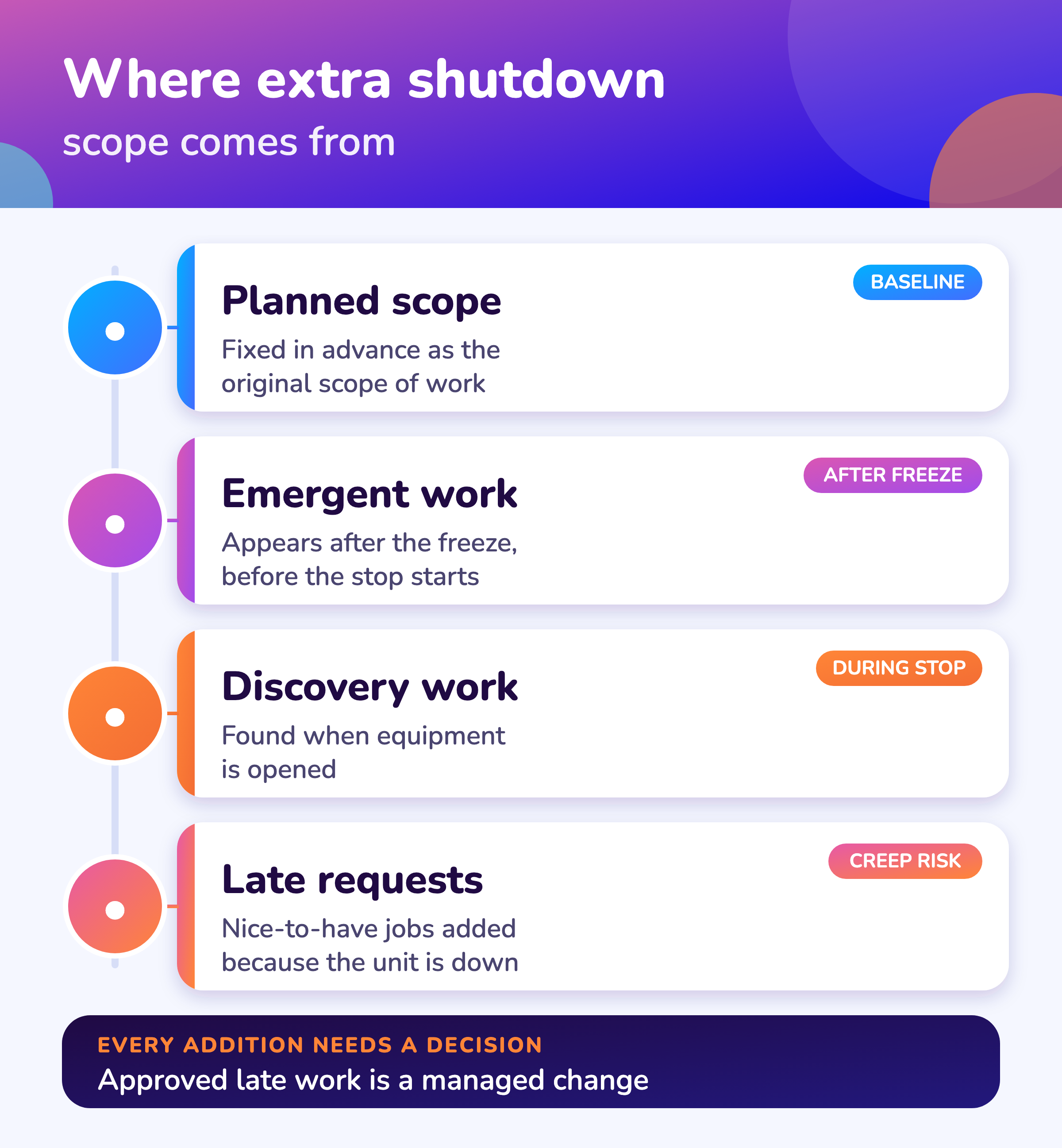
Planned scope
The tasks fixed in advance. NERC's generator reporting rules call this the original scope of work for a planned outage. 1
Emergent work
Work that appears after the scope is frozen but before the stop starts, for example a failure found in service. This is a working definition.
Discovery work
Work found when equipment is opened. NERC treats discovery work and re-work as outside the original scope. 1
Scope creep
Additions that enter the plan without an approved decision. Approved late work is a managed change, not creep.
Freeze
When should the shutdown scope be frozen?
Freeze the scope when the work list is complete and the plan, materials and budget are built on it, which for a large refinery turnaround means well inside the 1 to 2 years of planning that EIA describes. No public, vendor-neutral standard sets a freeze date, so set it from your longest lead item. 2
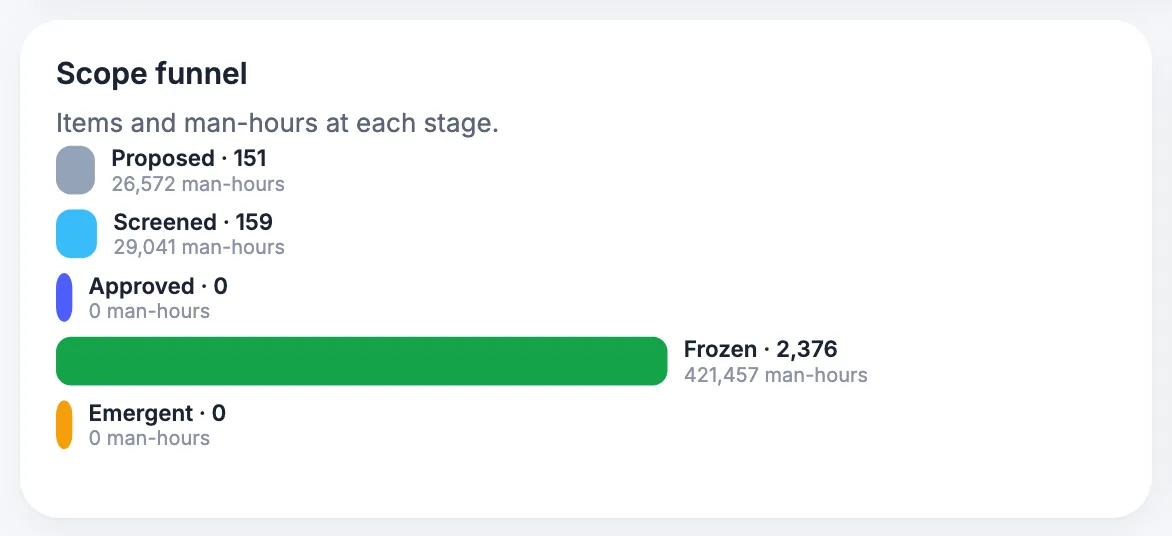
For T&I scope and gates, see T&I turnaround and inspection planning. To see float after the freeze, paste the list into the Excel to Gantt tool. The scope freeze is a gate at about 90 days; see turnaround readiness review and phase gates.
DOE's contingency protocol notes that estimate uncertainty is expected to decrease as project definition improves, which is why a frozen, well-defined scope tightens the cost range. 4 GAO adds that baseline and current schedules should be subject to a change control process. 3
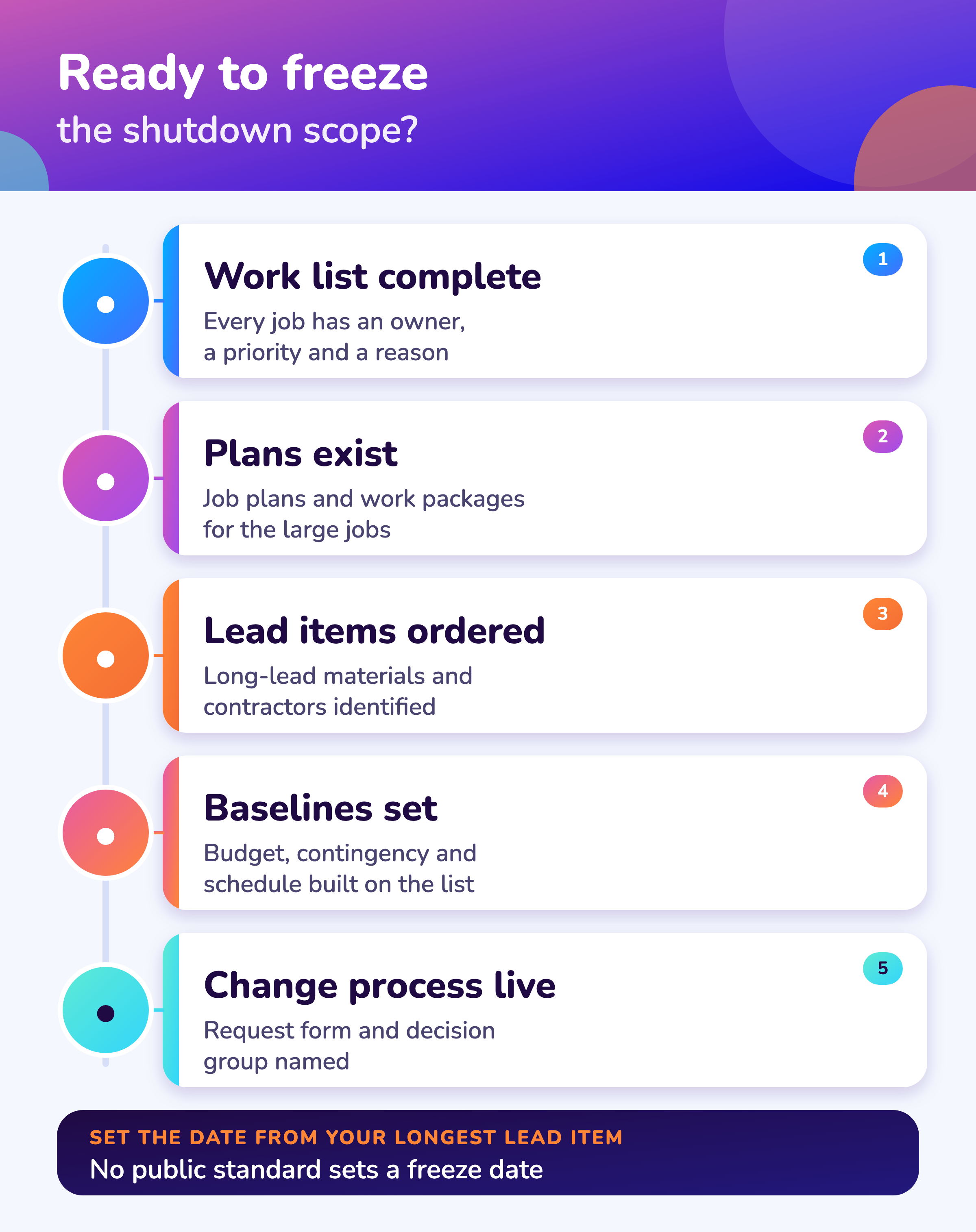
What must be true at the freeze
- The work list is complete and each job has an owner
- Every job has a priority and a reason: safety, integrity, regulatory or reliability
- Job plans and work packages exist for the large jobs
- Long-lead materials and contractors are identified and ordered
- Budget, contingency and schedule are baselined against this list
- The change request process is live and the decision group named
For an illustrative backward calendar with a freeze gate, see how to plan a plant shutdown.
Software
Where should the work list and change requests live?
The work list, its priorities and every change request should live where planning, materials and permits can see them, so a late job shows its full effect before it is approved.
Scope and baseline features are listed in the MaintWiz shutdown module data sheet. The shutdown module FAQ covers readiness gates and scope control. Digitizing the scope register first is covered in digital shutdown management.
About MaintWiz. MaintWiz is an industrial AI platform with IoT, SAP integration and predictive maintenance (PdM) capabilities. Its shutdown and turnaround module helps plants plan, schedule, execute and close out shutdown work.
Also: product data sheet.
What the shutdown module covers
As described on the MaintWiz shutdown maintenance product page.
- Shutdown calendar and critical-path scheduling, with work order sequencing and dependencies
- Asset prioritization, so the most critical equipment is scoped first
- Resource planning for people, spares, heavy equipment such as cranes, and outsourced vendors
- Electronic permits to work, risk management and contingency plans
- Real-time progress monitoring: schedule adherence, cost variance, quality metrics and risk factors
- Step-by-step checklists, pre-restart testing protocols and post-shutdown analysis
Proof
What MaintWiz customers report
Figures as published in MaintWiz case studies on maintwiz.com. They come from maintenance management projects, not shutdowns.
Sources of growth
Where does extra scope come from?
Extra scope comes from five places: emergent work, discovery work, late requests, modifications and inspection findings, and each needs its own control.
Scope growth is a leading cost driver: why shutdowns go over budget. With SAP PM, shutdown orders are grouped by a revision: SAP PM shutdown management.
| Source | Example | Control |
|---|---|---|
| Emergent | A pump found failing after the freeze | Change request with a decision, drawn from contingency if approved |
| Discovery | Corrosion found when a vessel is opened | Inspection findings logged on the day, with a pre-agreed rate and allowance for likely findings |
| Late requests | A new job someone wants done while the unit is down | Backlog entry; accepted only through the freeze gate or change process |
| Modifications | A changed pipe route or control logic | Management of change review before the work is done 5 |
| Inspection or regulatory findings | A statutory inspection finds a defect | Mandatory work approved outside normal prioritization, with the reason recorded |
HSE guidance says to plan intrusive maintenance for shutdown periods, which is why the standing backlog fills up before the stop. 6
Calculator
How do you measure scope growth?
Scope growth is the work added after the freeze, less the work removed, divided by the frozen scope, expressed as a percentage. This is a working definition; no standard defines it.
The shutdown calculator tools page lists this and the other calculators. To see how added jobs move the critical path, use the Excel to Gantt tool. Scope growth in a worked example: shutdown case study.
Try it: scope growth by source
Enter the frozen scope in hours or cost and what was added or removed afterward. Nothing is sent or stored; the sums run in your browser. The numbers shown are made up.
The form
What should a scope change request record?
A scope change request records who asked, what, why, the cost and lead time, the effect on the critical path and the decision with its reason.
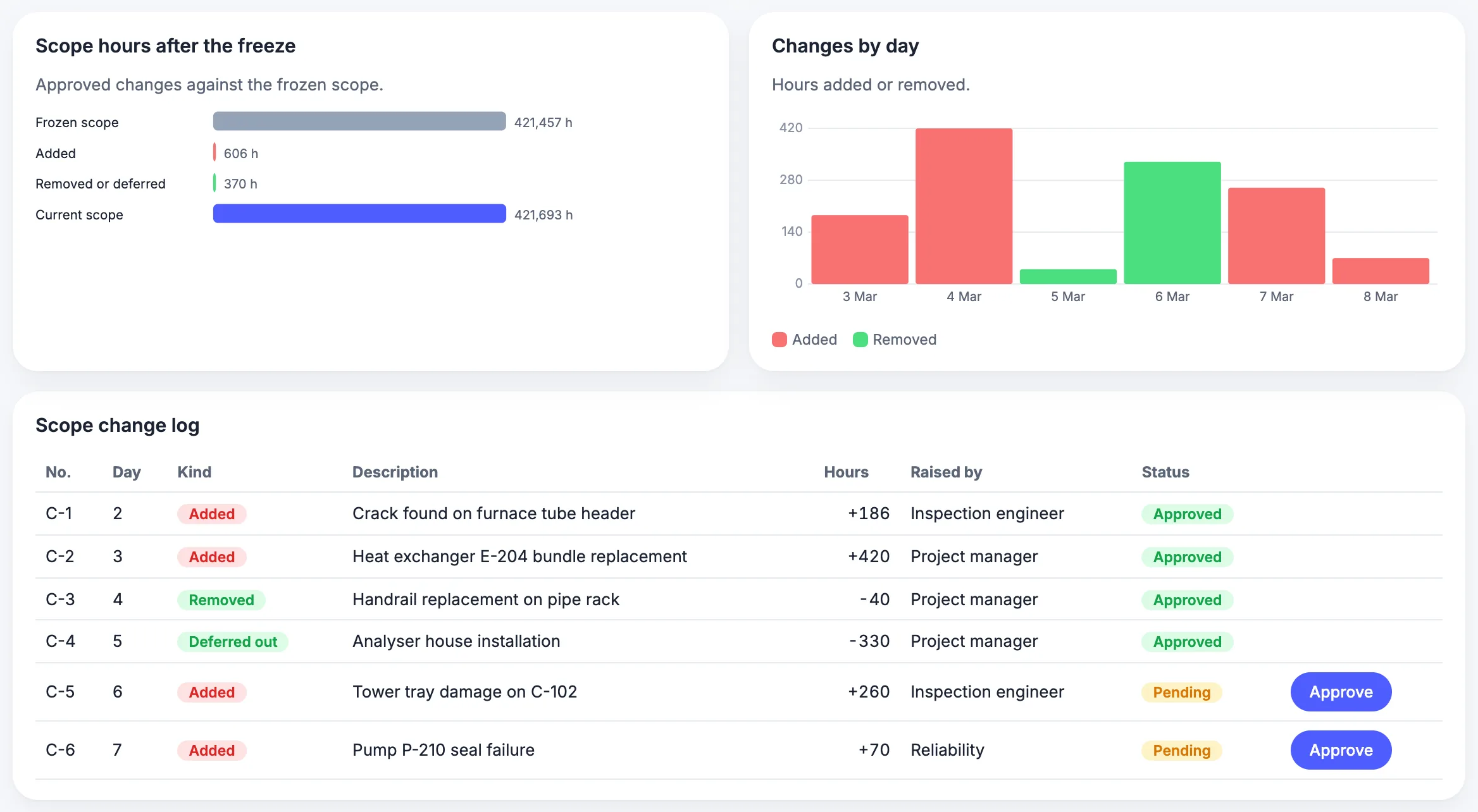
The scope freeze register template records each request and calculates scope growth by reason.
| Field | What to record |
|---|---|
| Requester and date | Who asked and when |
| Work requested | What is to be done, on which equipment |
| Reason | Safety, integrity, regulatory, reliability or convenience |
| Cost and hours | Estimate, with materials and contractor effects |
| Lead time | Whether materials or specialists can arrive in time |
| Effect on the critical path | Days added or float used |
| Decision | Approve, defer or reject, by whom, with the reason |
Backlog
What is a standing shutdown backlog?
A standing shutdown backlog is the running list of jobs that can only be done with equipment out of service, kept so that deferred and discovered work is ready for the next window. HSE guidance supports the logic: plan intrusive maintenance for shutdown periods to minimize isolation requirements. 6
| Field | Why it matters |
|---|---|
| Job description and equipment tag | Makes the job findable at the next scope challenge |
| Reason deferred | Separates "needs an outage" from "not yet planned" |
| Evidence | Inspection result, failure history or photo |
| Needs an outage? | Only unit-down jobs belong in the shutdown list |
| Lead time and materials | Shows what must be ordered if the job is promoted |
Unplanned stops are also windows for backlog work; see types of plant shutdowns.
Visuals
Save the scope charts
Two one-page charts for the planning room. Click either to open it at full size.
FAQ
Frequently asked questions
What is shutdown scope management?
Defining the work to be done in the stop, freezing it at a defined point, and controlling later additions through a documented decision process.
When should the shutdown scope be frozen?
No public, vendor-neutral standard sets a date. Freeze when the work list is complete and the plan, materials and budget are built on it; for large refinery turnarounds EIA describes 1 to 2 years of advance planning. 2
What is the difference between emergent and discovery work?
Emergent work appears after the freeze but before the stop (a working definition). Discovery work is found when equipment is opened, and NERC treats it as outside the original scope of work. 1
What is scope creep?
Work added to the plan without an approved decision. Approved late work is a managed change.
How do you calculate scope growth?
Add the work added after the freeze, subtract work removed, divide by the frozen scope and multiply by 100. This is a working definition, not a standard. The calculator above does it.
Why does a frozen scope matter for cost?
DOE's contingency protocol says estimate uncertainty is expected to decrease as project definition improves, so a defined scope narrows the range. 4
Does a late modification need more than a change request?
If it changes equipment, procedures or chemicals in a process covered by OSHA's process safety standard, management of change procedures apply, with replacements in kind excepted. 5
What is a standing shutdown backlog?
A running list of jobs that need equipment out of service, kept ready for the next window, with the reason deferred, evidence and lead time.
Sources
Sources
- North American Electric Reliability Corporation, Generating Availability Data System (GADS) Data Reporting Instructions, effective 1 January 2026
- U.S. Energy Information Administration, Refinery Outages: Description and Potential Impact on Petroleum Product Prices
- US Government Accountability Office, GAO Schedule Assessment Guide: Best Practices for Project Schedules (GAO-16-89G, December 2015)
- US Department of Energy, EM Protocol for Application of Contingency and Management Reserve for the Acquisition of Capital Asset Projects (final, 12 April 2010)
- OSHA, 29 CFR 1910.119, Process safety management of highly hazardous chemicals
- UK Health and Safety Executive, The safe isolation of plant and equipment (HSG253, 2006)
Control scope from the freeze to the last task
Book a demo and bring your scope list. We will show how work packages, baselines and findings work together.