
Work packages
Shutdown Work Package: Contents, Sizing and Sample
A shutdown work package is a self-contained unit of work with a defined scope, a start and finish date, a budget and a way to measure progress. This guide lists what goes in one, how large it should be, shows a one-page sample and gives a ten-point readiness test.
The package layout and sizing rule are working templates; use your own job plans and procedures for the values.
How MaintWiz helps: A well-sized package starts only when materials, crews and permits are ready. The MaintWiz shutdown module checks seven readiness gates before a package starts and records waivers with a typed reason, name and date. See the module · Get the readiness checklist
By Jai Balachandran · Published · Last reviewed
What MaintWiz adds:Seven readiness gatesSigned waivers with name and dateKeyboard operationLook-ahead by gate
Contents
What goes in a shutdown work package?
A shutdown work package is a self-contained unit of work with a defined scope, a start and finish date, a budget and a way to measure progress; the contents below make it ready for a crew to execute. 1
A work list template to feed these packages is in the shutdown planning templates. Long-lead parts for each package are covered in shutdown spare parts planning. Components planned in SAP generate the demand: SAP MM shutdown materials.
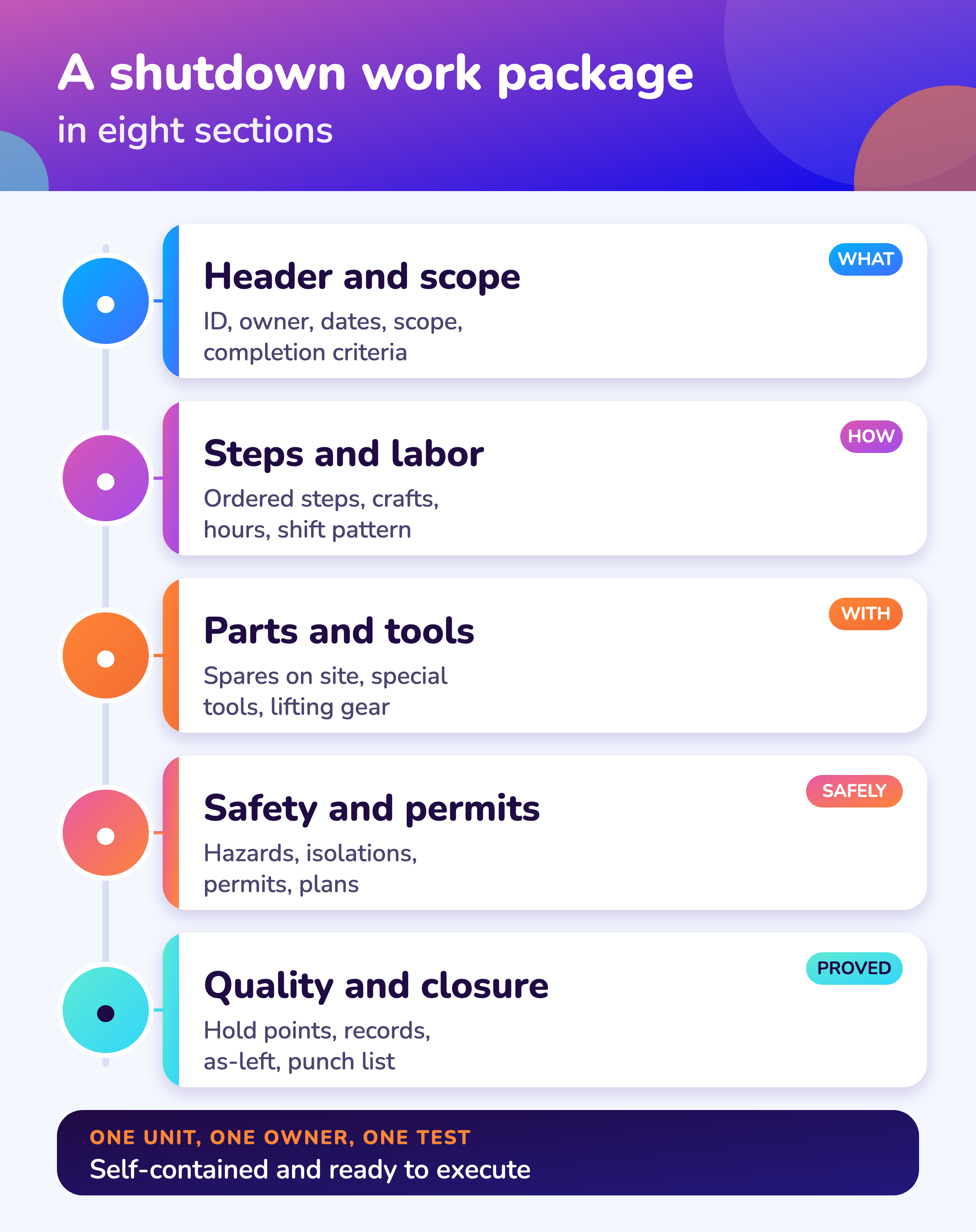
The US Department of Health and Human Services earned value glossary defines a work package as a task or set of tasks with a defined work scope, a scheduled beginning and end, a time-phased budget and a documented method of measuring earned value. 1 A shutdown package adds the field detail a crew needs. The table lists eight sections that most large stops use; trim it for small jobs. See the 40-step checklist for when packages are built (steps 9 to 16).
| Section | What goes in it | Why it matters |
|---|---|---|
| 1. Header | Package ID, title, equipment tag, area, owner, planned start and finish, predecessors | Ties the package to the schedule and to one named owner |
| 2. Scope and acceptance | What is in and out, the completion criteria, inspection and hold points | Defines done; stops scope drifting inside the package |
| 3. Job steps | Ordered steps, procedures, torque and clearance values, drawings and P&IDs | Lets a crew work without waiting for clarification |
| 4. Labor and hours | Crafts, headcount, hours per craft, contractor or in-house, shift pattern | Feeds resource loading and the daily plan |
| 5. Materials and tools | Parts with stock status, consumables, special tools, lifting gear, scaffold | No job starts without its parts and tools on site |
| 6. Safety and permits | Hazards, isolation points, permit types, confined space and lifting plans, simultaneous work | Builds safe work into planning instead of being decided on site |
| 7. Quality records | Inspection forms, readings to record, photos required, acceptance sign-offs | Creates the evidence that closes the package |
| 8. Closure | As-left notes, findings for the planner, punch items, handover to operations | Feeds the next stop and the restart checks |
The eight-section layout is a working template, not a published standard. The definition above comes from a project-management glossary, and shutdown sites adapt it.
Example
What does a finished work package look like?
A finished work package fits on about one page, names an owner, shows its place in the schedule, lists parts and permits, and ends with the test that proves the work is done.
A mill reline schedule built from packages is shown in mining shutdown planning.
The example below is invented to show the format. It does not describe a real plant or give real hours; use your own job plans, vendor instructions and engineering procedures for the values.
| Field | Entry |
|---|---|
| Package | WP-014 Replace mechanical seal, feed pump A (illustrative example) |
| Owner and crew | Mechanical lead; two fitters and one helper; one shift |
| Window | Day 3 start of shift to Day 3 end of shift; follows isolation package WP-009; precedes alignment check WP-015 |
| Scope | In: remove and replace seal, check shaft sleeve, reassemble, leak test. Out: motor work, coupling replacement (separate package) |
| Steps | 1 Verify isolation and tags. 2 Drain and flush. 3 Uncouple. 4 Remove seal. 5 Inspect sleeve and chamber. 6 Fit new seal to the vendor setting. 7 Reassemble and align. 8 Leak test |
| Parts and tools | Seal kit and gaskets (staged, bin checked), seal setting tools, hoist, torque wrench |
| Hours | 24 labor hours estimated (3 people, 8 hours); contingency set separately by the planner |
| Safety and permits | Isolation and lockout; cold work permit; manual handling plan; no simultaneous hot work within the area |
| Acceptance | No leak at test pressure; alignment within procedure limits; foreman and inspector sign-off |
| Closure | As-left note, photo of the fitted seal, findings sent to the planner |
Software
Can software manage work packages?
Software can hold the package contents in one record, calculate completion from the tasks a technician closes, and block closure while a permit or isolation is open, which a document folder cannot do.
About MaintWiz. MaintWiz is an industrial AI platform with IoT, SAP integration and predictive maintenance (PdM) capabilities. Its shutdown and turnaround module helps plants plan, schedule, execute and close out shutdown work.
Also see spare parts planning and scope management.
What the shutdown module covers
As described on the MaintWiz shutdown maintenance product page.
- Work packages with owner, crew, dates, tasks and predecessors in one Gantt chart
- Work order tasks of kind tick, reading or photo, with reading limits and an out-of-spec flag
- Readiness gates for each package: materials, resources, predecessors, tools and scaffold, permits and isolations, scope and engineering, go
- Package completion calculated from closed tasks; a package with an open permit or isolation cannot be closed
- Spares status with the SAP request or order behind each short part
- Handover note and as-left summary; findings go to the planner
Proof
What MaintWiz customers report
Figures as published in MaintWiz case studies on maintwiz.com. They come from maintenance management projects, not shutdowns.
Sizing
How large should a work package be?
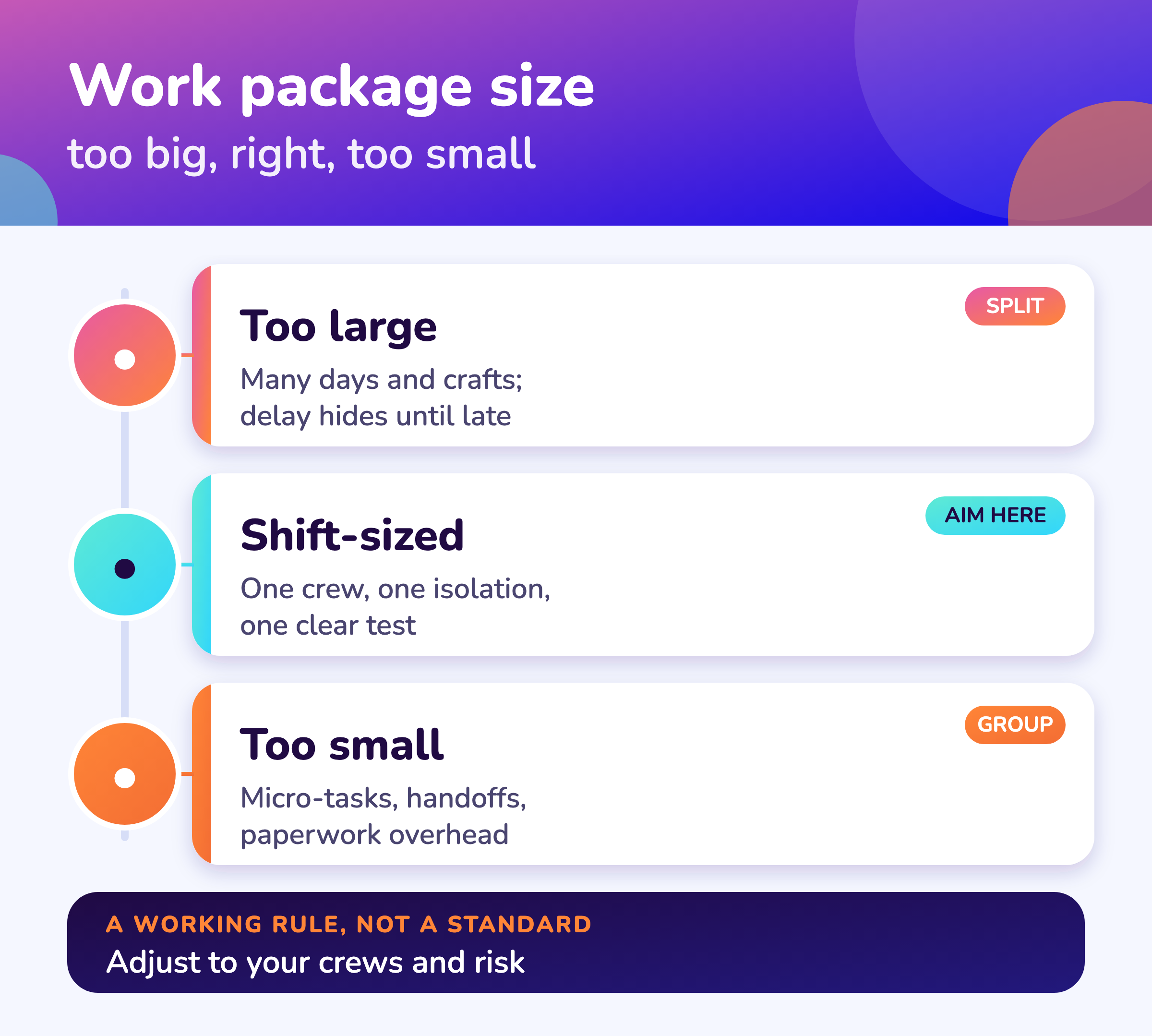
A common rule of thumb is to size a package to about one shift of work for one crew, with one isolation boundary and one clear completion test, but no public standard fixes a size, so adjust it to your crews and risk.
To test a task list for float, use the Excel to Gantt tool. See critical path vs critical chain for how package sequence sets the finish. Turn package hours into daily headcount with the turnaround manpower plan and labor histogram.
The size of a package sets how finely you can control the stop. Packages that fit a shift can be assigned and checked daily; packages that run for weeks hide delay until it is late. Packages that share an isolation boundary save isolation time and keep the control record short. For isolations, see the permit to work guide and the HSE isolation guidance.3
| Problem | Looks like | Effect | Fix |
|---|---|---|---|
| Too large | Spans many days and crafts with many predecessors | Progress is hard to measure and one blocked step stalls it all | Split at natural hold points or by isolation boundary |
| Too small | Many micro-tasks with separate handoffs | More coordination work, more permits, more paperwork | Group tasks that share the same isolation and the same crew |
| Mixed hazards | Hot work, lifting and confined space in one package | Permit conflicts and unclear controls | Group by risk profile so each package has one clear set of controls |
The shift-sized rule is a working rule, not a published standard. There is no published benchmark for ideal package size.
Readiness
How do you know a work package is ready to release?
A work package is ready to release when it passes all ten tests below: scope, ownership, logic, procedures, parts, tools, isolations, permits, hold points and an acceptance test.
A package is ready only when access is ready too; see turnaround scaffolding planning and turnaround readiness review and phase gates.
Try it: is your work package ready?
Tick what is true for one work package. The count updates as you tick. Nothing is sent or stored.
Readiness is also checked at plant level before the stop; see the checklist phase 3. The ten tests are a working framework, not a standard.
Rules
Which work package content do US and UK rules address?
No rule defines the layout of a shutdown work package, but isolation, lockout, confined space and permit rules shape what the safety section must contain. 3,4,5
| Package section | Rule or guidance | What it says | Source |
|---|---|---|---|
| Scope, schedule and closure | HHS earned value glossary | A work package has a defined scope, a scheduled start and end, a time-phased budget and a documented method of measuring earned value | HHS earned value glossary |
| Schedule logic | GAO schedule assessment guide | Describes the baseline, the critical path, float and resource loading of a schedule; used here as a general scheduling reference | GAO schedule guide |
| Isolation points | HSE HSG253, safe isolation | Plan intrusive maintenance for shutdown periods to keep isolation needs down | HSE HSG253 |
| Lockout steps | OSHA 1910.147(f)(2)-(3) | Host and outside employers inform each other of lockout or tagout procedures; group lockout and tagout is covered | OSHA 1910.147 |
| Confined space entry | OSHA 1910.146(e)(1) | Before entry is authorized, the employer documents completion of the required measures by preparing an entry permit | OSHA 1910.146 |
| Permit types | HSE HSG250 | Guidance on permit-to-work systems for the petroleum, chemical and allied industries | HSE HSG250 |
Visuals
Save the package charts
Two charts to share with planners. Click either for the full-size image.
FAQ
Frequently asked questions
What is a shutdown work package?
A self-contained unit of work with a defined scope, a start and finish date, a budget and a way to measure progress. 1 A shutdown package adds the steps, parts, tools, permits and acceptance test a crew needs.
What is the difference between a work order and a work package?
A work order is one job on one asset. A work package groups the work orders, permits, isolations and tasks that one crew or area will run together, so it can be scheduled, assigned and closed as a unit.
How big should a work package be?
A common rule of thumb is about one shift of work for one crew, but no public standard fixes a size. Split a package that spans many days; merge micro-tasks that share an isolation and a crew.
When should work packages be ready?
After the scope freeze and before the readiness review. In the 40-step checklist packages are built in steps 9 to 16 and checked in step 23.
Who writes the work package?
The planner writes it with the area or discipline lead, using job plans, drawings, procedures and past records. The crew supervisor reviews it before release.
What must be in the safety section?
The hazards, the isolation points, the permit types and any lifting or confined space plan. See permit to work during a shutdown. 3,4,5
How does a work package link to the schedule?
Each package is an activity or a small group of activities with predecessors, a duration and a crew, so it shows float and sits on or off the critical path. See shutdown scheduling. 2
What happens when a package finds extra work?
The finding goes to the planner as a request, and the shutdown manager approves, defers or rejects it. See scope management.
Sources
Sources
- US Department of Health and Human Services, Earned Value Management, Appendix D: Glossary of Terms
- US Government Accountability Office, GAO Schedule Assessment Guide: Best Practices for Project Schedules (GAO-16-89G, December 2015)
- UK Health and Safety Executive, The safe isolation of plant and equipment (HSG253, 2006)
- OSHA, 29 CFR 1910.147, The control of hazardous energy (lockout/tagout)
- OSHA, 29 CFR 1910.146, Permit-required confined spaces
- UK Health and Safety Executive, Guidance on permit-to-work systems: a guide for the petroleum, chemical and allied industries (HSG250, 2005)
Start each package only when it is ready
Book a demo and bring a work package. We will walk through the seven readiness gates.