
Shutdown checklist
Shutdown Checklist: 40 Steps for a Safe Plant Shutdown
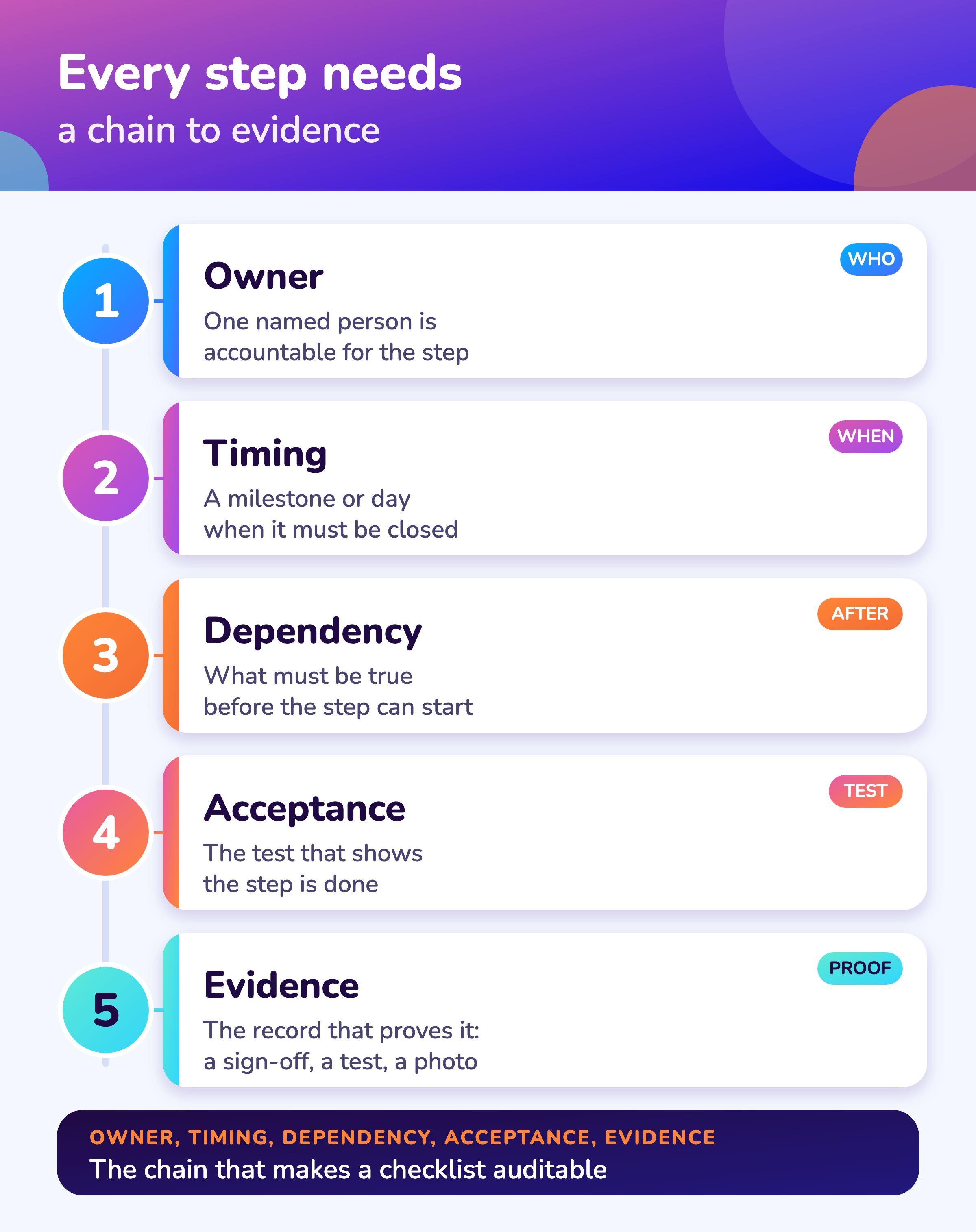
A shutdown checklist is an ordered list of the controls a plant needs before, during and after a stop: frozen scope, packaged work, staged materials, controlled isolations and permits, and a safety review before restart. Each of the 40 steps below has an owner, a timing and the evidence that closes it.
Owners and timings are typical working assumptions; adjust them to your organization and the size of the stop.
How MaintWiz helps: A checklist in a spreadsheet does not tell you what is blocked. The MaintWiz shutdown module moves the plan from spreadsheets into one system with a critical path, readiness gates, permits and spares status. See the module · Get the 40-step checklist
By Jai Balachandran · Published · Last reviewed
What MaintWiz adds:Critical path and floatReadiness gatesPermits and isolationsSpares status with SAP
The structure
How is the 40-step shutdown checklist organized?
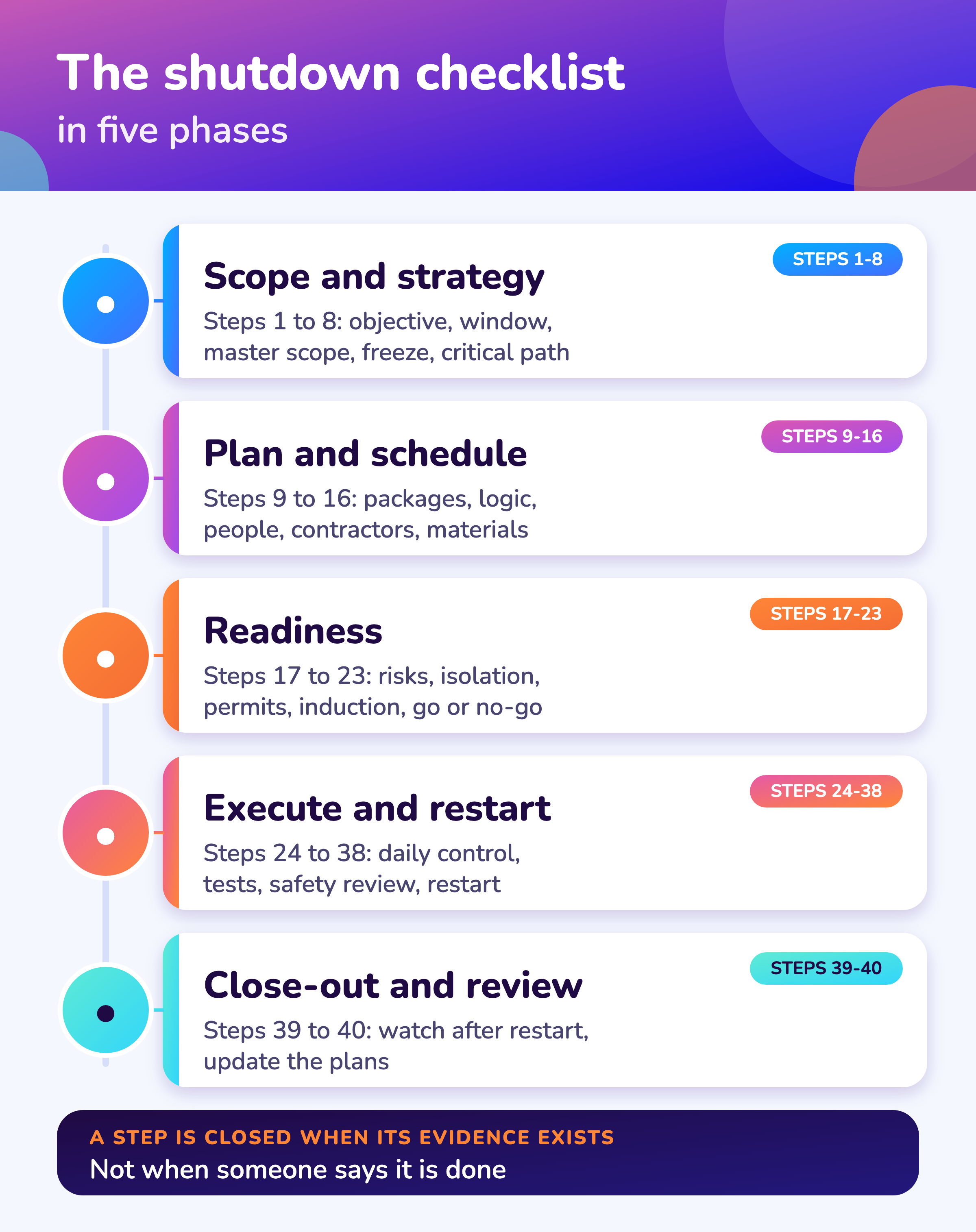
The checklist has five phases, from scope and strategy to close-out and review, and each of its 40 steps names an owner, a timing and the evidence that closes it, so progress can be checked rather than assumed.
A gated version of these phases is shown in T&I turnaround and inspection planning.
This checklist covers the work of shutdown maintenance from the first planning decision to the review after restart. It has 40 steps in five phases. Every step has a typical owner, a timing and the evidence that closes it. A step is not done until its evidence exists.
| Phase | Steps | The question it answers | It ends when |
|---|---|---|---|
| 1. Scope and strategy | 1 to 8 | What is in, why, and by when? | The baseline scope is frozen and the critical path is known |
| 2. Plan and schedule | 9 to 16 | Can the work be done in the window? | Packages, schedule, people and materials are confirmed |
| 3. Readiness | 17 to 23 | Is the plant safe and ready to start? | The readiness review records a go |
| 4. Execute and restart | 24 to 38 | Are we still on the path to a safe restart? | The pre-startup review is signed and the plant restarts in sequence |
| 5. Close-out and review | 39 to 40 | What did the stop teach us? | Post-startup results and lessons update the plans |
The phases are the same five used across the MaintWiz shutdown guides. Owners and timings are working assumptions that fit a typical process plant; change them to match your organization and the size of your stop. There is no published standard that fixes the number of steps.
Phase 1 · Scope and strategy
What are the steps in phase 1, scope and strategy?
Phase 1 settles why the plant is stopping, when, and exactly what work is in: define the objective and window, build one controlled scope, learn from the last stop, rank the equipment and freeze the baseline.
| Done | Step | Owner (typical) | When | Evidence that closes it |
|---|---|---|---|---|
| 1. Define the objective State why the stop happens (statutory inspection, overhaul, reliability work, modification) and the measurable outcomes, such as a safe restart, compliance work complete or no critical punch items. | Plant manager | Start of planning | Signed objective statement | |
| 2. Set the window Fix the start and finish dates, the operating constraints and the restart deadline. | Operations manager | Start of planning | Approved window | |
| 3. Build one master scope One controlled register of all approved work: work orders, inspections, statutory work, modifications, cleaning, deferred and opportunity work. No side lists in spreadsheets and email. | Shutdown manager | Early planning | Scope register with one owner | |
| 4. Review the last shutdown Check deferred jobs, recurring failures, inspection findings, overruns, contractor and material issues and startup problems, and carry them into the scope. | Shutdown manager | Early planning | Lessons carried into scope | |
| 5. Rank equipment by criticality Rank by consequence of failure, safety exposure, production impact, environmental risk, redundancy, repair complexity and regulatory importance. | Reliability engineer | Early planning | Criticality ranking | |
| 6. Validate the work orders Each has a description, asset, scope, duration, craft, safety and material needs and completion criteria. | Planner | Before the scope freeze | Complete work order set | |
| 7. Freeze the baseline scope Set a freeze milestone. After it, additions need written approval with a safety, compliance, reliability or production reason. 1 | Shutdown manager | Scope-freeze milestone | Approved baseline and open change log | |
| 8. Identify the critical path Map the dependencies and find the activities that set the restart date, so management attention goes where a delay moves the finish. 1 | Scheduler | After the freeze | Network and critical-path list |
Scope that is found during the stop costs more than scope that is found in planning. See the scope management guide for the freeze date and for emergent work.
Software
Can software run the shutdown checklist?
A spreadsheet can hold the 40 steps, but it cannot link them to the schedule, the work orders, the permits and the spares; software can keep each step tied to its evidence and show which open step blocks the restart.
See the shutdown module FAQ and shutdown software vs CMMS vs Primavera P6 before choosing a tool. See the turnaround software checklist before you choose a tool.
About MaintWiz. MaintWiz is an industrial AI platform with IoT, SAP integration and predictive maintenance (PdM) capabilities. Its shutdown and turnaround module helps plants plan, schedule, execute and close out shutdown work.
Also see the work package guide.
What the shutdown module covers
As described on the MaintWiz shutdown maintenance product page.
- Gantt chart with critical path and float, so step 8 stays live as work changes
- Readiness gates for each work package, with waivers and sign-offs recorded with a reason, the name and the date
- Work orders with tick, reading and photo tasks; findings go to the planner as requests for added work
- Spares status with the SAP request or order behind each short part
- Permits and isolations from ePTW shown on each work order
- Import and export with Excel
- Approvals recorded against the signed-in user with the name and the time
- QR code scan and offline use on transaction screens
Proof
What MaintWiz customers report
Figures as published in MaintWiz case studies on maintwiz.com. They come from maintenance management projects, not shutdowns.
Phase 2 · Plan and schedule
What are the steps in phase 2, plan and schedule?
Phase 2 turns the frozen scope into field-ready work packages, a logic-linked schedule, confirmed people and contractors, and materials that are physically on site.
Long-lead parts are covered in shutdown spare parts planning. In SAP, see SAP MM shutdown materials for reservations and requisitions.
| Done | Step | Owner (typical) | When | Evidence that closes it |
|---|---|---|---|---|
| 9. Develop work packages Each package holds the job steps, tools, materials, drawings, procedures, permits, manpower, duration, inspection points and acceptance criteria. | Planner | After the freeze | Field-ready packages | |
| 10. Validate the estimates Review hours and durations with planners, supervisors and technicians, using historical actuals where they exist. | Planner and supervisors | After packaging | Reviewed estimates | |
| 11. Sequence the work Order isolation, cleaning, inspection, dismantling, repair, testing, reassembly and commissioning, and link each activity to its predecessors. 1 | Scheduler | During scheduling | Logic-linked schedule | |
| 12. Confirm drawings and procedures Current P&IDs, equipment and electrical drawings, inspection procedures, torque specifications and vendor documents for every package. | Engineering | Before the readiness review | Document set per package | |
| 13. Screen changes for management of change Any change to design, process conditions, controls, materials or operating procedures goes through the site’s management of change process. 6 | Engineering | Before the freeze and on every change | Management of change records | |
| 14. Confirm the workforce Trades, inspectors, scaffolders, riggers, engineers, planners, supervisors and safety staff, with shifts, weekends, fatigue, competence and cover. 1 | Shutdown manager | After scheduling | Resource-loaded plan | |
| 15. Mobilize contractors early Choose on capability, safety performance, availability, certification and shutdown experience, and confirm capacity before the window, not during it. 6,7 | Contracts manager | Before the stop | Contracts and mobilization plan | |
| 16. Confirm long-lead materials Identify parts that could stop the critical path and check they are physically received, not only ordered. | Materials planner | Before the stop | Material readiness report |
The scheduling guide shows how to find the critical path and float, and the spare parts guide covers long-lead items and kitting.
Phase 3 · Readiness
What are the steps in phase 3, readiness?
Phase 3 makes sure the plant is safe and ready before the first permit is issued: risks, isolations, permits, contractor induction, simultaneous work and a formal go or no-go.
| Done | Step | Owner (typical) | When | Evidence that closes it |
|---|---|---|---|---|
| 17. Build the risk register List technical, safety, environmental, schedule, material, contractor, quality and restart risks. For each major one record the trigger, the preventive control, the owner and the contingency. | Shutdown manager | Before the readiness review | Risk register | |
| 18. Confirm the isolation approach List every energy source to isolate: electrical, mechanical, hydraulic, pneumatic, thermal, chemical, pressure, gravity and stored energy. Plan intrusive work for the stop to keep isolation needs down. 2 | Operations and safety | Before the stop | Isolation plan | |
| 19. Verify lockout requirements Define lockout and tagout, or the site equivalent, for each item, including group lockout and the exchange of procedures between host and contractors. 4 | Safety | Before the stop | Lockout procedures | |
| 20. Prepare the permit requirements Decide which jobs need hot work, confined space entry, line breaking, electrical, work at height, excavation, lifting, radiation or chemical handling permits. 3,5,6 | Permit coordinator | Before the stop | Permit matrix by package | |
| 21. Induct the contractors Cover site rules, emergency arrangements, restricted areas, protective equipment, the permit process, reporting and stop-work authority. 6 | Safety | At mobilization | Induction records | |
| 22. Plan simultaneous operations Map jobs that could affect each other: hot work near chemical cleaning, lifting near energized work, scaffolding near operating equipment, confined space entry beside other work. | Shutdown manager and safety | Before the peak | Simultaneous operations plan | |
| 23. Hold the readiness review Check scope, people, materials, permits, equipment, procedures, logistics, safety controls and communication, and record a go or no-go for each major work front. | Shutdown manager | Before the stop | Signed go or no-go record |
Permits, isolations and lockout are covered in the permit to work guide and the safety plan guide.
Phase 4 · Execute and restart
What are the steps in phase 4, execute and restart?
Phase 4 runs the stop day by day and then brings the plant back: controlled shutdown, daily control, quality hold points, then completion checks, testing, a safety review and a staged restart.
Float and the critical path: critical path vs critical chain. Restart in regulated plants: pharmaceutical plant shutdowns.
Execution and daily control: steps 24 to 31
| Done | Step | Owner (typical) | When | Evidence that closes it |
|---|---|---|---|---|
| 24. Shut down under control Follow the approved sequence. Hand equipment to maintenance only after isolation, depressurizing, draining, cleaning, purging and verification are complete. | Operations | Day of shutdown | Handover-to-maintenance record | |
| 25. Set up the control room One control point for the schedule, work-front status, safety, critical path, resource conflicts, shortages, scope changes, quality and restart readiness. | Shutdown manager | Day of shutdown | Control room running | |
| 26. Hold the daily meeting Short and decision-oriented: planned against actual, critical path, safety events, permits, shortages, contractors, quality holds, new scope and recovery actions. 8 | Shutdown manager | Every day | Minutes and actions | |
| 27. Track progress against the baseline Measure completed work, inspection sign-offs and test records, not percent-complete estimates alone. 1 | Scheduler | Every day | Progress report against the baseline | |
| 28. Control emergent work Judge each finding by safety consequence, regulation, production risk, reliability, restart risk, time and resources, then approve, defer or reject it in writing. | Shutdown manager | As findings appear | Decision log | |
| 29. Protect the critical path When a critical task slips, start recovery at once: extra shifts, resources moved, work resequenced, specialists, parallel work or material escalation. 1 | Shutdown manager | When a critical task slips | Recovery plan | |
| 30. Hold quality hold points Set inspection and acceptance points for critical work, so equipment moves from repair to inspection, testing, acceptance and reassembly only with evidence. | Inspection lead | Per package | Signed inspection records | |
| 31. Keep a live punch list Record incomplete or defective work as it appears and classify each item by its effect on safe startup. A list started at the end signals weak completion control. | Supervisors | Every day | Classified punch list |
Testing, commissioning and restart: steps 32 to 38
| Done | Step | Owner (typical) | When | Evidence that closes it |
|---|---|---|---|---|
| 32. Verify mechanical completion Confirm reassembly, inspections, torque checks, lubrication, guards, supports, alignment and documentation. | Maintenance lead | Before testing | Mechanical completion records | |
| 33. Complete the pressure and functional tests Pressure, leak, electrical, instrument, control-loop and system tests, recorded and traceable. | Commissioning lead | Before restart | Test records | |
| 34. Verify blinds and isolations Keep a controlled record of blinds, blanks, isolations, temporary connections and removed protections, and verify the approved configuration before re-energizing or pressurizing. 2 | Operations and safety | Before re-energizing | Closed isolation and blind register | |
| 35. Walk down the systems Operations, maintenance, engineering and safety check for loose tools, foreign objects, open drains, wrong valve positions, missing guards, temporary hoses, unconnected instruments, unfinished insulation and wrong electrical connections. | Operations | Before startup | Walkdown sheets | |
| 36. Close the critical punch items Verify startup-critical items before authorization. Give every other item an owner and an approved post-startup plan. | Shutdown manager | Before startup | Punch list closure record | |
| 37. Run the pre-startup safety review A formal review of technical completion, safety controls, procedures, training, documentation, alarms, interlocks, emergency systems and operating readiness. 6 | Operations manager and safety | Before restart | Signed review | |
| 38. Restart in the approved sequence Bring systems back in order, not all at once, and watch equipment closely during the first operating period. 9 | Operations | Restart | Restart log |
For the daily routine see the progress tracking guide, and for change control and handover see the execution guide. The restart checks are explained in the start-up guide.
Phase 5 · Close-out and review
What are the steps in phase 5, close-out and review?
Phase 5 checks that the plant stays healthy after restart and turns what the stop taught you into better plans for the next one.
| Done | Step | Owner (typical) | When | Evidence that closes it |
|---|---|---|---|---|
| 39. Monitor post-startup performance Track temperature, vibration, pressure, flow, energy use, quality, alarms, repeat failures and production stability. Some defects only show once equipment runs. | Reliability engineer | First days and weeks after restart | Post-startup report | |
| 40. Capture the lessons and update the plans Review schedule, cost, safety, scope growth, contractors, materials, inspection findings, repeat failures, startup problems and planning accuracy. Then update asset history, maintenance plans, job plans, checklists, risk registers, spares strategy and the scope of the next stop. | Shutdown manager and reliability engineer | After restart | Lessons report and updated plans |
The measures to report are in the KPI guide.
Rules
Which checklist steps do US and UK rules address?
No rule requires this exact checklist, but nine groups of steps are backed by US or UK rules or guidance, including management of change, contractor control, isolation and lockout, permits, shift handover and the pre-startup safety review. 6,2,4
The pre-shutdown shutdown audit checks these steps. Gate reviews at T-90 and T-30 days are covered in turnaround readiness review and phase gates.
| Steps | Rule or guidance | What it says | Source |
|---|---|---|---|
| 7, 8, 11, 14, 27, 29 | GAO schedule assessment guide | Describes the baseline, the critical path as the longest continuous sequence of activities, float, and the resource-loaded schedule. The guide is for US federal programs and is used here as a general scheduling reference. | GAO schedule guide |
| 13 | OSHA 1910.119(l), US covered processes | Requires written procedures to manage changes, except replacements in kind | OSHA 1910.119 |
| 15, 21 | OSHA 1910.119(h) and HSE contractor guidance | The host employer evaluates contractor safety performance, informs contractors of hazards and controls their presence; the contractor trains its people. HSG159 sets out how to manage contractors | OSHA 1910.119, HSE HSG159 |
| 18, 34 | HSE HSG253, safe isolation | Plan intrusive maintenance for shutdown periods to keep isolation needs down; a blank and blind register is among the controls that assure full reinstatement | HSE HSG253 |
| 19 | OSHA 1910.147, control of hazardous energy | Host and outside employers inform each other of their lockout or tagout procedures; group lockout and tagout is covered | OSHA 1910.147 |
| 20 | HSE HSG250; OSHA 1910.146 and 1910.119(k) | Permit-to-work systems; an entry permit documents the measures taken before confined space entry; a hot work permit documents fire prevention and protection on a covered process | HSE HSG250, OSHA 1910.146, OSHA 1910.119 |
| 26 | HSE shift handover guidance | Handover has three elements: preparation, an exchange between outgoing and incoming staff, and a cross-check | HSE shift handover |
| 37 | OSHA 1910.119(i), US covered processes | A pre-startup safety review applies to new facilities and to modified facilities when the modification changes the process safety information. Using the same review after maintenance is a site choice | OSHA 1910.119 |
| 38 | US CSB, BP Texas City | The 2005 explosions occurred during the restarting of a hydrocarbon isomerization unit | CSB Texas City report |
Progress
How do you know the checklist is on track?
Count a step as closed only when its evidence exists, and watch the phase counts rather than one overall percentage, because a late phase 1 or phase 3 step blocks everything after it.
A free Excel version of the checklist, with a progress count by phase, is in the shutdown planning templates. The Excel to Gantt tool turns your task list into a Gantt chart with the critical path.
Try it: how far along is your checklist?
Tick the steps your team has closed with evidence in the tables above. The counts update as you tick. Nothing is sent or stored, and ticks are cleared when you leave the page.
Priorities
Which steps matter most?
The steps that matter most are those that protect people or sit on the critical path: freezing the scope, finding the critical path, controlling isolations and permits, and the pre-startup review. 1,6
Not every step weighs the same. Rank open items by how much they threaten safety, scope, schedule or restart. A high-criticality pump overhaul on the restart path deserves more attention than a housekeeping task that can finish on its own. The sharper question is not how many work orders are done but which unresolved constraint could stop a safe, on-time restart.
A work package is ready only if it passes all six tests
| Test | The question |
|---|---|
| Scope | Is the work clearly defined and approved? |
| People | Are qualified people available? |
| Materials | Are all critical parts physically on site? |
| Safety | Are permits, isolations and risk controls ready? |
| Method | Are the procedures, drawings and job plans complete? |
| Completion | Are the inspection and acceptance criteria defined? |
Visuals
Save the checklist charts
Two charts to pin up in the control room. Click either for the full-size image.
FAQ
Frequently asked questions
What is a shutdown checklist?
An ordered list of the controls a plant needs before, during and after a shutdown: scope frozen, work packaged, materials staged, isolations and permits controlled, and a safety review before restart. Each item has an owner, a timing and evidence of completion.
How many steps should a shutdown checklist have?
No public, vendor-neutral standard fixes a number. This guide uses 40 steps in five phases, which suits a large planned shutdown; a small shutdown can use the same phases with fewer steps.
When should the checklist start?
At the start of planning, because steps 1 to 8 settle the objective, the window, the scope and the critical path. How far ahead that is depends on the size of the stop. See how to plan a plant shutdown and how often a plant should shut down.
Does OSHA require a shutdown checklist?
No single checklist is required. For covered processes OSHA 1910.119 requires specific elements such as management of change, contractor controls, hot work permits and a pre-startup safety review, and 1910.147 covers lockout and tagout. 6,4
What is a pre-startup safety review?
A review before restart. Under OSHA 1910.119(i) it applies to new facilities and to modified facilities when the modification changes the process safety information, and confirms that construction, procedures and training are in place. Using it after routine maintenance is a site decision. 6
What is the difference between a checklist and a schedule?
The checklist says what must be true before work moves on and what evidence proves it. The schedule says when each activity runs and how activities depend on each other. The critical path comes from the schedule, not the checklist. 1 See shutdown scheduling.
Who owns the checklist?
The shutdown manager owns the checklist as a whole. Each step has a named owner, and the owners in this guide are typical, not mandatory.
What happens after restart?
Steps 39 and 40: monitor the plant for defects that only appear in operation, then record the lessons and update asset history, maintenance plans, job plans, checklists and the scope of the next stop. See learning and improvement.
Sources
Sources
- US Government Accountability Office, GAO Schedule Assessment Guide: Best Practices for Project Schedules (GAO-16-89G, December 2015)
- UK Health and Safety Executive, The safe isolation of plant and equipment (HSG253, 2006)
- UK Health and Safety Executive, Guidance on permit-to-work systems: a guide for the petroleum, chemical and allied industries (HSG250, 2005)
- OSHA, 29 CFR 1910.147, The control of hazardous energy (lockout/tagout)
- OSHA, 29 CFR 1910.146, Permit-required confined spaces
- OSHA, 29 CFR 1910.119, Process safety management of highly hazardous chemicals
- UK Health and Safety Executive, Managing contractors: a guide for employers (HSG159, 2nd edition, 2011)
- UK Health and Safety Executive, Human factors: Shift handover
- US Chemical Safety and Hazard Investigation Board, Investigation Report: Refinery Explosion and Fire, BP Texas City (Report No. 2005-04-I-TX)
Move your shutdown plan out of spreadsheets
Book a demo and bring the spreadsheet you use today. We will show how the module covers the same ground.