
Critical path
Critical Path vs Critical Chain: A Shutdown Float Example
The critical path is the longest continuous sequence of activities that sets the shutdown finish date, and float is how long an activity can slip without moving it. Critical chain also counts resource dependencies and uses buffers. This page works one example by hand and gives a float calculator.
How MaintWiz helps: Float and critical path change daily; the plan has to follow. The MaintWiz shutdown module puts the whole shutdown on a Gantt chart with the critical path, float and baselines, so you can see what moves the finish date. See the module · Get the Gantt template
By Jai Balachandran · Published · Last reviewed
What MaintWiz adds:Gantt with critical path and floatBaselines show what movedFloat flag at your limitOne plan from portfolio to task
Float
What are the critical path and float in a shutdown?
The critical path is the longest continuous sequence of activities that sets the finish date, and float is how long an activity can slip without moving that date; activities on the critical path have zero float. 1
A free Excel file for this page: Schedule with Gantt template (.xlsx).
The US GAO schedule guide describes the critical path as the longest continuous sequence of activities and float as the amount an activity can slip without delaying a later date; float is not contingency. 1 This page works a small example by hand so you can see how the numbers arise. The full method, with the Gantt chart and resource loading, is in the shutdown scheduling guide.
The worked example
| ID | Activity | Days | After | Early start | Early finish | Late start | Late finish | Total float |
|---|---|---|---|---|---|---|---|---|
| A | Isolate and drain | 2 | none | 0 | 2 | 0 | 2 | 0 (critical) |
| B | Remove pump | 1 | A | 2 | 3 | 5 | 6 | 3 |
| C | Overhaul pump | 3 | B | 3 | 6 | 6 | 9 | 3 |
| D | Open vessel | 2 | A | 2 | 4 | 2 | 4 | 0 (critical) |
| E | Clean vessel | 3 | D | 4 | 7 | 4 | 7 | 0 (critical) |
| F | Inspect vessel | 2 | E | 7 | 9 | 7 | 9 | 0 (critical) |
| G | Reassemble pump | 2 | C | 6 | 8 | 9 | 11 | 3 |
| H | Reassemble vessel | 2 | F | 9 | 11 | 9 | 11 | 0 (critical) |
| I | Leak test | 1 | G, H | 11 | 12 | 11 | 12 | 0 (critical) |
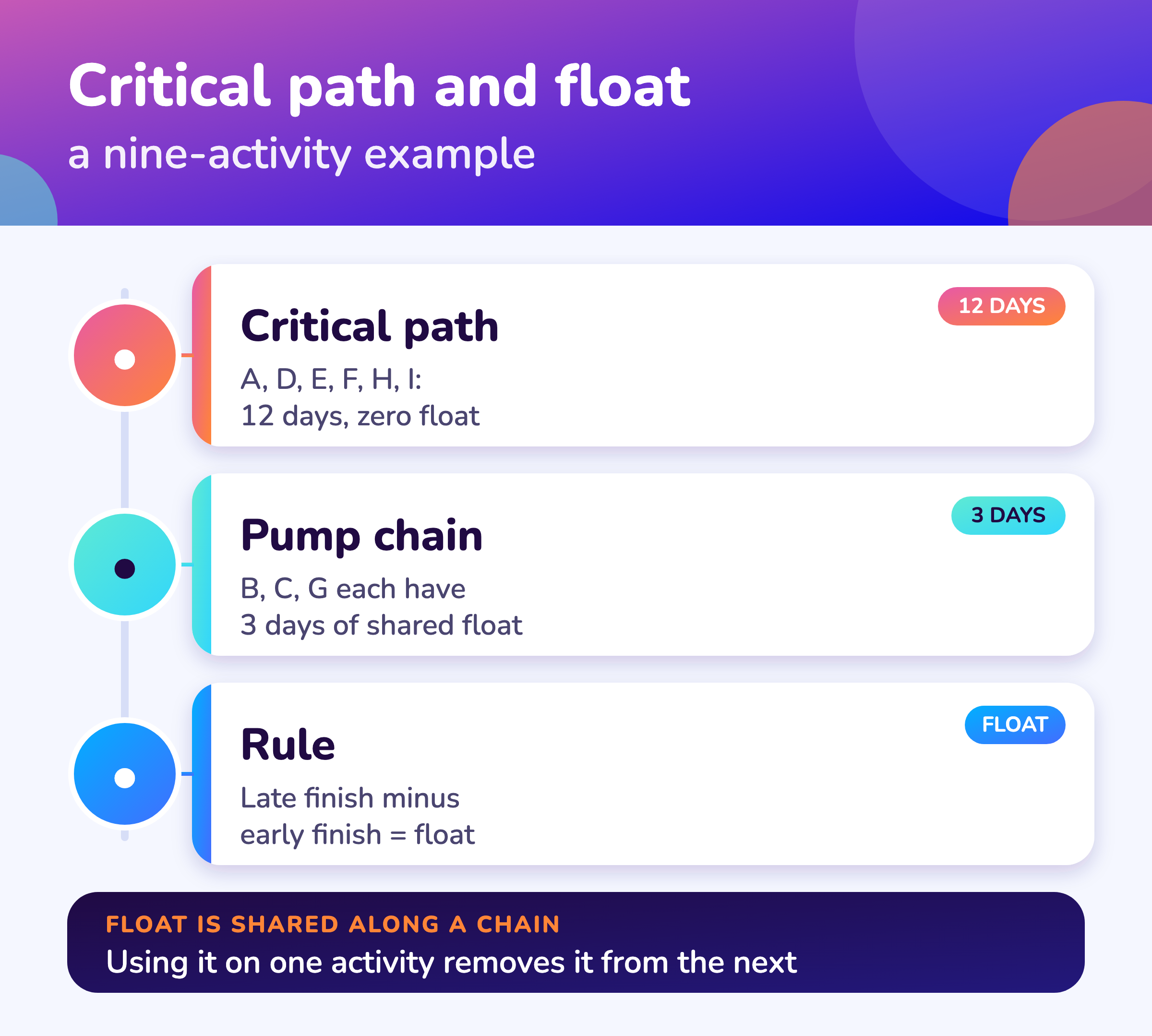
The finish is day 12. The critical path is A to D to E to F to H to I: any delay to one of those activities delays the restart by the same amount. The pump activities B, C and G each have 3 days of total float, and because they are a chain, the 3 days are shared: using it all on B leaves none for C and G. Late finish minus early finish gives total float for each activity.
Calculator
How do you calculate float?
Total float is the late start minus the early start, or equivalently the late finish minus the early finish; early dates come from a forward pass through the network and late dates from a backward pass from the finish.
More tools are on the shutdown calculator tools page. The free Excel to Gantt tool runs this calculation on a whole task list.
Early start is the latest early finish among the predecessors. Early finish is early start plus duration. Late finish is the earliest late start among the successors, and the last activity's late finish equals the project finish. The calculator below applies the same arithmetic to one activity. The default values are those of activity C above, which has three days of float.
Try it: compute total float
Enter an activity's early start, duration and late finish, in days. The calculator gives early finish, late start and total float. Nothing is sent or stored.
Software
What does MaintWiz do for critical path and float?
MaintWiz computes the critical path and float for the shutdown schedule today and flags activities as their float runs down; critical chain analysis, what-if scenarios and Monte Carlo finish confidence are planned for later releases.
About MaintWiz. MaintWiz is an industrial AI platform with IoT, SAP integration and predictive maintenance (PdM) capabilities. Its shutdown and turnaround module helps plants plan, schedule, execute and close out shutdown work.
Planned, not available today: critical chain analysis, what-if scenarios, Monte Carlo confidence of finish.
What the shutdown module covers
As described on the MaintWiz shutdown maintenance product page.
- Gantt chart with the critical path and float for every activity
- A flag when float falls to a limit you set
- Baselines that show what moved against the plan
- Resource availability by trade and week across projects
- Import and export with Excel, Primavera P6 and Microsoft Project
Proof
What MaintWiz customers report
Figures as published in MaintWiz case studies on maintwiz.com. They come from maintenance management projects, not shutdowns.
Critical chain
What is the difference between critical path and critical chain?
The critical path considers only the logic between activities, while critical chain also counts resource dependencies and moves schedule safety into buffers; a 1997 practitioner paper puts the difference as including resource dependencies and never changing. 2
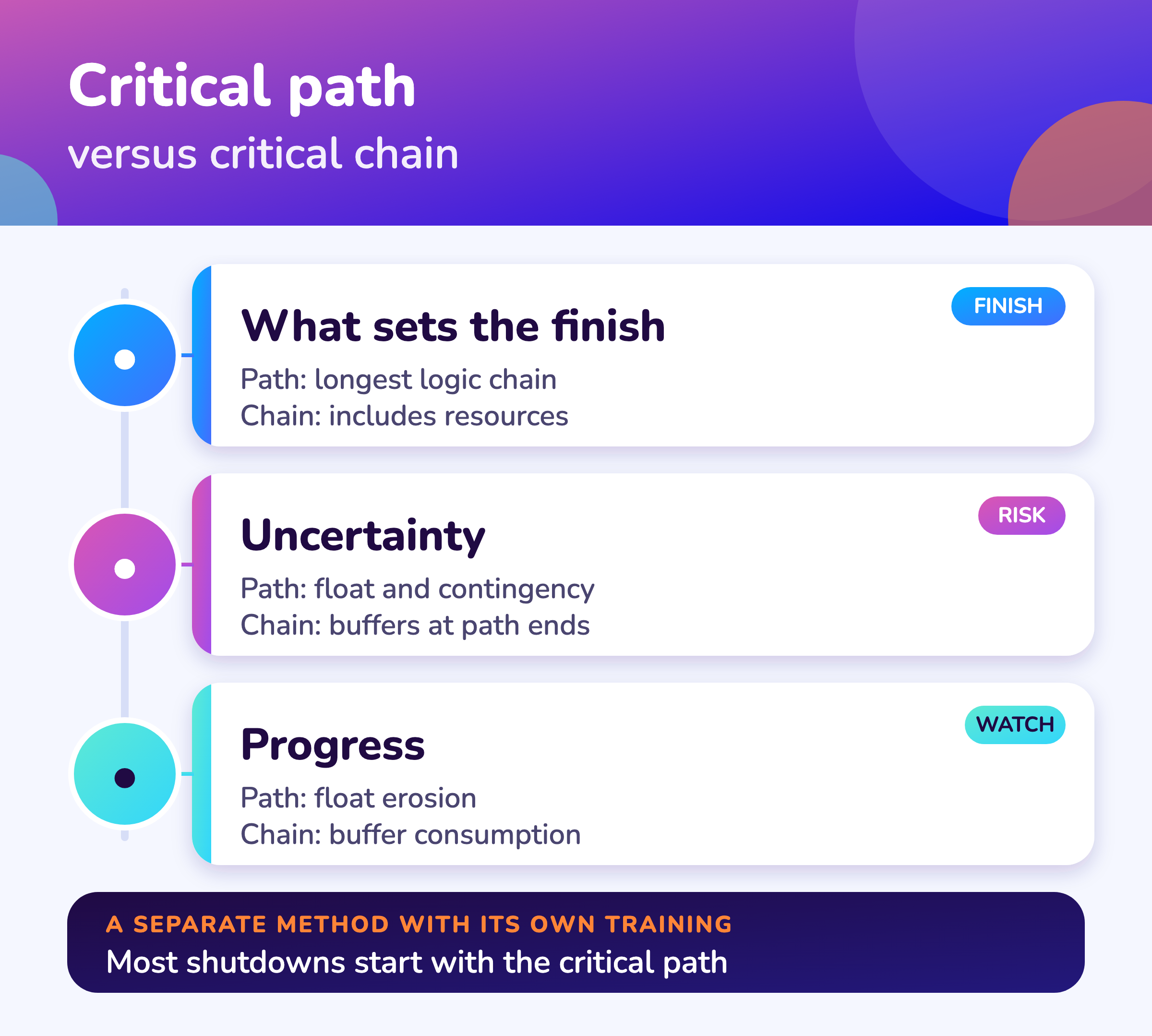
| Question | Critical path method | Critical chain method |
|---|---|---|
| What sets the finish? | The longest sequence of dependent activities | The longest sequence once resource dependencies are included |
| How is uncertainty handled? | Float and, separately, contingency | Aggregated into buffers at the end of paths |
| How is progress watched? | Float erosion on each activity | Consumption of the project and feeding buffers |
| What do the tools support? | Schedule tools describe their engines as critical-path based | Specialized methods and add-ons |
The paper describes a project buffer protecting the finish and feeding buffers protecting the critical chain where paths merge. 2 It is an advocacy paper from a practitioner, so use it for the definitions only, not for its performance claims. Mainstream schedule tools are built on the critical path method; Oracle says its Primavera P6 uses a critical-path algorithm, and Microsoft Project shows critical tasks in red on the Gantt chart. 3,4
In a shutdown, resources are often the real constraint: one crane, one crew of welders, one clean room. A critical path schedule that ignores this can be late in practice even when its float looks healthy. The usual practical answer is to resource-load the schedule and level the peaks, which the GAO guide also expects. 1
The comparison table is a simplified summary for orientation. Critical chain is a separate method with its own training; this page does not teach it.
In practice
Which should a shutdown use?
Most shutdowns run on the critical path method with resource loading and visible float, and they treat critical chain buffers as an advanced option rather than a starting point.
A resource-driven example is in mining mill reline shutdown planning. Refueling outages are a planned-outage example: nuclear refueling outage planning. A boiler-led off-season with a fixed end date: sugar mill off-season maintenance. Emergent work on the critical path, worked through: shutdown case study planned vs actual.
| Situation | Practical approach |
|---|---|
| You have a logic-linked schedule with durations | Find the critical path and watch float every day; start recovery when a critical activity slips |
| A crew or machine is the bottleneck | Resource-load the schedule, level the peaks and treat the resource-driven sequence as part of the critical path |
| Estimates are padded in every task | Challenge task estimates against past actuals; keep one explicit contingency rather than hidden padding |
| You want critical chain buffers | Treat it as a separate method; check that your scheduling tool and your team can support it before adopting it |
See the scheduling guide for the method and the schedule delays guide for recovery. Contingency sizing is in the budget guide.
Definitions
How do public sources define critical path and float?
The HHS earned value glossary defines the critical path as the path of dependent tasks with the longest elapsed time, and the GAO schedule guide defines float as the time an activity can slip without delaying a later date. 5,1
| Term | Definition | Source |
|---|---|---|
| Critical path | The path through a network of dependent tasks with the longest elapsed time; any delay to a task on it delays the finish by the same amount | HHS earned value glossary, GAO schedule guide |
| Float | The time an activity can slip without delaying a later date; float is not contingency | GAO schedule guide |
| Critical chain | A method that adds resource dependencies and buffers to the logic | Leach critical chain paper |
Visuals
Save the float charts
Two charts to share with schedulers. Click either for the full-size image.
FAQ
Frequently asked questions
What is the critical path in a shutdown?
The longest continuous sequence of activities that sets the restart date. A delay to any activity on it delays the finish by the same amount. 1
What is float?
The time an activity can slip without delaying a later activity or the finish. Total float is late start minus early start. Float is not contingency. 1
Why can float be shared?
Activities in a chain share the float of the chain: if the first one uses all of it, the others have none. In the worked example B, C and G share three days.
What is critical chain?
A method that adds resource dependencies to the logic and moves schedule safety into buffers at the end of paths. 2 It is a different method from the critical path method.
Should a shutdown use critical chain?
Most plants start with a logic-linked, resource-loaded critical path schedule and daily float tracking. Critical chain is an advanced option that needs a trained team and tool support.
Does MaintWiz support critical chain analysis?
Not today. MaintWiz shows the critical path and float. Critical chain analysis is planned for a later release.
How often should you check float?
Daily during the stop, in the daily meeting. See progress tracking.
Where is the full scheduling method?
In the shutdown scheduling guide.
Sources
Sources
- US Government Accountability Office, GAO Schedule Assessment Guide: Best Practices for Project Schedules (GAO-16-89G, December 2015)
- Larry P. Leach, Critical Chain Project Management Improves Project Performance (Advanced Projects Institute, 1997; practitioner paper, copy hosted by Universidade Federal de Pernambuco)
- Oracle, Primavera P6 (product page)
- Microsoft Support, Show the critical path of your project in Project
- US Department of Health and Human Services, Earned Value Management, Appendix D: Glossary of Terms
Put your shutdown schedule in one plan
Book a demo and bring your shutdown schedule. We will show how the module handles the critical path, float and baselines.