
STO terms explained
Shutdown vs Turnaround vs Outage: What Is the Difference?
A shutdown is any deliberate stop of a plant or unit. A turnaround is usually the large, planned, periodic form of shutdown. An outage is any period out of service and can be planned or unplanned, so check the word in front of it. An overhaul is major repair or inspection work, often done during a planned outage.
In this guide, STO means shutdown, turnaround and outage.
How MaintWiz helps: Whatever your plant calls the stop, the planning problems are the same. The MaintWiz shutdown module moves the plan from spreadsheets into one system with a critical path, readiness gates, permits and spares status. See the module · Get the 40-step checklist
By Jai Balachandran · Published · Last reviewed
What MaintWiz adds:Critical path and floatReadiness gatesPermits and isolationsSpares status with SAP
STO
What does STO stand for?
STO is shorthand for shutdown, turnaround and outage: the planned and unplanned stops of a plant or unit. This guide uses it as a collective term. Public sources use the full words, so each definition below names its source.
The work done during these stops is shutdown maintenance. The three words describe the stop itself, and they are used differently by industry.
Compare
Shutdown vs turnaround vs outage vs overhaul: side by side
A turnaround is usually the large, planned, periodic form of shutdown. An outage can be planned or unplanned. An overhaul is a type of work, not a type of stop.
Planned
- ShutdownA deliberate stop, from one unit to a whole plantEIA
- TurnaroundThe large, periodic, planned form of shutdownEIA, AFPM
- Planned outageScheduled well ahead; work scope set beforehandNERC
- Refueling outagePlanned stop of a nuclear reactor to refuelEIA
In between
- Maintenance outageCan wait past the next weekend, not past the next planned outageNERC
Unplanned
- Forced outageNot scheduled; graded immediate, delayed or postponedNERC
- Emergency shutdownBrought down immediately, without warningEIA
The same terms in detail
| Term | Planned? | Scale | Timing and length (published examples) | Source |
|---|---|---|---|---|
| Shutdown | Planned | Any: from a targeted stop of one unit to a whole plant | No single figure applies; it depends on scope | EIA |
| Turnaround | Planned, periodic | Large: one or more units, or the whole plant | US refining: routine turnarounds on key units every 3 to 5 years; a unit offline several weeks to several months; 1 to 2 years of advance planning | EIA, AFPM |
| Overhaul | Usually planned | A major repair or inspection job, not a type of stop | Power generation: turbine and boiler overhauls or inspections are given as typical planned outages | NERC GADS |
| Planned outage | Planned | Unit or plant | Reporting rules: scheduled well in advance, of predetermined duration, can last several weeks, once or twice a year (a definition, not frequency data) | NERC GADS |
| Maintenance outage | Deferrable | Unit | Can be deferred beyond the end of the next weekend; usually much shorter than a planned outage | NERC GADS |
| Forced (unplanned) outage | Unplanned | Unit | Graded U1 immediate, U2 delayed (within six hours) or U3 postponed (before the end of the next weekend) | NERC GADS |
| Emergency shutdown | Unplanned | Unit or whole refinery | Brought down immediately, without warning | EIA |
| Nuclear refueling outage | Planned | Reactor | Refuel after about 18 or 24 months; outage recently averaged 34 to 38 days and can be as short as 10 days | EIA |
Software
Does the word change how the work is managed?
No, the word does not change how the work is managed. Whatever the stop is called, a planned one still needs a scope, a schedule, permits, spares and a close-out.
About MaintWiz. MaintWiz is an industrial AI platform with IoT, SAP integration and predictive maintenance (PdM) capabilities. Its shutdown and turnaround module helps plants plan, schedule, execute and close out shutdown work.
Also: product data sheet.
What the shutdown module covers
As described on the MaintWiz shutdown maintenance product page.
- Shutdown calendar and critical-path scheduling, with work order sequencing and dependencies
- Asset prioritization, so the most critical equipment is scoped first
- Resource planning for people, spares, heavy equipment such as cranes, and outsourced vendors
- Electronic permits to work, risk management and contingency plans
- Real-time progress monitoring: schedule adherence, cost variance, quality metrics and risk factors
- Step-by-step checklists, pre-restart testing protocols and post-shutdown analysis
Proof
What MaintWiz customers report
Figures as published in MaintWiz case studies on maintwiz.com. They come from maintenance management projects, not shutdowns.
By industry
Which word does each industry use?
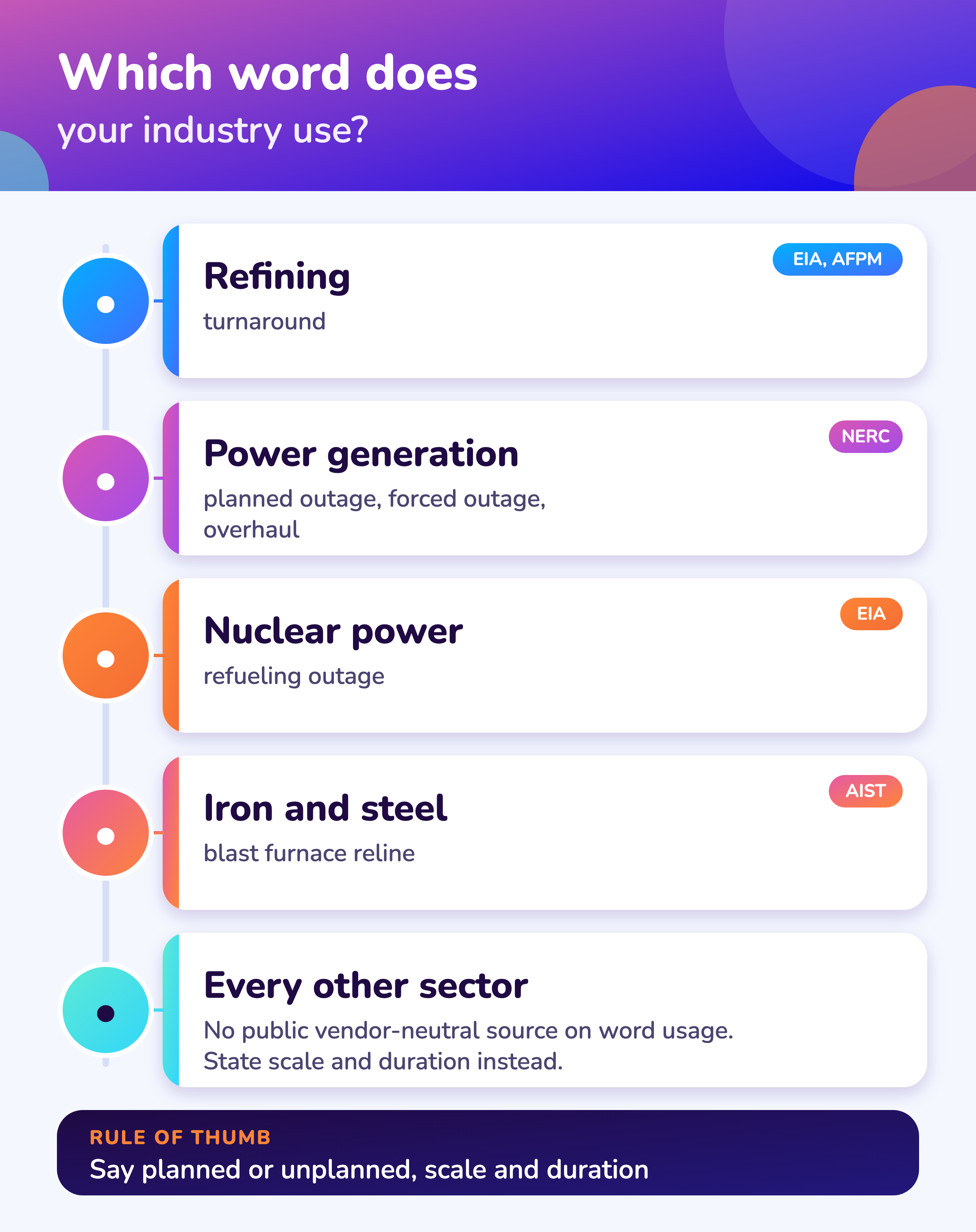
The word for a stop follows the sector. Refining says turnaround, power generation says planned and forced outage, nuclear says refueling outage, and steel says reline. For other sectors there is no published source on word usage, so state the scale and duration instead of relying on the word.
For T&I in Gulf refining and a gated planning model, see T&I turnaround and inspection planning. Nuclear refueling outages are covered in nuclear refueling outage planning. Water and wastewater plants use the word outage for taking a unit offline; see water and wastewater plant outages.
Some refiners use T&I, short for turnaround and inspection. One article on a Saudi Arabian refinery calls its stop a “major turnaround and inspection (T&I)” and says the plants are on a five-year T&I cycle. 8
Refining
The word is turnaround. EIA and AFPM both use it for the planned, periodic stop of processing units. 1,2
Power generation
The words are planned outage, forced outage and overhaul. NERC reporting rules define them. 3
Nuclear power
The word is refueling outage, scheduled about every 18 or 24 months. 4
Iron and steel
The word is reline for a blast furnace. One German furnace reline in 2008 was reported at a record 70 days of downtime. 7
Process industries (UK HSE)
HSE isolation guidance refers to "plant maintenance shutdowns or turnarounds" in the same sentence. 6
Sector guides: manufacturing · cement · power generation · refinery · chemical.
Outage classes
What is the difference between a planned and a forced outage?
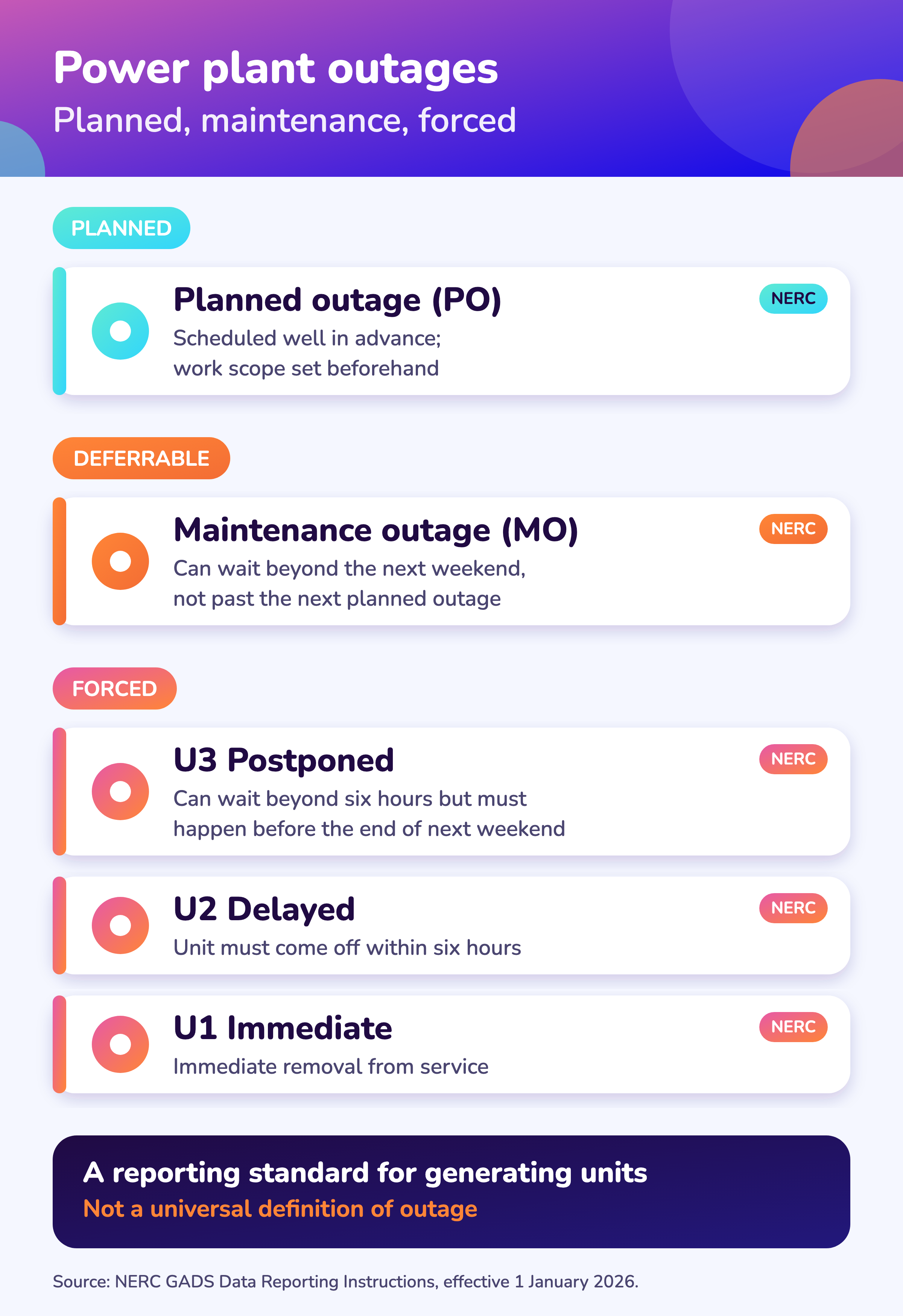
A planned outage is scheduled well in advance with its work scope set beforehand. A forced outage is not scheduled and is graded by how fast the unit must come off.
For the cost of each kind of stop, see planned vs unplanned shutdown cost.
- PO
Planned outage
Scheduled well in advance and of predetermined duration. The individual tasks are set in advance as the "original scope of work". Typical examples are turbine and boiler overhauls, inspections and testing. 3
Scheduled - MO
Maintenance outage
Can be deferred beyond the end of the next weekend, but the unit must come off before the next planned outage. It can occur any time of year and is usually much shorter than a planned outage. 3
Deferrable - U3
Forced outage, postponed
Can be postponed beyond six hours, but the unit must come off before the end of the next weekend. 3
Unplanned - U2
Forced outage, delayed
Does not need immediate removal, but the unit must come off within six hours. 3
Unplanned - U1
Forced outage, immediate
Needs immediate removal from service, typically after an automatic trip or an operator-initiated trip in response to alarms. 3
Unplanned
NERC also treats discovered work as outside the original scope: in-scope inspection overrun is a planned extension, while repairs to damage found are forced outage time. 3
Stop vs work
Is a turnaround the same as an overhaul?
No, a turnaround is not the same as an overhaul. Shutdown, turnaround and outage describe the stop. Overhaul, inspection, repair and replacement describe the work done during it.
Planned and forced outage coding for nuclear plants is in nuclear refueling outage planning. SAP ECC to S/4HANA and your shutdown history: SAP S4HANA maintenance data migration.
| The stop (event) | The work (activity) |
|---|---|
| Shutdown, turnaround, outage, reline, refueling outage | Overhaul, inspection, repair, replacement, modification, cleaning, testing |
| Answers: when is the plant or unit out of service, and for how long? | Answers: what is done while it is out of service? |
| Planned or unplanned; small or large | Scoped, scheduled and resourced before a planned stop |
EIA describes a turnaround as a shutdown to perform maintenance, inspection and repair, and to replace worn or broken process materials and equipment. NERC lists turbine and boiler overhauls among typical planned outages. 1,3 See the full guide to shutdown maintenance for what goes into the work scope.
Look-alikes
Words that sound alike but mean something else
Hot and cold shutdown (nuclear)
In nuclear regulation, cold shutdown describes a reactor coolant system at atmospheric pressure and below 200 degrees Fahrenheit after a cooldown. It is a reactor state, not a maintenance event. 5
For sourced definitions of 49 related terms, see the shutdown turnaround glossary. T&I is covered in T&I turnaround and inspection planning.
Outage as a power cut
In electricity supply, "outage" can also mean customers losing power. This guide covers stops of a plant or unit, not interruptions to supply.
Annual shutdown
An annual shutdown is any shutdown scheduled once a year. It is not automatically a turnaround: a turnaround is the large, periodic form. No public benchmark applies across industries.
Which word
Which word should you use?
Use whichever word your audience uses, as long as you also state planned or unplanned, scale and duration.
- 1
Say planned or unplanned
Write "planned outage" or "forced outage", not just "outage". Write "emergency shutdown" for an immediate stop.
- 2
Say the scale
Name the units or the whole plant. "Turnaround" implies the large, periodic form; "targeted shutdown" implies smaller scope.
- 3
Give the dates and length
State the start date and planned duration. A date and a duration remove most of the confusion that the word leaves.
- 4
Use your audience's word, and define it once
Use the term your site, contractors and regulator use. Expand STO once if you use it as a collective term.
Next: Types of plant shutdowns · How to plan a shutdown · 40-step shutdown checklist.
Visuals
Save the comparison charts
Two charts from this guide, ready to save and share. Click one to open it full size.
FAQ
Frequently asked questions
What does STO stand for?
In this guide STO means shutdown, turnaround and outage: shorthand for the planned and unplanned stops of a plant or unit. Public sources use the full words, so check which term a source defines before quoting it. 1,3
Is a shutdown the same as a turnaround?
No. A turnaround is usually the large, planned, periodic form of shutdown. EIA defines a refinery turnaround as a planned, periodic shutdown of one or more processing units for maintenance, inspection and repair, and describes planned, targeted shutdowns of smaller scope. 1
Is an outage the same as a turnaround?
No. An outage is any period out of service and can be planned or unplanned. AFPM says the key distinction is that turnarounds are planned, while unplanned outages are typically shorter. 2
What is the difference between a planned and a forced outage?
In NERC reporting rules a planned outage is scheduled well in advance with its work scope set beforehand. A forced outage is not scheduled and is graded U1 (immediate), U2 (within six hours) or U3 (before the end of the next weekend). 3
Is an overhaul the same as a shutdown?
No. An overhaul is major repair or inspection work. A shutdown or outage is the stop during which it is done. NERC lists turbine and boiler overhauls among typical planned outages. 3
How long does each take?
A refinery unit can be offline for several weeks to several months and that US reactors recently averaged 34 to 38 days for a refueling outage. A German blast furnace reline was reported at 70 days in 2008. No single figure applies to every industry. 1,4,7
Is an annual shutdown a turnaround?
Not necessarily. An annual shutdown is any shutdown scheduled once a year. A turnaround is the large, periodic form, which in US refining is planned about every 3 to 5 years for key units. 1
What are hot shutdown and cold shutdown?
These are reactor states in nuclear regulation, not maintenance events. The NRC glossary describes cold shutdown as a reactor coolant system at atmospheric pressure and below 200 degrees Fahrenheit following a cooldown. 5
Sources
Sources
Each definition and figure on this page comes from the public sources below, and the text says where a number is only an example. Sources can be revised, so check the original before you rely on a figure.
- U.S. Energy Information Administration, Refinery Outages: Description and Potential Impact on Petroleum Product Prices
- American Fuel & Petrochemical Manufacturers, Refinery turnarounds 101: What are turnarounds and why do we need them? (17 October 2023)
- North American Electric Reliability Corporation, Generating Availability Data System (GADS) Data Reporting Instructions, effective 1 January 2026
- U.S. Energy Information Administration, Nuclear power plants undergo seasonal scheduled outages (23 May 2011)
- US Nuclear Regulatory Commission, Glossary: Cold shutdown
- UK Health and Safety Executive, The safe isolation of plant and equipment (HSG253, 2006)
- Association for Iron & Steel Technology, ThyssenKrupp Steel to Restart Blast Furnace 1 at Duisburg-Schwelgern (20 March 2008)
- Hydrocarbon Engineering, Ras Tanura refinery completes inspection project (18 February 2018)
Move your shutdown plan out of spreadsheets
Book a demo and bring the spreadsheet you use today. We will show how the module covers the same ground.