
Equipment guide
Heat Exchanger Turnaround Planning: Bundle Pull Sequence and Job Card
Heat exchanger turnaround planning sequences each exchanger through isolation, bundle pull, cleaning, inspection, repair or retubing, reassembly, pressure test and reinstatement on one job card. Plan the crane lift and the cleaning pit first, because they are shared by every exchanger. MaintWiz holds each exchanger as a work package with checklists and findings.
STO means shutdown, turnaround and outage. Plugging limits, test pressure and repair methods come from the engineer and the code.
How MaintWiz helps: Dozens of exchangers share one crane and one cleaning pit. The MaintWiz shutdown module gives plant teams one plan for scope, schedule, permits, spares and execution, from the first work package to close-out. See the module · Get the exchanger job card
By Jai Balachandran · Published · Last reviewed
What MaintWiz adds:Scope, schedule and permits in one planSpares status with SAPReadiness gatesFindings to the planner
Definition
What is heat exchanger turnaround planning?
Heat exchanger turnaround planning decides which exchangers to clean, inspect, repair, retube or replace in the stop, and sequences each one through isolation, bundle pull, cleaning, inspection, repair, reassembly, test and reinstatement with a job card, a lift plan and a cleaning pit. In this guide STO means shutdown, turnaround and outage.
Exchangers are repetitive work with shared constraints: one crane, one cleaning pit, one hydroblasting crew and one set of inspectors. A refinery or chemical turnaround can have dozens of them, so the sequence and the shared resources decide the finish date more than any single exchanger does.
Download the free heat exchanger job card sheet (Excel) for a twelve-step job card and an exchanger list that checks plugging against the engineer’s limit.
Sequence
What is the task sequence for a heat exchanger turnaround?
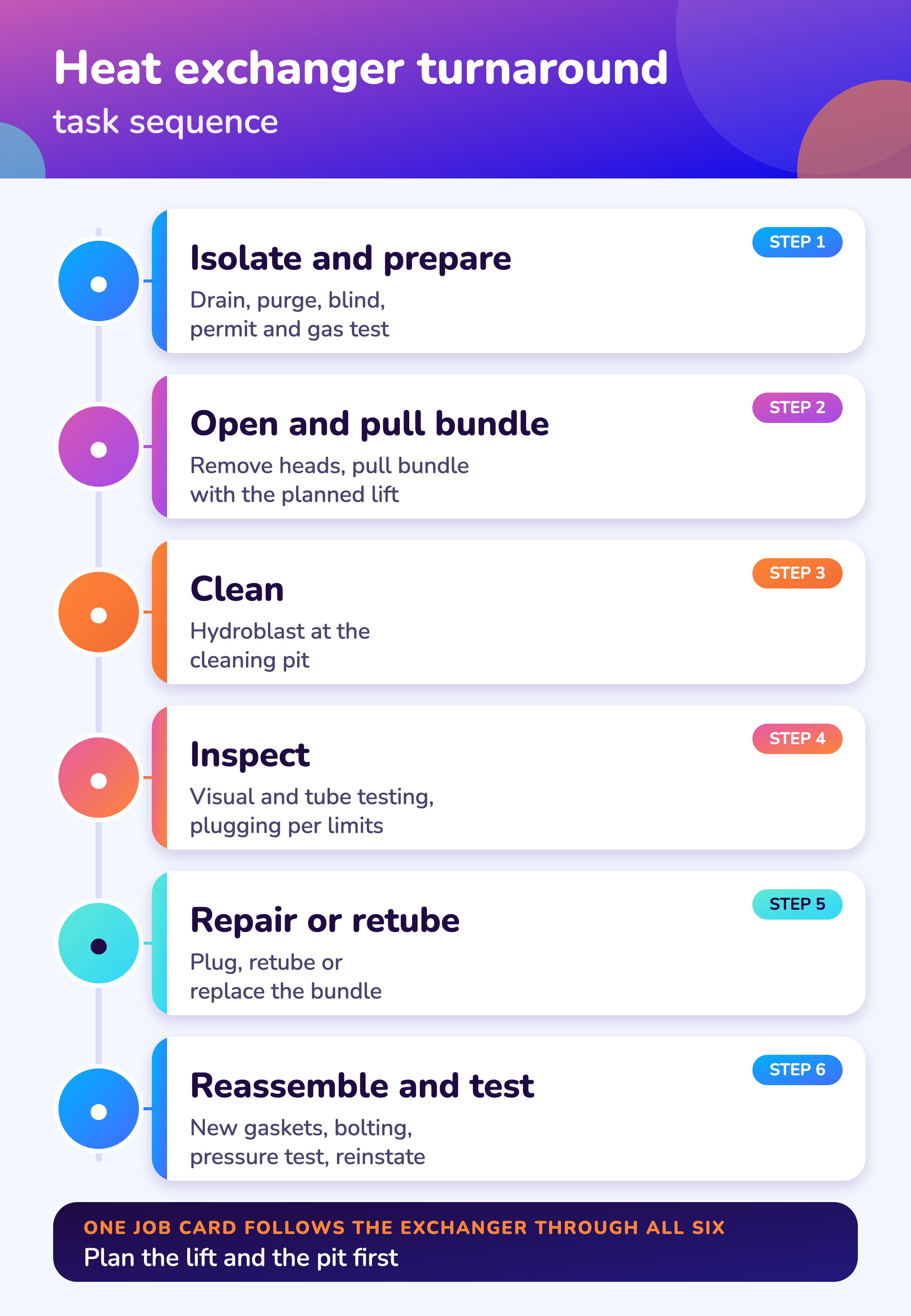
The task sequence for an exchanger is permit and isolation, open and pull the bundle, clean, inspect, repair or retube, reassemble with new gaskets, pressure test and reinstate, and each step has its own resource, so the job card follows the unit through all of them. 2,3
- 1
Isolate and prepare
Drain, purge, blind and test the atmosphere under a permit.
Permit - 2
Open and pull the bundle
Remove heads and bolting; plan the lift and the laydown.
Lift - 3
Clean
Hydroblast tubes and shell at a controlled cleaning pit.
Pit - 4
Inspect
Visual and tube testing; record findings by tube.
Data - 5
Repair or retube
Plug, retube or replace as the engineer decides.
Decision - 6
Reassemble and test
New gaskets, bolting to procedure, pressure test, reinstate.
Close
Isolation, blinding and lockout follow your procedures and the guidance. See permit management and the HSE guidance on safe isolation. 2 Entering a channel or shell is a confined space entry where the rules apply. 4
MaintWiz
How does MaintWiz plan repetitive exchanger work?
MaintWiz holds each exchanger as a work package with checklists, readings, photos and findings that reach the planner, and shows shared resources such as cranes and crews against demand; AI agents support shutdown planning.
Bring your exchanger list to a demo and we will load the job cards. Tell us how you sequence the pit and the crane: plant requirements shape what we build next.
About MaintWiz. MaintWiz is an industrial AI platform with IoT, SAP integration and predictive maintenance (PdM) capabilities. Its shutdown and turnaround module helps plants plan, schedule, execute and close out shutdown work.
What the shutdown module covers
As described on the MaintWiz shutdown maintenance product page.
- Work packages with steps, parts, labor and drawings
- Permits and isolations shown on each work order
- Checklists with readings and photos for technicians
- Findings from technicians sent straight to the planner
- Gantt chart with critical path, float and baselines
- Trade and tool availability by week
Proof
What MaintWiz customers report
Figures as published in MaintWiz case studies on maintwiz.com. They come from maintenance management projects, not shutdowns.
Decide
Should you clean, repair, retube or replace a heat exchanger?
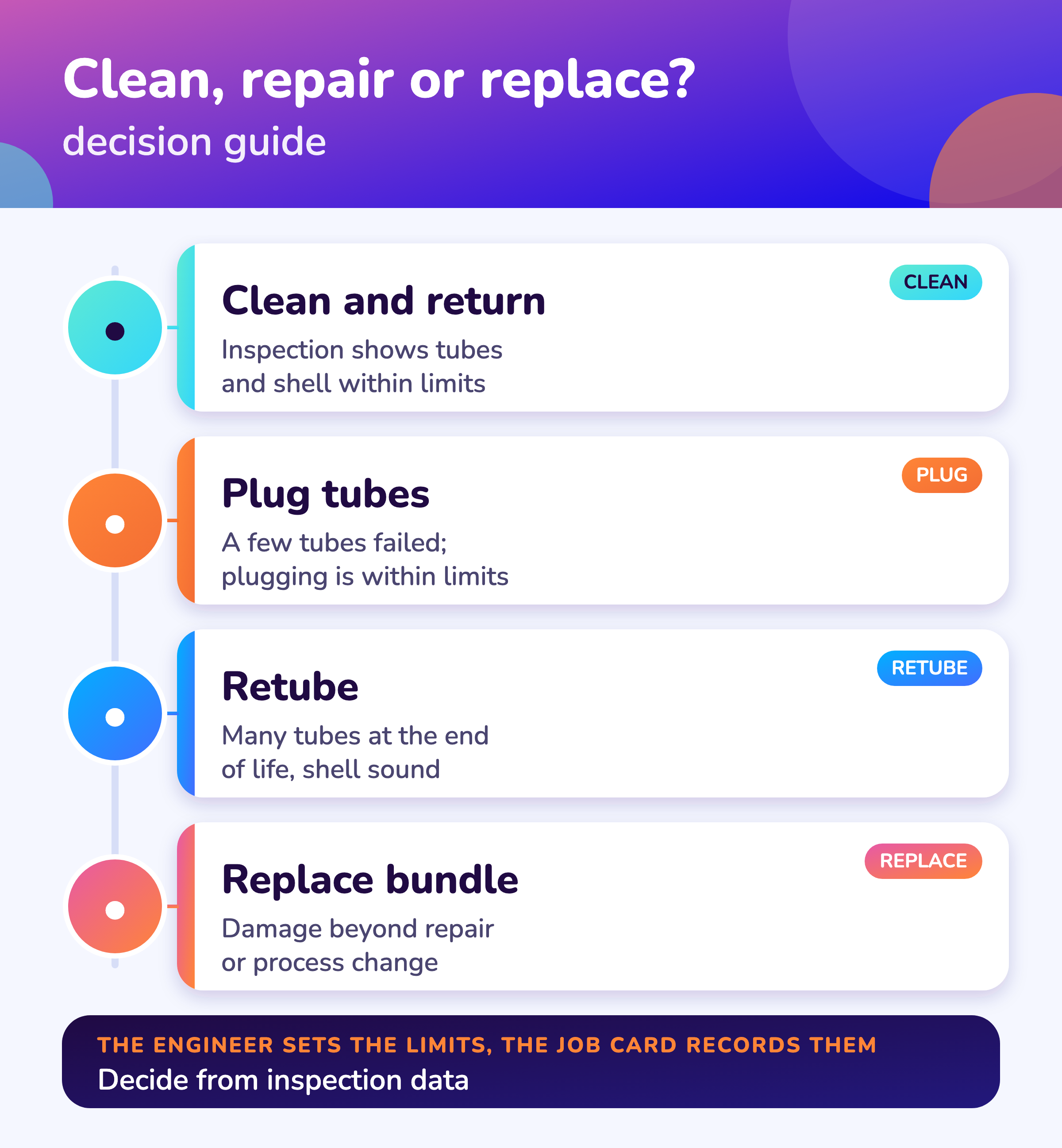
Decide from inspection data and the engineer’s limits: clean and return when tubes and shell are within limits, plug a few failed tubes while plugging stays under the limit, retube when many tubes are at end of life and the shell is sound, and replace when damage is beyond repair.
| Decision | When it fits | Planning impact |
|---|---|---|
| Clean and return | Inspection shows tubes and shell within limits | Shortest. Pit and crane time only |
| Plug tubes | A few failed tubes and plugging stays within the engineer’s limit | Adds inspection and plugging time |
| Retube | Many tubes at end of life and the shell is sound | Needs a tube specialist, material and test; order early |
| Replace the bundle | Damage beyond repair, or a process change | Long lead item; fabricate ahead and fit the lift |
Decide the likely outcome before the stop from the inspection history and order the tubes or the bundle if it is likely, because delivery is long and the stop is short.
Inspection
How are heat exchanger tubes inspected during a turnaround?
Tubes are cleaned first and then inspected visually and by tube testing such as eddy current or internal rotary inspection, chosen by the tube material, with the findings recorded by tube so the engineer can decide on plugging, retubing or replacement. 1
| Method | What it finds | Planning note |
|---|---|---|
| Visual of channel, tubesheet and bundle | Corrosion, fouling, damaged gaskets, pitting | Do it as soon as the bundle is out |
| Eddy current testing | Wall loss and cracks, mostly in non-ferromagnetic tubes | Needs clean tubes and a trained operator |
| Internal rotary inspection (IRIS) | Wall thickness in many tube materials | Needs clean and water-filled tubes |
| Hydrostatic leak test | Leaking tubes and joints | See hydrotest planning |
Which method fits which tube material is an inspector’s decision. Book the inspector and the equipment with the cleaning plan so tubes are clean when the inspector is ready.
Cleaning pit
How do you plan an exchanger cleaning pit?
Plan the cleaning pit as a shared resource: size it for the number of bundles, site it near the lift path, contain and treat the wash water, set an exclusion zone around the water jetting, and schedule bundles through it in the order the exchangers are needed.
- Place the pit near the crane path and the laydown
- Contain wash water and plan its disposal
- Set an exclusion zone and permit for water jetting
- Queue bundles by priority and critical path
- Provide lighting, drainage and welfare
- Track bundles in and out on one board
Job card
What goes on a heat exchanger job card?
A heat exchanger job card lists the twelve steps from permit to reinstatement with the resource and the planned hours for each, the isolation points, the lift plan, the inspection results, the plugging count against the engineer’s limit and the test result.
| Section | Contents |
|---|---|
| Identity | Tag, service, drawings, bundle weight and type |
| Isolation | Points, blinds, permit number |
| Lift plan | Crane, extractor, laydown, route |
| Steps and hours | Twelve steps with resource and planned hours |
| Inspection | Findings by tube, photographs |
| Decision | Clean, plug, retube or replace, signed by the engineer |
| Test and reinstatement | Test result, blinds removed, sign-off |
Use the job card to feed the work package. See work package optimization.
Visuals
Save the exchanger planning visuals
Two visuals for the exchanger planner. Click either for the full-size image.
FAQ
Frequently asked questions
What is the task sequence for a heat exchanger turnaround?
Permit and isolation, open and pull the bundle, clean, inspect, repair or retube, reassemble with new gaskets, pressure test and reinstate.
How long does a heat exchanger turnaround job take?
It depends on size, access, cleaning and repair. Build the duration from the twelve job card steps and your own history.
When should you retube instead of replace a bundle?
When many tubes are at end of life and the shell and tubesheet are sound. The engineer decides from the inspection data.
How do you inspect heat exchanger tubes?
Clean first, then inspect visually and by tube testing such as eddy current or internal rotary inspection, chosen by tube material.
What is a tube plugging limit?
The share of plugged tubes the engineer allows before the exchanger must be retubed or replaced. It is set for each exchanger.
Why plan the cleaning pit?
It is a shared resource. Placement, wash water, the exclusion zone and the order of bundles decide how fast the exchangers move.
What goes on an exchanger job card?
Identity, isolation, lift plan, twelve steps with hours, inspection findings, the decision, the test and reinstatement.
Is there a free exchanger job card?
Yes. The heat exchanger job card sheet (Excel) has the twelve-step job card and an exchanger list that checks plugging against the limit.
Does MaintWiz plan exchanger work?
It holds each exchanger as a work package with checklists, findings and resource demand. AI agents are part of the module. See AI shutdown planning.
Sources
Sources
This page gives planning practice. Inspection methods, plugging limits and repair methods are set by the inspector, the engineer and the code. Isolation and confined space references are HSE and OSHA.
- American Petroleum Institute, Standards (API 510, 570 and 653 inspection codes are listed here)
- UK Health and Safety Executive, The safe isolation of plant and equipment (HSG253, 2006)
- OSHA, 29 CFR 1910.147, The control of hazardous energy (lockout/tagout)
- OSHA, 29 CFR 1910.146, Permit-required confined spaces
Plan your next shutdown in one system
Book a demo and tell us about your plant. We will show how the module handles your shutdown.