
Access planning
Turnaround Scaffolding Planning: Requests, Tags and Lead Time
Turnaround scaffolding planning logs one request per scaffold with a needed-by date, sequences erection around the trades, inspects and tags every scaffold before use and dismantles only after final sign-off. A coordinator owns the register, because late or untagged scaffolds hold back every job at height. MaintWiz checks readiness before a package starts, including access.
STO means shutdown, turnaround and outage. Tag colors and inspection intervals follow your site rules and local regulation.
How MaintWiz helps: A late scaffold holds back every job at height. The MaintWiz shutdown module shows availability of trades and common tools by week across projects, with blackout windows from the admin calendar. See the module · Get the scaffold register
By Jai Balachandran · Published · Last reviewed
What MaintWiz adds:Trade and tool availabilityWeekly availability viewBlackout windowsRate cards and shifts
Definition
Why does scaffolding need its own turnaround plan?
Scaffolding is the access for most turnaround work at height, so a scaffold that is late, wrong or untagged holds back every job that depends on it, and it needs its own request register, sequence, inspection and handback plan. 2
Scaffold crews erect before the trades arrive and strip after the last job, so a delay at either end moves the finish date. A single coordinator who owns the register, the sequence and the tags keeps the trades from competing for the same access. In this guide STO means shutdown, turnaround and outage.
Download the free scaffold request register (Excel) to log requests and flag late ones.
Process
How do you plan scaffolding for a shutdown?
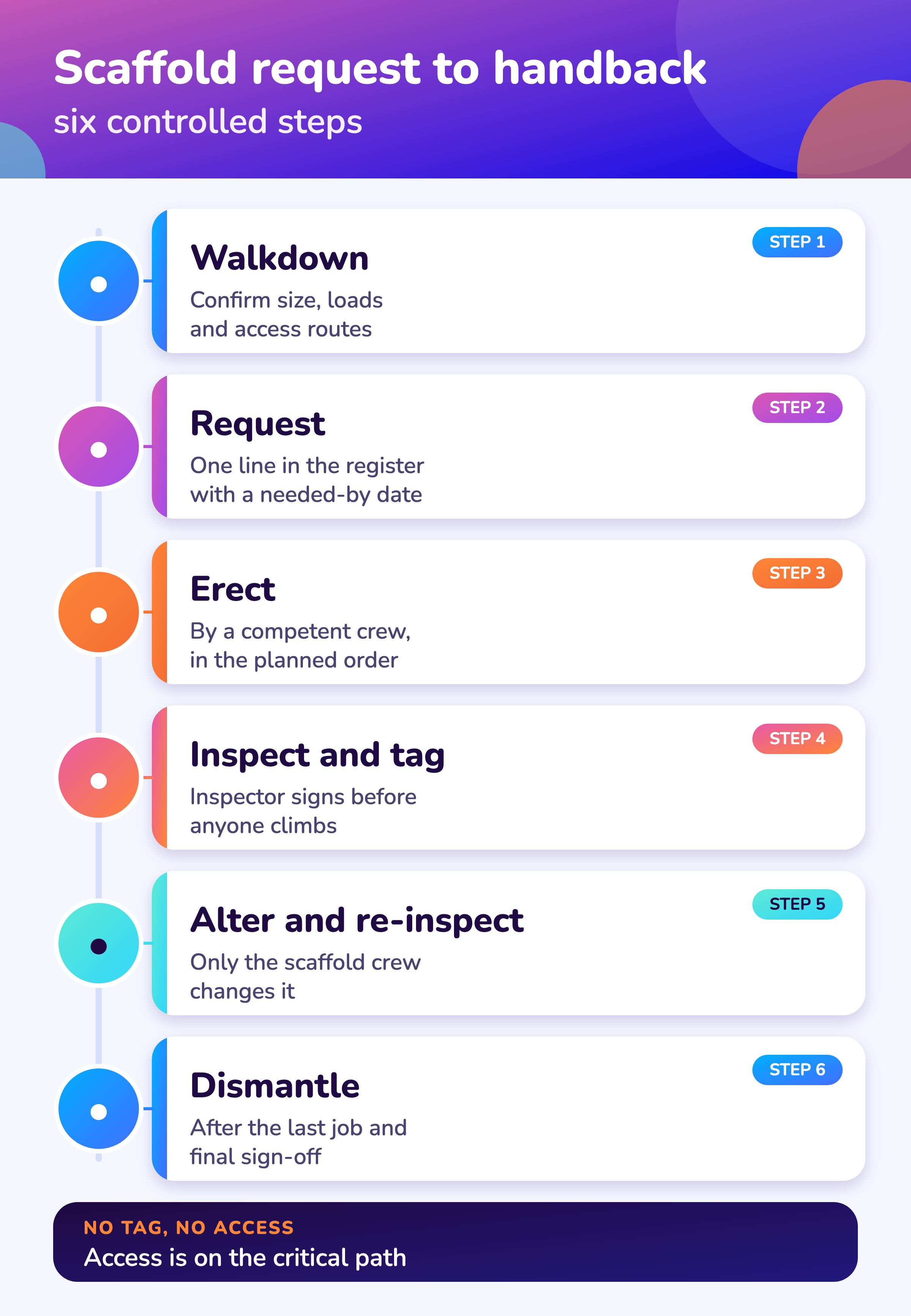
Plan shutdown scaffolding by walking down each job, logging one request per scaffold with a needed-by date, checking design and loads, sequencing erection around the trades, inspecting and tagging before use, controlling alterations and dismantling only after final sign-off.
- 1
Walk down the scope
Confirm size, loads, access routes and what is in the way.
Before the stop - 2
Log one request per scaffold
Area, job, type, needed-by date, erect days.
Register - 3
Check design and loads
Complex or heavily loaded scaffolds need a design check by a competent person.
Engineering - 4
Sequence the erection
Erect in the order the jobs start; avoid blocking other trades.
Plan - 5
Inspect and tag
A competent person inspects before use; the tag shows the result.
No tag, no access - 6
Control alterations
Only the scaffold crew changes a scaffold; every change is inspected again.
Control - 7
Dismantle after sign-off
Strip after the last job and the final inspection need it.
Handback
HSE guidance covers erecting, using, inspecting and dismantling scaffolds; follow the rules that apply where you work. 1
MaintWiz
How does MaintWiz help with scaffolding and access?
MaintWiz keeps access needs next to the work packages and checks readiness before a package starts, so a job without tagged access is flagged in the plan; AI agents support shutdown planning.
Bring your scaffold list to a demo and we will show it against the schedule. Tell us how your site tags and hands over scaffolds: plant requirements shape what we build next.
About MaintWiz. MaintWiz is an industrial AI platform with IoT, SAP integration and predictive maintenance (PdM) capabilities. Its shutdown and turnaround module helps plants plan, schedule, execute and close out shutdown work.
What the shutdown module covers
As described on the MaintWiz shutdown maintenance product page.
- Gantt chart with critical path and float
- Seven readiness gates, including access
- Permits and isolations shown on each work order
- Findings from technicians sent straight to the planner
- Trade and tool availability by week
- Handover notes and as-left summary
Proof
What MaintWiz customers report
Figures as published in MaintWiz case studies on maintwiz.com. They come from maintenance management projects, not shutdowns.
Request register
What goes in a scaffold request register?
A scaffold request register records for every scaffold its area and tag number, the job it supports, the type, the dates requested and needed, the erect days, the date tagged ready, the tag status, any alterations and the dismantle date.
| Field | Why it matters |
|---|---|
| Area and tag number | Locates the scaffold and links to the tag |
| Job it supports | Shows which job waits for it |
| Type: access, full, hanging, mobile tower | Drives erect time and design check |
| Date requested and needed-by date | Flags requests made too late |
| Erect days estimate | Sets the latest request date |
| Date tagged ready and tag status | Shows readiness for the look-ahead |
| Alterations and re-inspections | Controls change |
| Dismantle date | Frees the area for the next trade |
Feed the register into the daily look-ahead so jobs without tagged access are caught early. See shutdown progress and the 3-day look-ahead.
Tagging
How does a scaffold tagging system work?
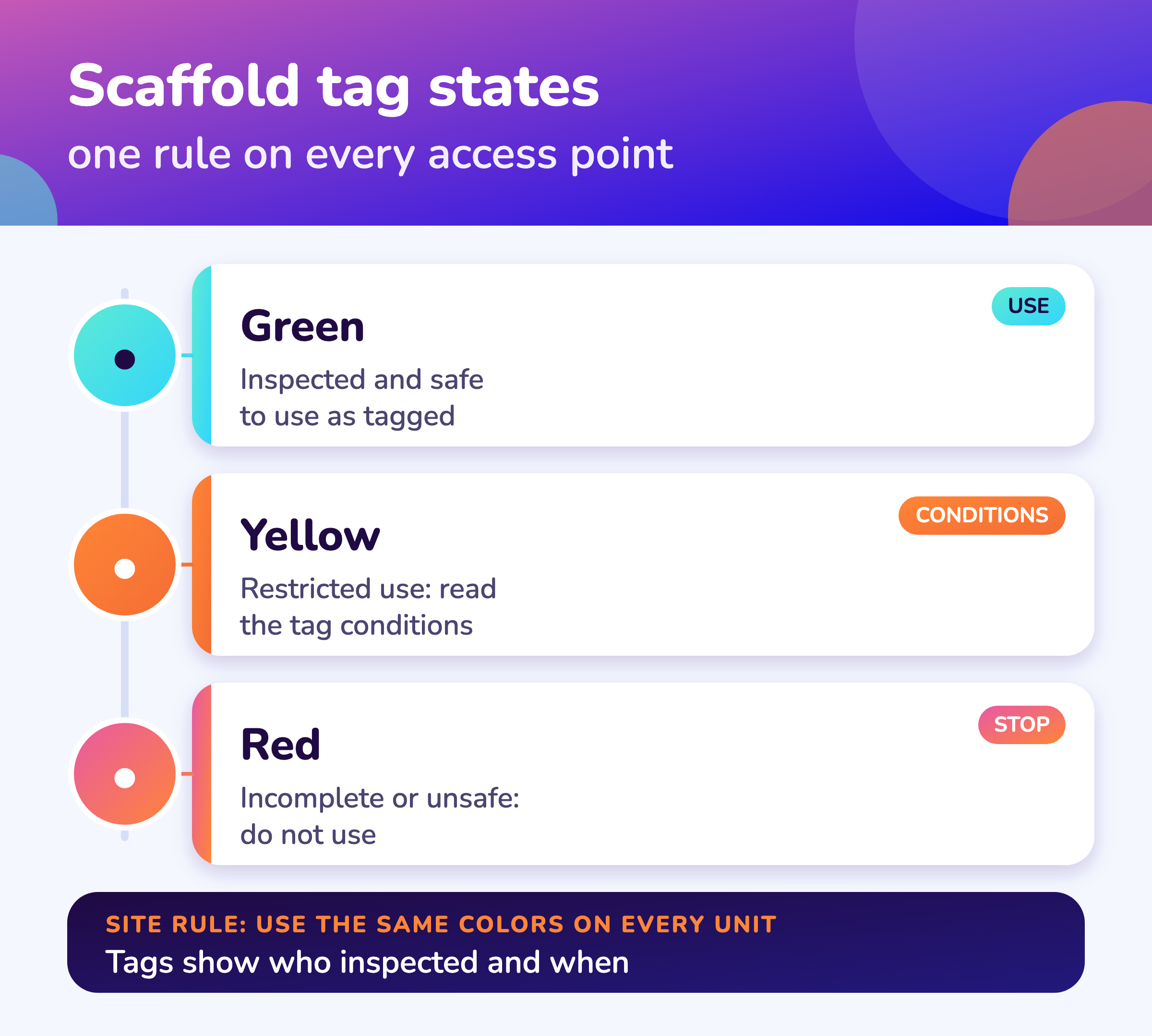
A scaffold tagging system fixes a tag at every access point that shows the inspection result by color and by name and date, so any worker can see whether the scaffold is cleared for use: green for inspected and safe, yellow for restricted conditions and red for do not use.
Green
Inspected by a competent person. Safe to use as tagged.
Yellow
Restricted use. Read and follow the conditions on the tag.
Red
Incomplete, damaged or altered. Do not use.
Tag colors and wording are a site rule, so use one system for the whole plant and brief every contractor at induction. Tags are replaced after any alteration or damage. Tag the scaffold only after the inspection, and make the tag status part of the readiness check for each job.
Options
Rope access vs scaffolding for turnaround work?
Choose rope access for short inspection or light repair at height where building a scaffold is impractical, and scaffolding for extended multi-trade work with heavier loads; either way, decide through your work at height risk assessment, not on speed alone.
| Factor | Rope access | Scaffolding |
|---|---|---|
| Best for | Short inspection or light repair at height where a scaffold is hard to build | Extended multi-trade work, heavy tools, many workers |
| Setup | Short, but needs trained rope technicians and rescue cover | Longer build and strip, with design checks for complex structures |
| Loads and materials | Light tools only | Heavier loads within the rated class |
| Interference | Small footprint | Can block other trades and routes |
| Planning note | Use only where it is the safer, justified choice under your work at height risk assessment 2 | Plan the erect and strip into the schedule |
Lead time
How long does scaffolding take for a shutdown?
Scaffold lead time is the time from request to tagged ready, and it depends on the quantity, the complexity, the crew size, material availability and permits, so set it from your own past stops and work back from each job start to find the latest request date.
Latest request date
Job start − erect days − planned lead time
Any request after this date is late by design.
Erect days
Scaffold quantity ÷ crew output × complexity
Take output from your own history, not from a rule of thumb.
Access idle hours
Crew hours waiting for access
The cost of late scaffolds. Track it daily.
Check the register against the schedule weekly. Requests that arrive during the stop are the main cause of late access.
Coordinator
What does a scaffolding coordinator do in a turnaround?
A scaffolding coordinator owns the request register, sequences erection with the schedule, resolves clashes between trades, makes sure every scaffold is inspected and tagged before use and reports late requests and access delays at the daily meeting.
- Owns the register and the needed-by dates
- Sequences erect and strip with the schedule
- Settles clashes between trades
- Checks inspection and tag before use
- Controls alterations
- Reports access delays at the daily meeting; see daily management
Visuals
Save the scaffolding planning visuals
Two visuals for the access coordinator. Click either for the full-size image.
FAQ
Frequently asked questions
Why is scaffolding on the critical path of a turnaround?
Most work at height cannot start until the scaffold is tagged, and strip-out cannot finish until the last job is signed off, so delays at either end move the finish date.
What is a scaffold request?
A logged request for one scaffold with its area, job, type, needed-by date and erect days.
How does scaffold tagging work?
A tag at each access point shows by color and by name and date whether the scaffold is cleared. Green is safe, yellow is restricted, red is do not use.
Who may alter a scaffold?
Only the scaffold crew. Any change needs a new inspection and a new tag.
How much lead time does a shutdown scaffold need?
It depends on quantity, complexity, crew and materials. Set it from your own past stops and work back from each job start.
When is rope access a better choice than scaffolding?
For short inspection or light repair at height where a scaffold is hard to build, if the work at height risk assessment supports it. 2
What does a scaffolding coordinator do?
Owns the register, sequences erection with the schedule, resolves clashes, checks tags and reports access delays.
Is there a free scaffold register?
Yes. The scaffold request register (Excel) logs requests, shows the latest request date and flags late ones.
Does MaintWiz handle scaffolding?
It keeps access needs with the work packages and checks readiness before a package starts. AI agents are part of the module. See AI shutdown planning.
Sources
Sources
This page gives planning practice. For the legal requirements on scaffolds and work at height, use the HSE pages and the rules where you work.
Plan trades and tools across every shutdown
Book a demo and bring your crew plan. We will show availability by trade and week.