
Shutdown timing
How Often Should a Plant Shut Down? Intervals
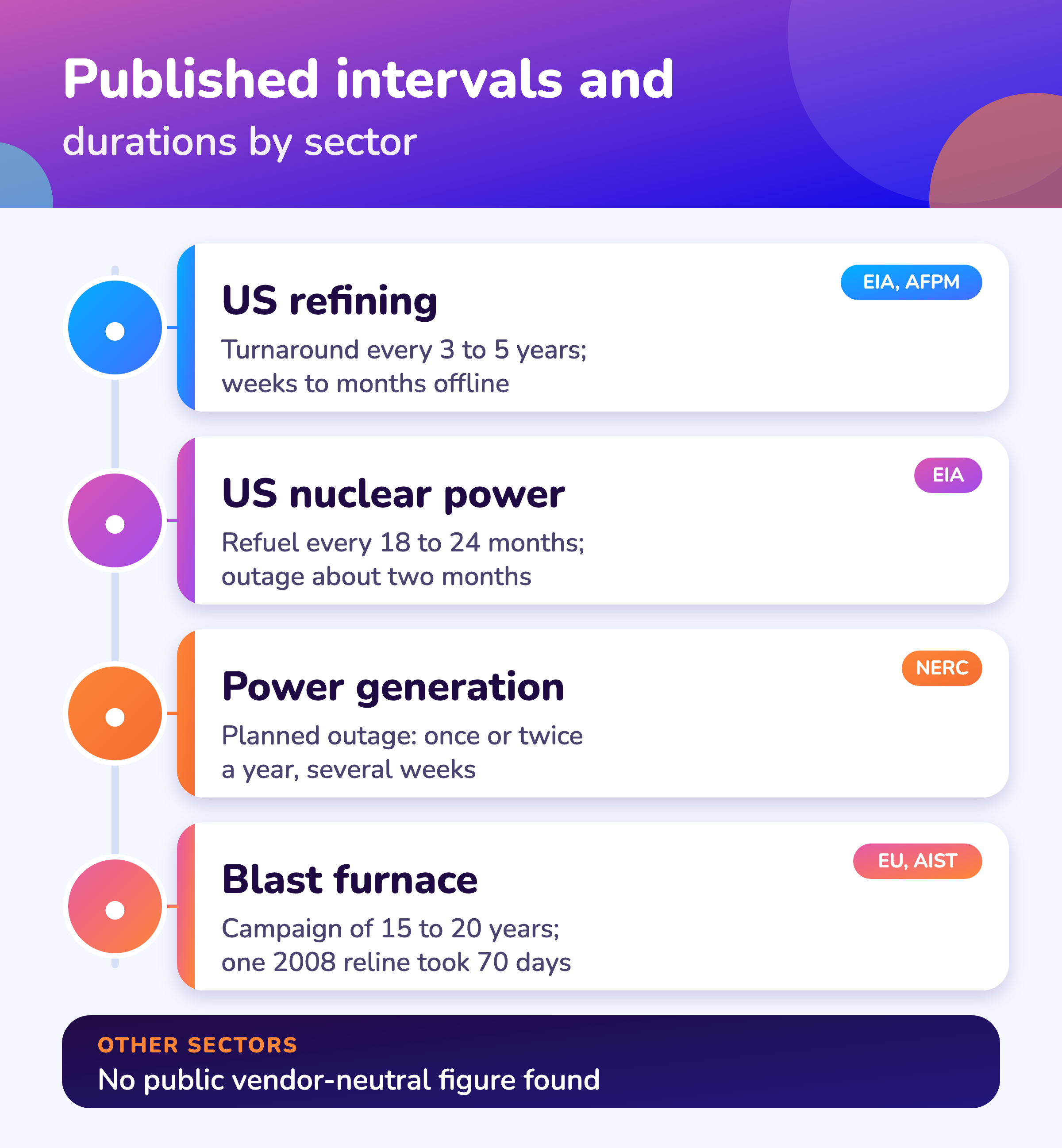
US refinery units are scheduled for turnarounds every 3 to 5 years and stay offline for several weeks to several months; US nuclear reactors refuel every 18 to 24 months, with outages that recent EIA data put at about 34 to 38 days. For most other industries there is no published interval, so intervals follow regulation, equipment condition, demand and your production calendar.
Figures are published examples from US refining and power, not benchmarks for other sectors.
How MaintWiz helps: Timing a stop means seeing blackout windows, crews and projects together. The MaintWiz shutdown module compares up to 20 concurrent projects and shows executives which one is at risk and which decisions matter most. See the module · Get the KPI dashboard
By Jai Balachandran · Published · Last reviewed
What MaintWiz adds:Health matrix, worst project firstDecisions ranked by effectUp to 20 concurrent projectsTrade and tool availability
The numbers
How often should a plant shut down, and how long does a turnaround take?
US refinery units are scheduled for turnarounds every 3 to 5 years and stay offline for several weeks to several months, while US nuclear reactors refuel every 18 to 24 months with outages that recent EIA data put at about 34 to 38 days. 1,3 For most other industries there is no published interval or duration.
For Indian boiler certificate cycles, see annual boiler shutdown in India.
- 3-5 yrsRoutine turnaround interval, key US refinery units 1
- weeks-monthsRefinery unit offline per turnaround 1,2
- 18-24 moUS reactor refueling cycle 3
- 15-20 yrsBlast furnace campaign life aimed for 6
| Sector | How often | How long | Usual window | Source |
|---|---|---|---|---|
| Refining (US) | Routine turnarounds on key units every 3 to 5 years | A unit offline for several weeks to several months, after 1 to 2 years of planning | Spring or fall | EIA, AFPM |
| Nuclear power (US) | Refueling every 18 or 24 months of full-power operation | About two months on average; as short as 10 days | Spring and fall | EIA |
| Power generation (reporting definition) | A planned outage is described as occurring once or twice a year | Several weeks, of predetermined duration | Spring and fall in New England data (2011) | NERC GADS, EIA |
| Iron and steel (blast furnace) | Campaigns of 15 to 20 years between relines are the aim | One 2008 reline took 70 days, against over 80 days in 1996 | No public figure | EU study, AIST |
| Pressure plant (statutory) | India: a boiler certificate runs for no more than 12 months (Boilers Act 2025, once in force). Great Britain: examinations follow a written scheme | No public figure | Set by the certificate or scheme date | Boilers Act 2025, HSE PSSR, HSE INDG178 |
| Cement, chemicals, pharmaceutical, food and beverage, mining, water, general manufacturing | No public, vendor-neutral benchmark found | No public, vendor-neutral benchmark found | No public, vendor-neutral benchmark found | Searched; see sources |
Read with care. Most figures come from US refining and power. Do not apply a refinery interval to a manufacturing plant’s annual shutdown.
Setting it
What sets how often a plant should shut down?
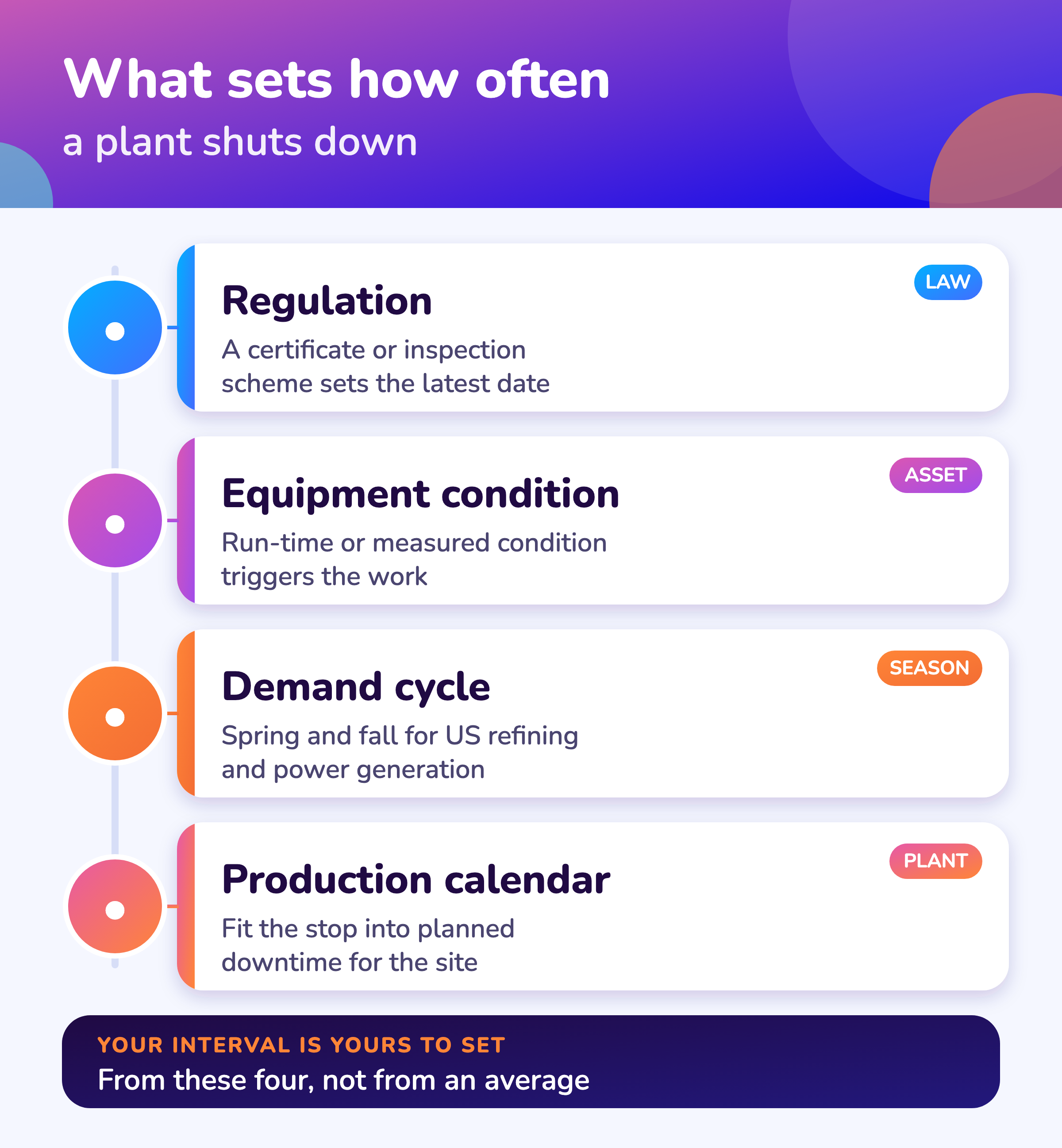
Four things set the interval: the law or an inspection scheme, the condition of the equipment, the demand cycle and the production calendar. 8,11,2
For India, see annual shutdown planning in India, which covers the statutory items under the Boilers Act, 2025 and the Factories Act. UK pressure system examination intervals come from the written scheme; see PSSR pressure systems safety regulations in the UK.
Regulation
A boiler certificate or an examination scheme fixes the latest date for the inspection. India's Boilers Act 2025 limits a certificate to 12 months in most cases and commences on a date the central government notifies. 8
Equipment condition
DOE's maintenance guidance describes time- or run-time-based preventive work and condition-based predictive work that uses measurements to detect the onset of degradation. 11
Production calendar
Plants with a seasonal or shift pattern fit the stop into planned downtime. No public figure exists for most sectors, so use your own calendar.
Calendar-based versus condition-based
| Question | Calendar or run-time based | Condition based |
|---|---|---|
| What triggers the stop? | A date or a number of operating hours | A measured condition crossing a limit |
| Strength | Simple to plan and budget; fits statutory dates | Avoids stopping equipment that is healthy |
| Weakness | May overhaul equipment that needs nothing | Needs reliable measurements and a trained analyst |
| Typical use | Pressure equipment inspections, turnaround cycles | Rotating equipment trending, with the stop timed to the finding |
The comparison is a working summary built on the DOE description of preventive and predictive maintenance, not a published table. 11
Software
How do you keep track of shutdown due dates?
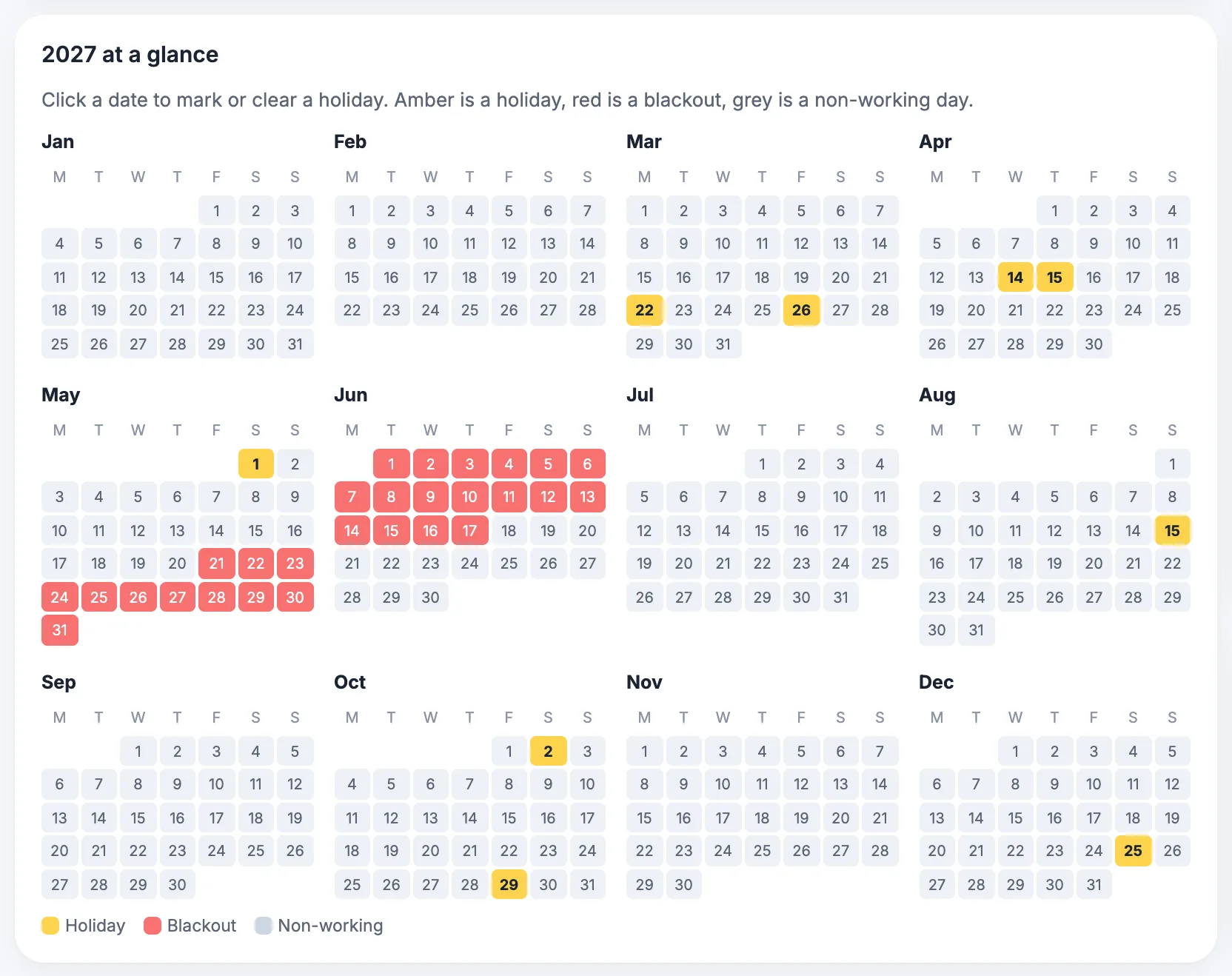
Keep statutory dates, equipment inspection intervals and planned shutdown windows in one calendar linked to the assets they cover, so the next due date and the planning start date are always visible.
About MaintWiz. MaintWiz is an industrial AI platform with IoT, SAP integration and predictive maintenance (PdM) capabilities. Its shutdown and turnaround module helps plants plan, schedule, execute and close out shutdown work.
Also: product data sheet.
What the shutdown module covers
As described on the MaintWiz shutdown maintenance product page.
- Shutdown calendar and critical-path scheduling, with work order sequencing and dependencies
- Asset prioritization, so the most critical equipment is scoped first
- Resource planning for people, spares, heavy equipment such as cranes, and outsourced vendors
- Electronic permits to work, risk management and contingency plans
- Real-time progress monitoring: schedule adherence, cost variance, quality metrics and risk factors
- Step-by-step checklists, pre-restart testing protocols and post-shutdown analysis
Proof
What MaintWiz customers report
Figures as published in MaintWiz case studies on maintwiz.com. They come from maintenance management projects, not shutdowns.
Duration
What decides how long a turnaround takes?
A turnaround lasts as long as its critical path: the longest chain of linked jobs, set by scope, the number of crews and the longest lead items. Published refinery figures run from several weeks to several months. 1,2
For a boiler-led annual stop, see the annual boiler shutdown in India. For nuclear refueling outages see nuclear refueling outage planning.
One furnace reline in 2008 was reported at a record 70 days, against over 80 days for its 1996 reline; that is one plant, not a norm. 7 See shutdown scheduling for how the critical path sets duration and shutdown scope management for why scope growth stretches it.
Calculator
How do you work out the next shutdown date?
Add your interval to the end date of the last shutdown to get the next due date, then subtract the planning lead time to get the latest date planning must begin.
All shutdown calculators are listed on the shutdown calculator tools page.
Try it: when is the next shutdown due, and when must planning start?
Enter the date of the last shutdown, the interval you use and the planning lead time. The dates are worked out in your browser; nothing is sent or stored. Your own interval and lead time come from your equipment, regulation and longest lead item.
The window
When in the year should a shutdown be scheduled?
Place the stop in the season when demand is lowest unless a regulation fixes the date: spring and fall for US refining and for generators and US reactors. 2,5,3
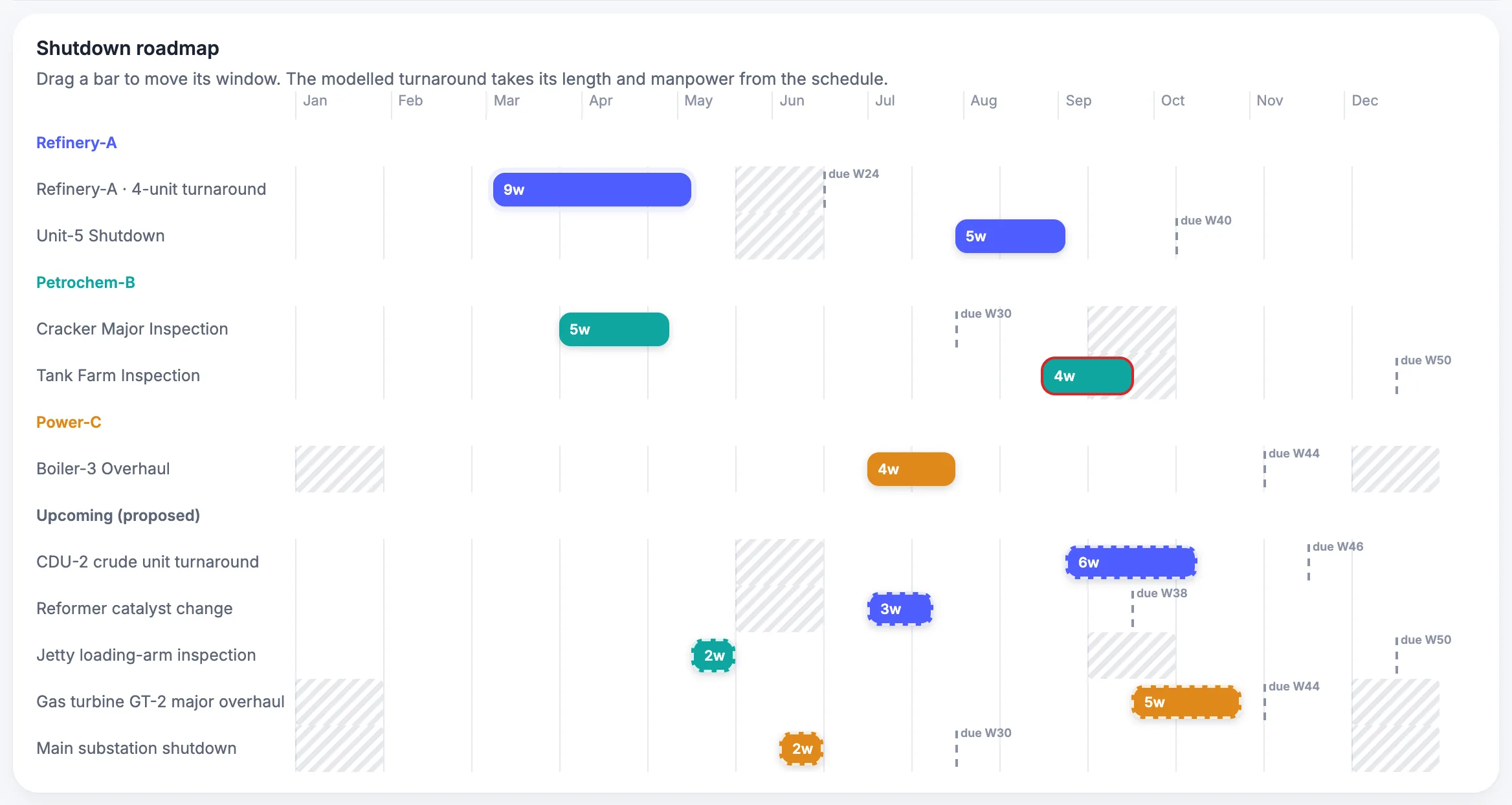
US nuclear refueling outages are usually in spring and fall; see nuclear refueling outage planning. For food plants with seasonal peaks see food and beverage plant shutdowns. For India annual boiler timing see annual boiler shutdown in India. For sugar mills the window is the off-season: sugar mill off-season maintenance planning.
In US refining the timing is tied to demand for fuels, and AFPM notes that spring and fall are typical; EIA's data for ISO New England generators and for US nuclear plants show the same pattern. 2,5,3 Where a regulation sets a certificate date, the window is fixed and the scope is built around it; see types of plant shutdowns. Lead times for turnarounds are covered in how to plan a plant shutdown.
Visuals
Save the timing charts
Two charts to pin up when you set next year's calendar. Click either for the full-size image.
FAQ
Frequently asked questions
How often should a plant shut down?
For key units in US refineries EIA describes routine turnarounds every 3 to 5 years; US reactors refuel every 18 to 24 months. For most other industries there is no published interval, and the interval follows regulation, equipment condition, demand and the production calendar. 1,3
How long does a turnaround take?
In US refining a unit can be offline for several weeks to several months. A US reactor refueling outage recently averaged 34 to 38 days and can be as short as 10 days. 1,2,3
How far in advance is a turnaround planned?
EIA says refinery turnarounds may involve 1 to 2 years of advance planning. 1 See the planning guide for smaller shutdowns.
When is the best time of year for a shutdown?
Refiners and generators schedule stops in spring and fall to avoid peak demand, per AFPM and EIA. A regulation may fix the date instead. 2,5
How often must a boiler be inspected in India?
The Boilers Act 2025 provides that a certificate authorizes use for no more than 12 months in most cases (section 12(6)). It commences on a date the central government notifies, so check its status. 8
What is the difference between calendar-based and condition-based intervals?
Calendar or run-time based work is done at a set time or number of hours; condition-based work is triggered by measurements that detect the onset of degradation. 11
Is a blast furnace reline a shutdown?
Yes. Operators aim for campaigns of 15 to 20 years between relines, and one 2008 reline was reported at 70 days of downtime. 6,7
Is there an industry average shutdown frequency for manufacturing?
There is no published figure for general manufacturing, cement, chemicals, pharmaceutical, food and beverage, mining or water. Use your own history and your equipment makers' guidance.
Sources
Sources
- U.S. Energy Information Administration, Refinery Outages: Description and Potential Impact on Petroleum Product Prices
- American Fuel & Petrochemical Manufacturers, Refinery turnarounds 101: What are turnarounds and why do we need them? (17 October 2023)
- U.S. Energy Information Administration, Nuclear power plants undergo seasonal scheduled outages (23 May 2011)
- North American Electric Reliability Corporation, Generating Availability Data System (GADS) Data Reporting Instructions, effective 1 January 2026
- U.S. Energy Information Administration, Seasonal maintenance helps keep power online during summer and winter peaks (22 April 2011; ISO New England data)
- Publications Office of the European Union, An in-depth study into prolonging blast furnace campaign life (2001)
- Association for Iron & Steel Technology, ThyssenKrupp Steel to Restart Blast Furnace 1 at Duisburg-Schwelgern (20 March 2008)
- Government of India, The Boilers Act, 2025 (Act No. 12 of 2025), Gazette text as published by PRS India
- UK Health and Safety Executive, Pressure Systems Safety Regulations 2000 (PSSR)
- UK Health and Safety Executive, Written schemes of examination (INDG178, rev 2, 2012)
- U.S. Department of Energy FEMP / Pacific Northwest National Laboratory, O&M Best Practices: Maintenance Approaches
See which shutdown is at risk today
Book a demo and tell us how many shutdowns you run at once. We will show the portfolio and executive views.