
Calculators
Shutdown Calculators: Delay, Scope, KPIs and Time on Tools
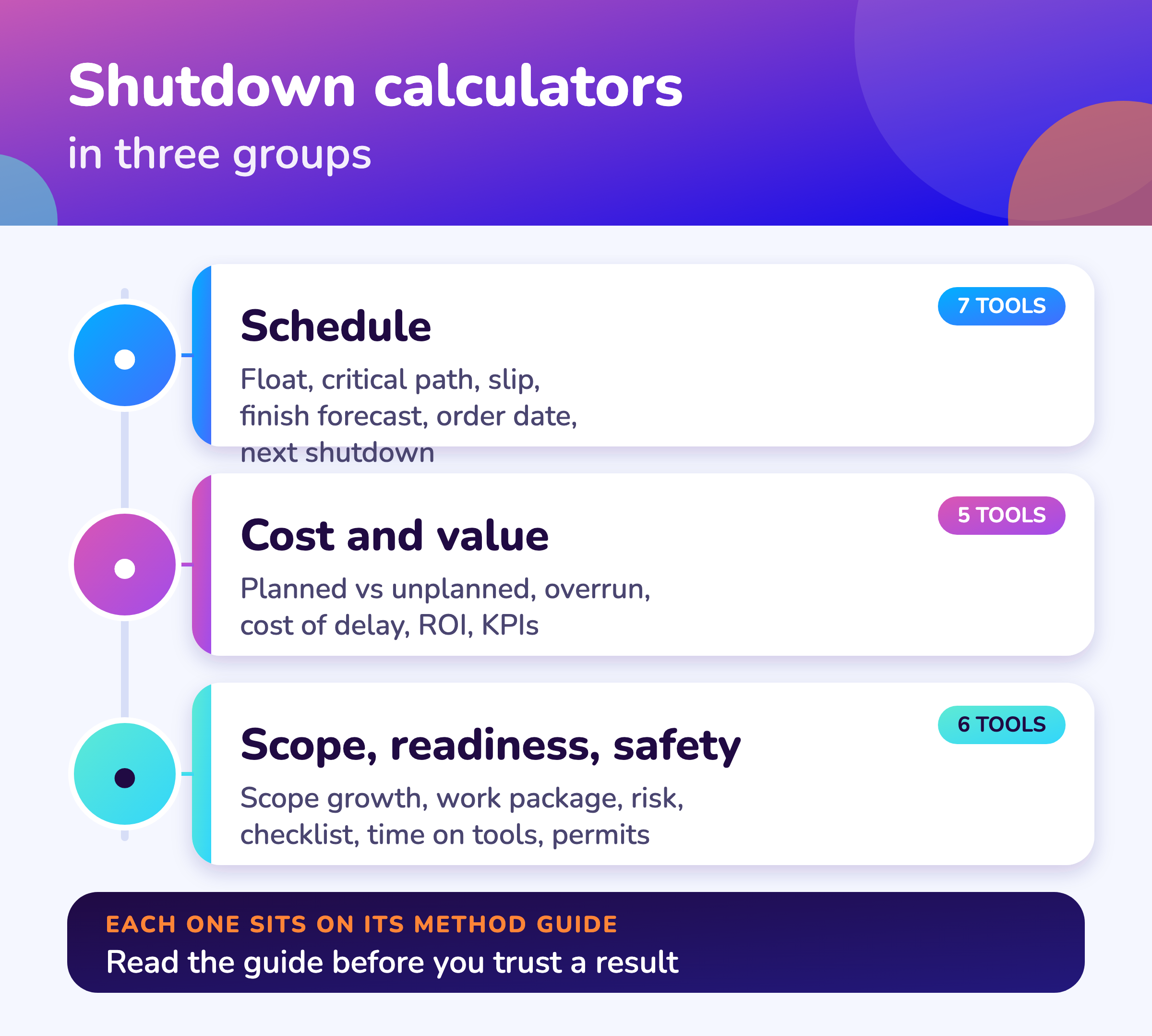
This page lists the 18 free shutdown calculators on MaintWiz guides, grouped by schedule, cost and value, and scope, readiness and safety. Each runs in your browser on your own numbers and sits on the guide that explains its method.
Starting values in every calculator are invented placeholders. Nothing you enter is sent or stored.
How MaintWiz helps: Calculators answer one question; a live plan answers them all. The MaintWiz shutdown module puts the whole shutdown on a Gantt chart with the critical path, float and baselines, so you can see what moves the finish date. See the module · Get the Gantt template
By Jai Balachandran · Published · Last reviewed
What MaintWiz adds:Gantt with critical path and floatBaselines show what movedFloat flag at your limitOne plan from portfolio to task
Schedule
Which shutdown schedule calculators are there?
The schedule calculators work out float, the critical path, the effect of a slip, the finish forecast, the backward plan from a start date, the latest order date for a part and the next shutdown date.
Schedule terms follow the US GAO schedule guide: float is how long an activity can slip without delaying a later date, and the critical path is the longest continuous sequence of activities. 1
| Calculator | You enter | Result shown | Where it lives |
|---|---|---|---|
| Compute total float | Early start (day); Duration (days); Late finish (day) | Early finish; Late start; Total float; Status | Parent guide |
| Change a duration and watch the critical path move | The activity durations of the worked example (editable) | Job duration, days; Zero-float activities | Parent guide |
| How far does one late job move the finish? | Total float of the job, days; Slip of the job, days | Delay to the finish date, days; Float left, days; Status | Parent guide |
| Forecast the finish from today's progress | Planned duration, days; Planned progress today, %; Actual progress today, % | Progress variance, points; Progress ratio (actual / planned); Forecast duration, days; Days late at this pace | Parent guide |
| Put your start date into the backward plan | Shutdown start date; Scope approved: weeks before start; Plan and schedule baselined: weeks before start; Scope frozen: weeks before start; Readiness review: weeks before start | Scope approved; Plan and schedule baselined; Scope frozen; Readiness review | Parent guide |
| When is the latest order date? | Shutdown start date; Supplier lead time, weeks; Transit and customs, days; Inspection and buffer, days | Total lead time, days; Latest order date | Parent guide |
| When is the next shutdown due, and when must planning start? | Last shutdown ended; Interval, months; Planning lead time, months | Next shutdown due; Planning should start by | Parent guide |
Cost and value
Which shutdown cost calculators are there?
The cost calculators compare planned and unplanned cost, overrun against contingency, the cost of delay, program ROI and the shutdown KPIs.
The cost calculators use the standard definitions of earned value measures where they apply. 2 Every starting value is an invented placeholder: replace it with your own figures.
| Calculator | You enter | Result shown | Where it lives |
|---|---|---|---|
| Planned versus unplanned cost of the same job | Margin lost per hour; Planned downtime, hours; Unplanned downtime, hours; Repair cost if planned; Repair cost if unplanned; Premiums and expedite cost if unplanned | Planned total; Unplanned total; Difference; Unplanned as a share of planned | Parent guide |
| Overrun and contingency used | Baseline budget (excluding contingency); Contingency held; Forecast or final cost | Overrun against baseline; Against authorized budget (baseline + contingency); Contingency used | Parent guide |
| Cost of delay | Lost margin per day; Crews and equipment kept on site, per day; Site services that continue, per day; Days of delay | Cost of one extra day; Cost of the delay | Parent guide |
| A worked ROI with your own numbers | Days of downtime avoided; Value of one production day; Other yearly benefits (rework, overtime, parts); Total program cost for the year | Yearly benefit; Net benefit; ROI; Payback | Parent guide |
| Shutdown KPI calculator | Budget at completion (BAC); Planned value to date (BCWS); Earned value to date (BCWP); Actual cost to date (ACWP); Planned duration, days; Actual or forecast duration, days | Cost variance; Cost performance index; Schedule variance; Schedule performance index; Estimate at completion; Duration variance; Scope growth; Recordable injury rate | Parent guide |
Software
When is a calculator not enough?
A calculator answers one question from numbers you type; a shutdown module keeps the schedule, cost, permits and spares as live records, so the answers update as the work does.
About MaintWiz. MaintWiz is an industrial AI platform with IoT, SAP integration and predictive maintenance (PdM) capabilities. Its shutdown and turnaround module helps plants plan, schedule, execute and close out shutdown work.
What the shutdown module covers
As described on the MaintWiz shutdown maintenance product page.
- Calculators on this page are free tools, not part of the shutdown module
- The module computes the critical path, float and baselines from your real schedule
- Earned value: planned, earned and actual cost with the cost and schedule indices
- Spares status with the SAP request or order behind each short part
- Reports and the tables behind the charts export to Excel
Proof
What MaintWiz customers report
Figures as published in MaintWiz case studies on maintwiz.com. They come from maintenance management projects, not shutdowns.
Scope, readiness and safety
Which scope, readiness and safety calculators are there?
These calculators measure scope growth, work package readiness, risk score, checklist progress, time on tools and the permit issuers needed on a peak day.
| Calculator | You enter | Result shown | Where it lives |
|---|---|---|---|
| Scope growth by source | Frozen scope; Emergent work added; Discovery work added; Approved late requests; Work removed or deferred | Final scope; Net scope growth; Share from discovery; Share from late requests | Parent guide |
| Is your work package ready? | Ticks against ten readiness tests | Ready items; Verdict | Parent guide |
| Score a risk | Likelihood; Severity | Score; Band | Parent guide |
| How far along is your checklist? | Ticks against the 40 steps | Steps closed; Phase 1; Phase 2; Phase 3; Phase 4; Phase 5 | Parent guide |
| Time on tools | Hours on site; Waiting for permits or isolations; Waiting for materials or tools; Travel, gear-up and breaks beyond plan; Other lost hours | Hands-on hours; Time on tools; Largest loss | Parent guide |
| How many permit issuers do the peak days need? | Permits on a peak day; Issuer minutes per permit (issue, checks, close); Productive minutes per issuer per shift | Issuer hours needed; Issuers needed | Parent guide |
Using them
How do the shutdown calculators work and what are their limits?
Each shutdown calculator runs in your browser on the numbers you enter, starts with invented placeholder values and sits on the guide that explains its method, so read the guide before you rely on a result.
More free tools are listed in free shutdown planning tools.
| Question | Answer |
|---|---|
| Is my data uploaded? | No. Each calculator runs in your browser; nothing is sent or stored |
| Are the starting numbers real? | No. They are invented placeholders from a worked example; replace them with your own |
| Where is the logic? | On the parent guide, next to the method it supports; this page does not duplicate it |
| Can I trust a result? | It is only as good as your inputs; read the caution on the parent guide, and check the sources it cites |
For a tool that turns a task list into a Gantt chart with a critical path, see the Excel to Gantt tool.
Definitions
Which definitions do the shutdown calculators use?
The calculators use public definitions: critical path and float from the HHS and GAO guides, the earned value measures from the HHS and GAO glossaries and guides, and the injury rate from the US Bureau of Labor Statistics. 3,1,2,4
| Measure | Definition | Source |
|---|---|---|
| Critical path | The path through a network of dependent tasks with the longest elapsed time; it sets the shortest possible duration | HHS earned value glossary |
| Float | The time an activity can slip without delaying a later date; float is not contingency | GAO schedule guide |
| Cost variance and cost performance index | CV is earned value minus actual cost; CPI is earned value divided by actual cost | HHS earned value glossary |
| Schedule variance and schedule performance index | SV is earned value minus planned value; SPI is earned value divided by planned value | HHS earned value glossary |
| Estimate at completion | Actual cost to date plus the current estimate to complete; the GAO guide gives EAC = ACWP + (BAC - BCWP) / efficiency index | HHS earned value glossary, GAO cost guide |
| Recordable injury (incidence) rate | Cases x 200,000 / hours worked (BLS example: 7 cases in 400,000 hours = 3.5) | BLS incidence rate |
Check the source for the full definition. The time-on-tools, scope growth and permit issuer calculations are working methods explained on their guides, not published standards.
Visuals
Save the calculator charts
Two charts to share with your team. Click either for the full-size image.

FAQ
Frequently asked questions
How do I calculate the cost of one extra shutdown day?
Use the cost of delay calculator on the budget guide: enter your own daily figures; the starting values are invented.
How do I calculate time on tools?
Use the time on tools calculator on the contractor guide: hours on site and hours lost to waiting.
How do I calculate the latest order date for a long-lead part?
Use the latest order date calculator on the spare parts guide: shutdown start date and the supplier lead time.
How do I calculate scope growth?
Use the scope growth calculator on the scope guide: the frozen scope and what was added or removed after.
How do I calculate the next shutdown date?
Use the next shutdown calculator on the timing guide: the last shutdown date, the interval and the planning lead time.
How many permit issuers do I need?
Use the permit issuer calculator on the permit guide: permits on a peak day and the time each takes.
Is my data uploaded?
No. The calculators run in your browser; nothing is sent or stored.
How many calculators are there?
18 across the shutdown guides, grouped above.
Sources
Sources
The scheduling terms come from the US GAO schedule guide and the earned value definitions from the GAO cost guide. The inputs and starting results listed for each calculator are read from the calculator itself on its guide page.
- US Government Accountability Office, GAO Schedule Assessment Guide: Best Practices for Project Schedules (GAO-16-89G, December 2015)
- US Government Accountability Office, GAO Cost Estimating and Assessment Guide (GAO-20-195G, March 2020)
- US Department of Health and Human Services, Earned Value Management, Appendix D: Glossary of Terms
- US Bureau of Labor Statistics, How to compute your firm's incidence rate for safety management
Put your shutdown schedule in one plan
Book a demo and bring your shutdown schedule. We will show how the module handles the critical path, float and baselines.