
Shutdown materials
Shutdown Spare Parts Planning: Long-Lead Items and Kitting
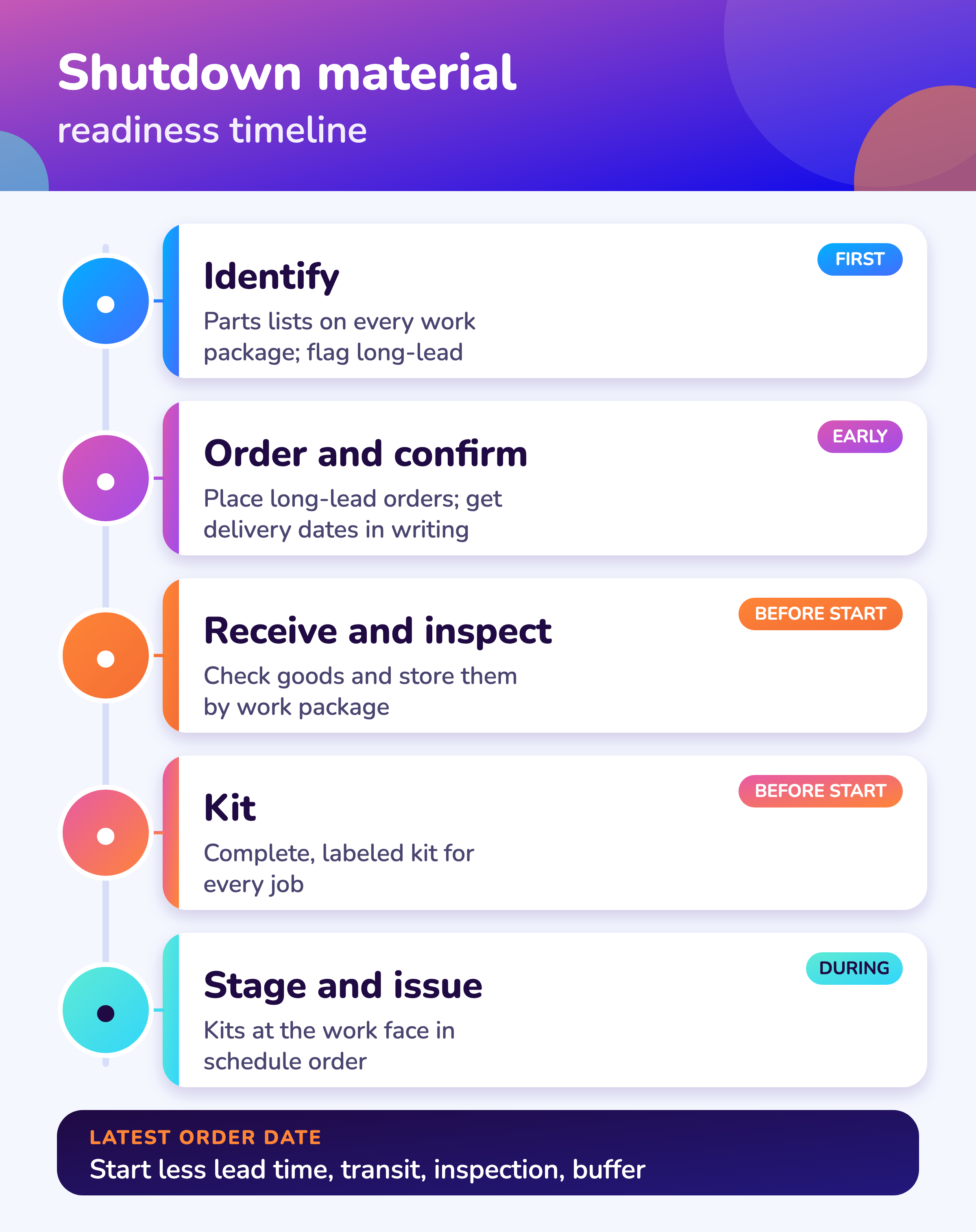
Plan shutdown spare parts by listing the materials each job needs, ordering the long-lead items first, confirming delivery in writing, and kitting every job before the stop. The latest order date is the start date less supplier lead time, transit, inspection time and a buffer.
A critical spare is a part of especially high value, long lead time or both (DOE glossary).
How MaintWiz helps: Late parts stop jobs that were ready to start. The MaintWiz shutdown module shows each short part with the SAP request or purchase order behind it, so shortages surface before the job starts. See the module · Get the long-lead tracker
By Jai Balachandran · Published · Last reviewed
What MaintWiz adds:Needed, in stock and shortSAP request or order behind each partResource master from ExcelData table with CSV export
Terms
What are long-lead items and critical spares?
A critical spare is a part with especially high value, a long lead time or both, and a long-lead item for a shutdown is anything that cannot arrive before the stop unless it is ordered now. 1
SAP status of each short part is described in SAP MM shutdown materials.
GAO describes a resource-loaded schedule as one that assigns all required labor and significant materials, equipment and other costs to activities and compares them with what is available. 2 Material planning is that comparison done for parts: each job in the plan carries the materials it needs, and the schedule shows whether they will be there.
Critical spares
DOE's O&M glossary describes critical spares as spare parts of especially high value, long lead time, or both. 1
Long-lead items
Any material or service whose order-to-delivery time is longer than the time left before the shutdown starts. This is a working definition; it depends on your date, not on the part.
Kits
All the parts, consumables and special tools for one job, gathered, labeled with the work order and staged near the work face.
Consumables
Gaskets, bolts, lubricants and similar low-cost items. They are cheap but a missing one can hold a job as surely as a missing pump.
Timeline
When must materials be ordered, received and kitted?
Work backward from the shutdown start date: the latest order date is the start date less supplier lead time, transit, inspection time and a buffer. For large refinery turnarounds EIA describes 1 to 2 years of advance planning, which is why long-lead items are identified first. 3
Backward plans can be checked in the Excel to Gantt tool. A free Excel version is available: Long-lead items tracker (.xlsx). Catalyst is a long-lead item with its own lead-time check in catalyst change-out and fired heater turnaround planning.
| Gate | What happens | Who owns it |
|---|---|---|
| Identify | Each work package lists parts, consumables and special tools; long-lead items are flagged | Planner |
| Order long-lead items | Purchase orders placed in time for delivery plus inspection and a buffer | Materials and purchasing |
| Confirm | Suppliers confirm delivery dates in writing; slipping dates are escalated | Materials |
| Receive and inspect | Goods checked against the order, certificates filed, stored by work package | Stores |
| Kit | Complete kits assembled and labeled per job | Stores and planner |
| Stage and issue | Kits moved near the work face in the order the schedule needs them | Materials and supervisors |
Software
Can software help with shutdown materials?
Software can attach parts lists to work orders, show on one screen which jobs are waiting on materials and tie that to the schedule, so a missing part is visible weeks before it stops a job.
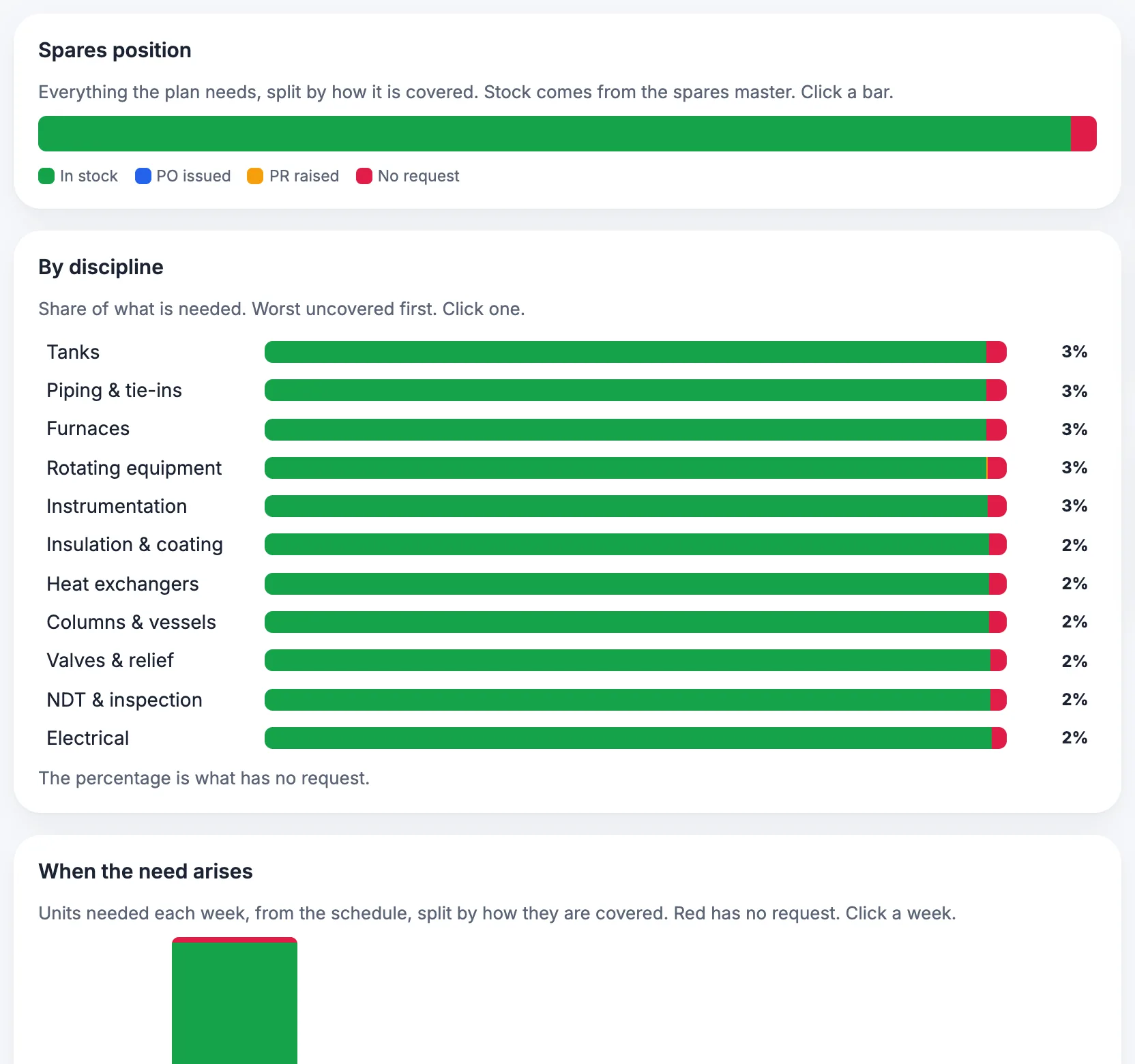
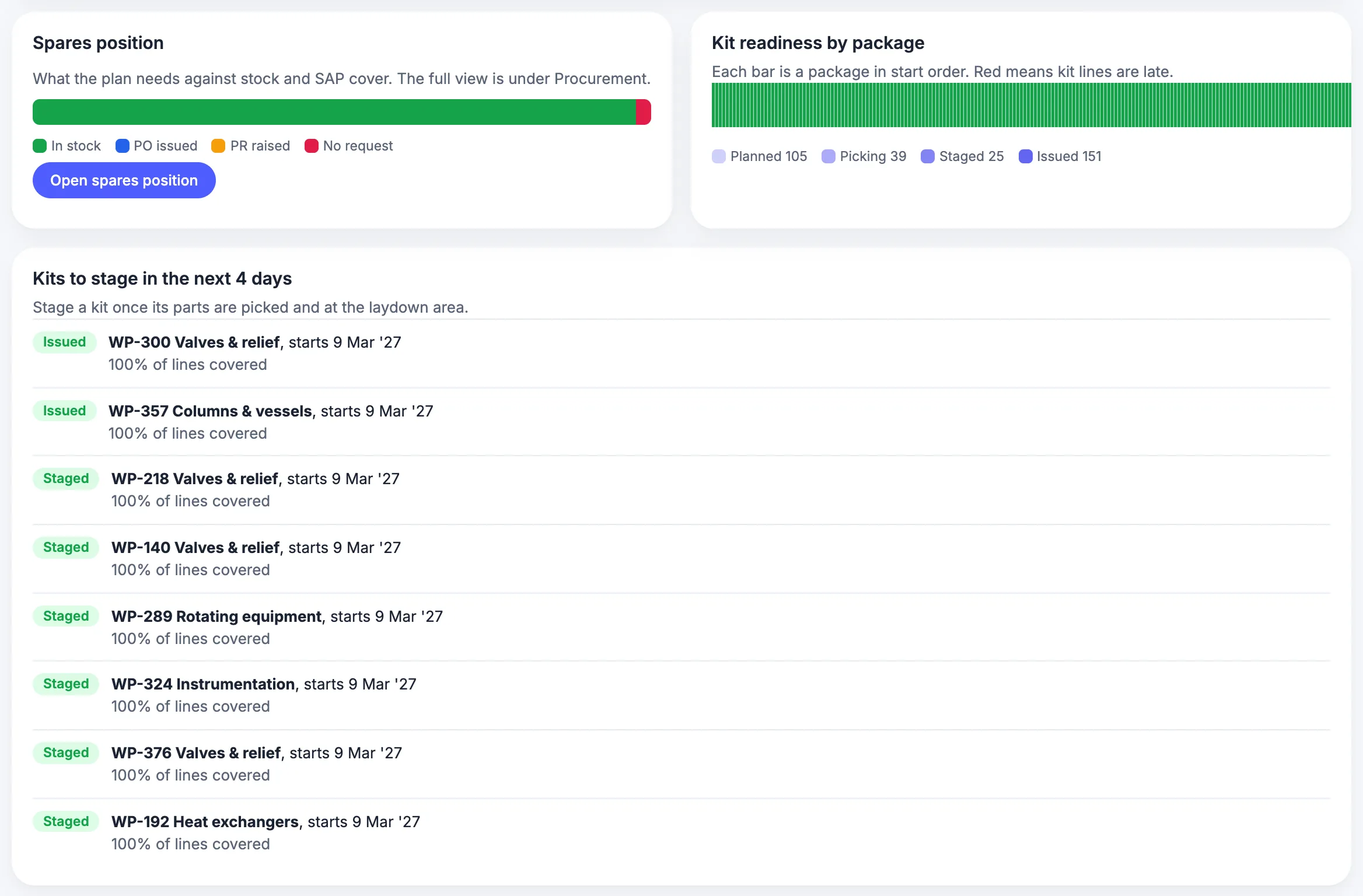
Spares status and SAP request or order status are described in the shutdown module data sheet. Questions about SAP status and spares are in the shutdown module FAQ.
About MaintWiz. MaintWiz is an industrial AI platform with IoT, SAP integration and predictive maintenance (PdM) capabilities. Its shutdown and turnaround module helps plants plan, schedule, execute and close out shutdown work.
Also: product data sheet.
What the shutdown module covers
As described on the MaintWiz shutdown maintenance product page.
- Shutdown calendar and critical-path scheduling, with work order sequencing and dependencies
- Asset prioritization, so the most critical equipment is scoped first
- Resource planning for people, spares, heavy equipment such as cranes, and outsourced vendors
- Electronic permits to work, risk management and contingency plans
- Real-time progress monitoring: schedule adherence, cost variance, quality metrics and risk factors
- Step-by-step checklists, pre-restart testing protocols and post-shutdown analysis
Proof
What MaintWiz customers report
Figures as published in MaintWiz case studies on maintwiz.com. They come from maintenance management projects, not shutdowns.
Calculator
How do you work out the latest order date?
Add the supplier lead time, transit and customs time, and inspection and buffer days, then subtract the total from the shutdown start date.
More tools are on the shutdown calculator tools page.
Try it: when is the latest order date?
Enter the shutdown start date and the supplier's quoted lead time. The date is worked out in your browser; nothing is sent or stored. Use your own supplier lead times and buffers.
Readiness
How do you measure material readiness?
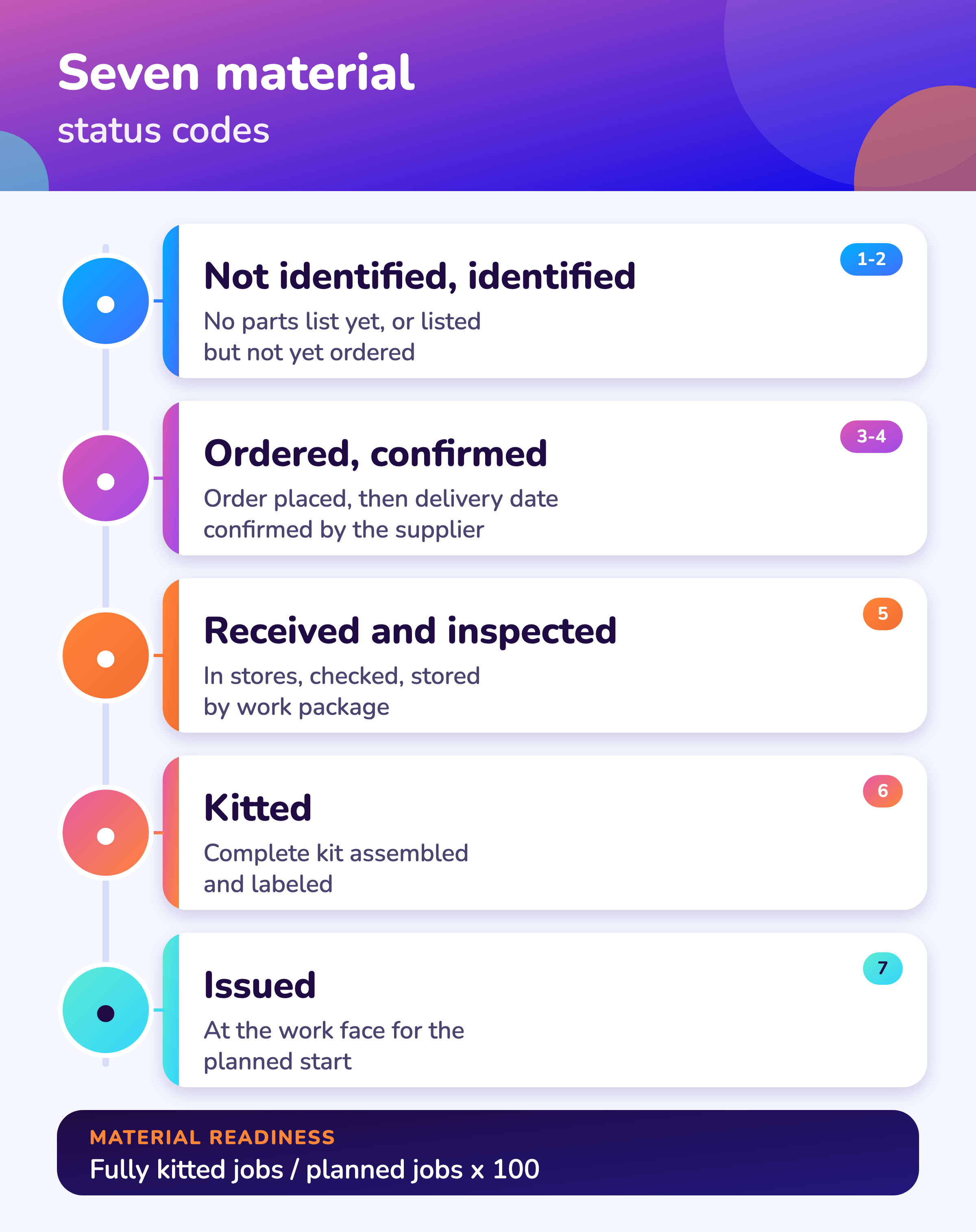
Material readiness is the share of planned jobs whose kits are complete: jobs fully kitted divided by jobs planned for the period, times 100. With 164 of 200 jobs kitted, readiness is 82 percent. The numbers are made up and the measure is a working definition.
| Status | Meaning |
|---|---|
| Not identified | The job has no confirmed parts list |
| Identified | Parts listed; not yet ordered |
| Ordered | Purchase order placed, delivery date unconfirmed |
| Confirmed | Supplier has confirmed a delivery date that meets the need |
| Received and inspected | In stores, checked and stored by work package |
| Kitted | Complete kit assembled and labeled |
| Issued | At the work face for the planned start |
Track readiness weekly in the run-up and daily in the last week, and report only fully complete kits as ready. The work packages that carry the parts lists are covered in work package optimization.
Late work
How do you handle materials for work found late?
Plan for it before the stop: agree which common parts and consumables can be drawn quickly, set the rule for ordering anything with a longer lead time, and put the cost against contingency through a change request. NERC treats work found during the outage as discovery work outside the original scope, so its materials are unplanned by definition. 4
For the cost effect of late parts, see why shutdowns go over budget.
The decision rule is in shutdown execution and scope control in shutdown scope management.
SAP
How does SAP create reservations and requisitions for shutdown parts?
In SAP Plant Maintenance the system generates a reservation for stock material and a purchase requisition for external procurement from the order components, at order creation or at release, so shutdown parts demand follows the work orders you plan. 5
For how SAP PM creates the demand see SAP MM shutdown materials.
| Step | What SAP Plant Maintenance does | Source |
|---|---|---|
| Order components | Components are entered on the maintenance order | SAP Library |
| Reservation or requisition | The system generates a reservation for stock material and a purchase requisition for external procurement from the components; neither can be created individually in Plant Maintenance | SAP Library |
| When | If the generation indicator is not set at creation, they are generated when the order is released | SAP Library |
The source is an older SAP library release (release not stated); check your own system and release.
Visuals
Save the materials charts
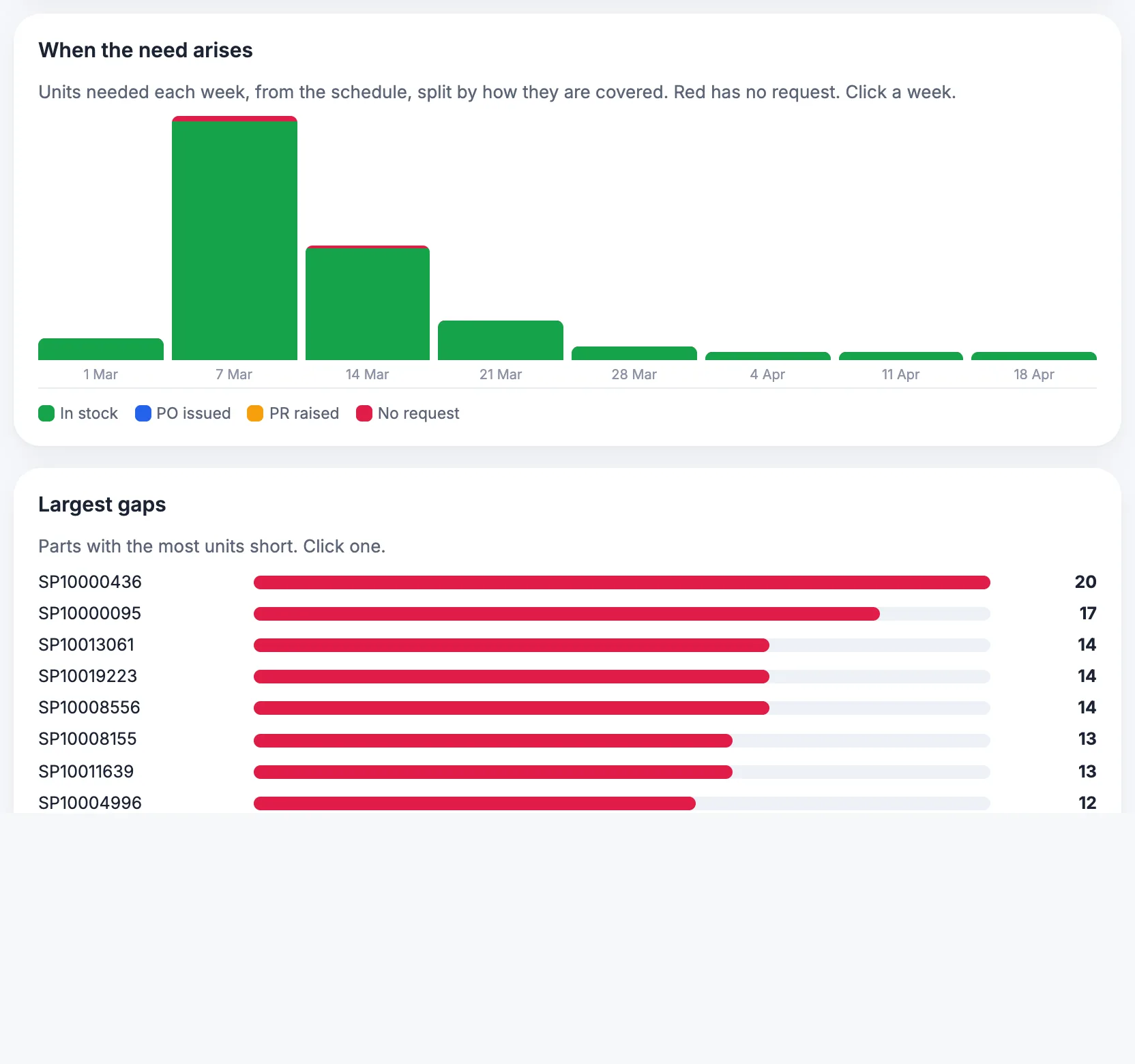
Two charts for the stores and planning offices. Click either to open it full size.
FAQ
Frequently asked questions
What are long-lead items in a shutdown?
Materials or services whose order-to-delivery time is longer than the time left before the shutdown starts. DOE's glossary describes critical spares as parts of especially high value, long lead time, or both. 1
When should shutdown materials be ordered?
Work backward from the start date: supplier lead time plus transit, inspection and a buffer. For large refinery turnarounds EIA describes 1 to 2 years of advance planning, so long-lead items come first. 3
What is kitting?
Gathering all the parts, consumables and special tools for one job, labeling them with the work order and staging them near the work face.
How do you measure material readiness?
Jobs fully kitted divided by jobs planned for the period, times 100. For example 164 of 200 is 82 percent. This is a working definition, not a standard.
What is a critical spare?
A spare part with especially high value, a long lead time or both, usually carried in stock to limit downtime after a breakdown. 1
How do you plan materials for emergent work?
Agree beforehand which common parts can be drawn quickly and how longer-lead orders are approved. NERC treats work found during an outage as discovery work outside the original scope. 4
What does a resource-loaded schedule include?
GAO says it assigns all required labor and significant materials, equipment and other costs to activities and compares them with what is available. 2
Is there a benchmark for shutdown material readiness?
There is no published benchmark. Track your own readiness against the same definition from shutdown to shutdown.
Sources
Sources
- US Department of Energy FEMP / Pacific Northwest National Laboratory, O&M Best Practices: Glossary
- US Government Accountability Office, GAO Schedule Assessment Guide: Best Practices for Project Schedules (GAO-16-89G, December 2015)
- U.S. Energy Information Administration, Refinery Outages: Description and Potential Impact on Petroleum Product Prices
- North American Electric Reliability Corporation, Generating Availability Data System (GADS) Data Reporting Instructions, effective 1 January 2026
- SAP Library, Materials Planning (Customer Service and Plant Maintenance; older release, no release stated)
Know which parts are short before the job starts
Book a demo and bring your parts list. We will show spares status and the SAP request or order behind each short part.