
Glossary
Shutdown Turnaround Glossary: Sourced Terms A to Z
This glossary defines 49 shutdown, turnaround and outage terms, each paraphrased from a named regulator, government body or standards source. Terms with no authoritative source, such as TAR and linestop, are listed as gaps instead of being defined.
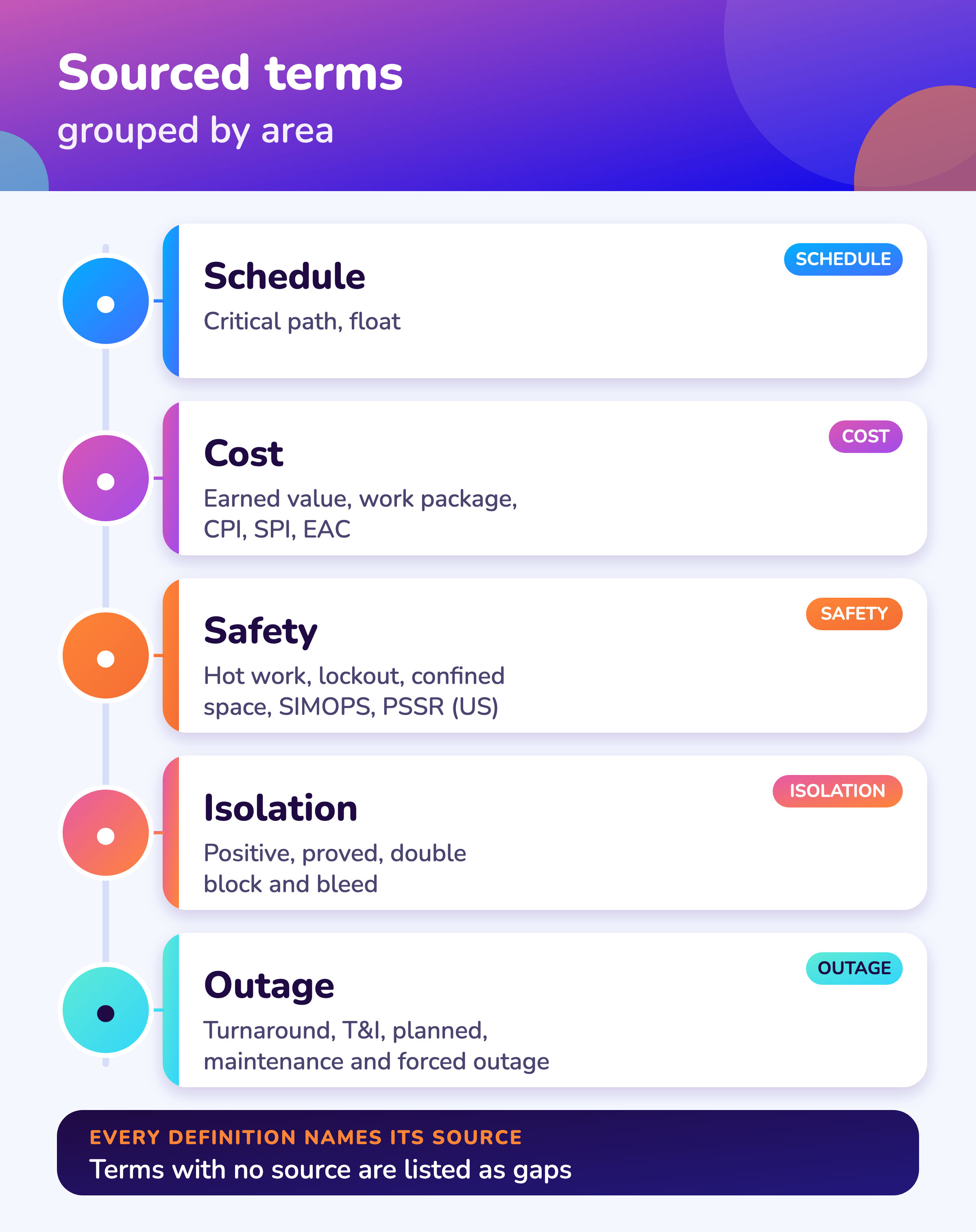
Every definition names its source. Definitions apply in the country and process the source covers.
How MaintWiz helps: Shared terms help, and a shared plan helps more. The MaintWiz shutdown module moves the plan from spreadsheets into one system with a critical path, readiness gates, permits and spares status. See the module · Get the 40-step checklist
By Jai Balachandran · Published · Last reviewed
What MaintWiz adds:Critical path and floatReadiness gatesPermits and isolationsSpares status with SAP
A to Z
What do the main shutdown and turnaround terms mean?
This glossary defines 49 shutdown and turnaround terms, each paraphrased from a named regulator, government body or standard, so a definition here is only as strong as the source shown beside it. 2,1,5
The HSE isolation categories are explained in HSG253 safe isolation for shutdowns, and the UK PSSR in PSSR pressure systems safety regulations in the UK. T&I is explained in T&I turnaround and inspection planning. A free Excel version is available: Sourced glossary (.xlsx).
Jump to: A B C D E F H L M O P R S T W
| Term | Area | Definition | Source |
|---|---|---|---|
| Actual cost | Cost | The costs actually incurred and recorded in accomplishing the work performed in a given time period. | HHS earned value glossary |
| Affected employee | Safety | An employee whose job requires them to operate or use equipment on which servicing is done under lockout or tagout, or to work in an area where it is done. | OSHA 1910.147 |
| API 510, 570 and 653 | Inspection | API inspection codes: 510 for in-service pressure vessels (inspection, repair, alteration and rerating), 570 for in-service piping, and 653 for steel aboveground storage tanks built to API 650 or API 12C. The edition that applies depends on what the owner or jurisdiction has adopted. | API 510 summary, API 570, API 653 summary |
| Authorized employee | Safety | A person who locks out or tags out machines or equipment to perform servicing or maintenance on it. | OSHA 1910.147 |
| Budget at completion | Cost | The total budget planned to accomplish the work of a work package or project. | HHS earned value glossary |
| Catastrophic release | Safety | A major uncontrolled emission, fire or explosion involving one or more highly hazardous chemicals that presents serious danger to employees in the workplace. | OSHA 1910.119 |
| Confined space | Safety | A space large enough for an employee to enter and work in, with limited or restricted means of entry or exit, that is not designed for continuous occupancy. | OSHA 1910.146 |
| Control account | Cost | A management control point at which budgets and actual costs are accumulated and compared with earned value; it may contain several work packages. | HHS earned value glossary |
| Cost performance index (CPI) | Cost | Cost efficiency of work accomplished: earned value divided by actual cost. | HHS earned value glossary |
| Cost variance (CV) | Cost | Earned value minus actual cost; positive is favorable and negative unfavorable. | HHS earned value glossary |
| Critical path | Schedule | The path through a network of dependent tasks with the longest elapsed time, which determines the shortest possible duration of the project; any delay to a task on it delays the finish by the same amount. | HHS earned value glossary, GAO schedule guide |
| Discovery work | Scope | Work found during an outage that was not in the original scope; in NERC reporting, discovery work and re-work that keep a unit out of service beyond the estimated end date are not part of the original scope of work. | NERC GADS |
| Double block and bleed | Isolation | Closure of a line by closing and locking or tagging two in-line valves and opening and locking or tagging a drain or vent valve between them. | OSHA 1910.146 |
| Earned value (EV) | Cost | A measure of completed work equal to the budget planned for that work. | HHS earned value glossary |
| Energy isolating device | Safety | A mechanical device that physically prevents the transmission or release of energy, such as a manually operated circuit breaker, a disconnect switch, a line valve or a block; push buttons and selector switches are not energy isolating devices. | OSHA 1910.147 |
| Entry permit | Safety | The written or printed document the employer provides to allow and control entry into a permit-required confined space. | OSHA 1910.146 |
| Estimate at completion (EAC) | Cost | The current expected cost of the project, ordinarily actual cost to date plus the current estimate to complete. | HHS earned value glossary |
| Float | Schedule | The time an activity can slip without delaying a later activity or the project finish; float is not contingency. | GAO schedule guide |
| Forced outage | Outage | An unplanned outage. NERC grades them: U1 requires immediate removal from service; U2 is delayed, requiring removal within six hours; U3 is postponed. | NERC GADS |
| Highly hazardous chemical | Safety | A substance with toxic, reactive, flammable or explosive properties that is specified by OSHA 1910.119(a)(1). | OSHA 1910.119 |
| Hot tap | Safety | A repair or maintenance procedure that involves welding on equipment under pressure, such as pipelines, vessels or tanks, to install connections without interrupting service. | OSHA 1910.147 |
| Hot work | Safety | Work involving electric or gas welding, cutting, brazing or similar flame or spark-producing operations. | OSHA 1910.119 |
| Lesson learned | Improvement | A good work practice or innovative approach, or an adverse experience, that is captured and shared to promote repeat application or avoid recurrence. | DOE lessons learned standard |
| Lockout | Safety | Placement of a lockout device on an energy isolating device under an established procedure, so the device and the equipment cannot be operated until the lockout device is removed. | OSHA 1910.147 |
| Maintenance outage (MO) | Outage | An outage that can be deferred beyond the end of the next weekend but requires the unit to be removed from service before the next planned outage; it is usually much shorter than a planned outage. | NERC GADS |
| Management of change | Safety | Written procedures to manage changes, other than replacements in kind, to process chemicals, technology, equipment, procedures and facilities that affect a covered process (OSHA 1910.119(l)). | OSHA 1910.119 |
| Mechanical integrity | Safety | OSHA 1910.119(j): written procedures, training, inspection and testing, and correction of deficiencies for pressure vessels and storage tanks, piping, relief and vent systems, emergency shutdown systems, controls and pumps. | OSHA 1910.119 |
| Original scope of work | Scope | In NERC reporting, the specific individual tasks of a planned outage that are determined in advance; a general task such as repair boiler is not a work scope. | NERC GADS |
| Planned outage (PO) | Outage | An outage scheduled well in advance, of a predetermined duration, that can last several weeks and occurs only once or twice a year; turbine and boiler overhauls, inspections, testing and nuclear refueling are typical examples. | NERC GADS |
| Planned value (PV) | Cost | The sum of the budgets for all work packages and planning packages scheduled to be accomplished in a period (also called budgeted cost of work scheduled). | HHS earned value glossary |
| Planning package | Cost | A logical aggregation of work, usually for future efforts, that is identified and budgeted but not yet planned in the detail of a work package. | HHS earned value glossary |
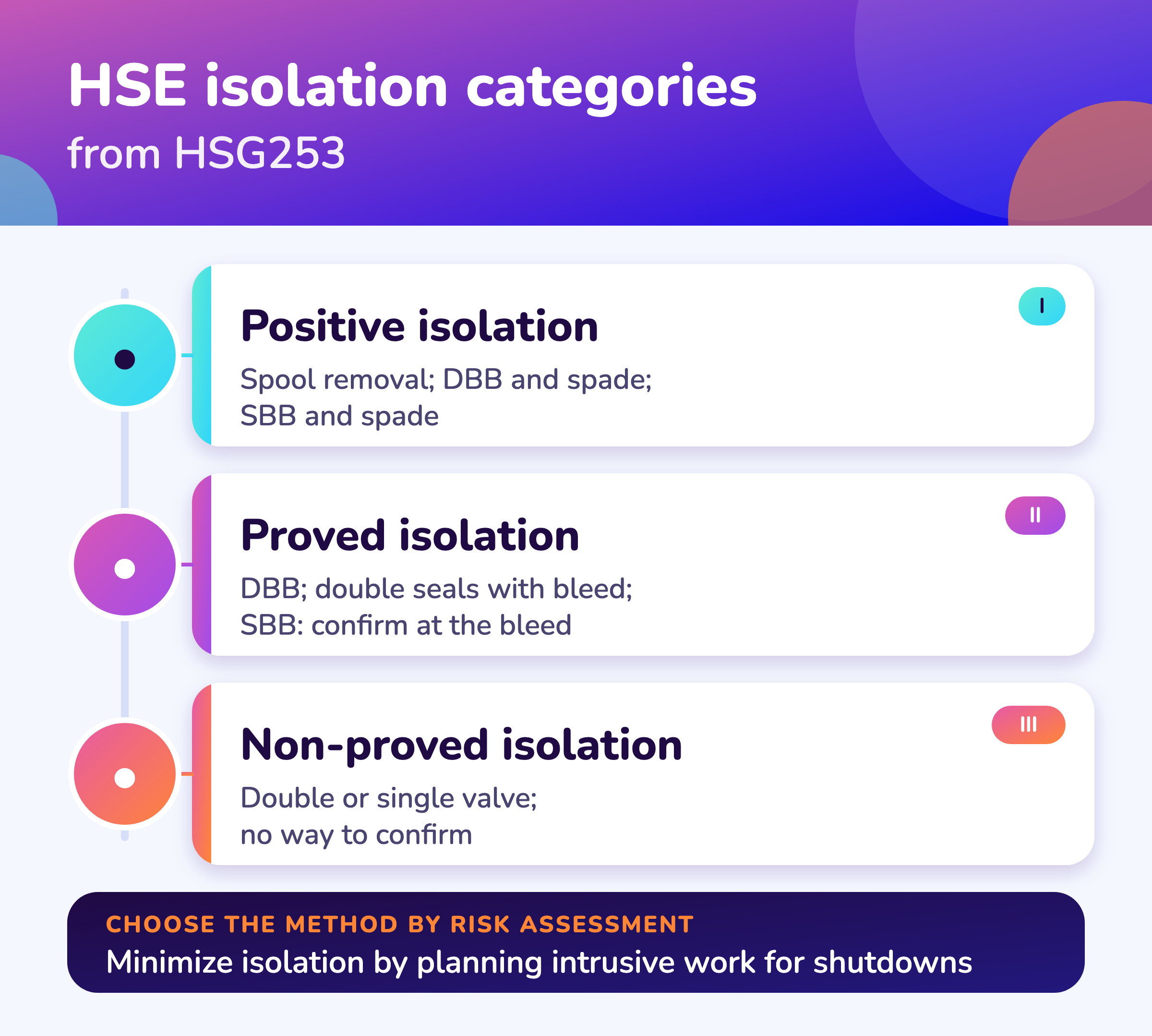
| Positive isolation | Isolation | HSE category I isolation: complete separation of the plant to be worked on from other parts of the system, for example by spool removal or a spade with valved isolation. | HSE HSG253 |
| Pre-startup safety review | Safety | A review required by OSHA 1910.119(i) for new facilities and for modified facilities when the modification is significant enough to require a change in process safety information; it confirms construction, procedures, training and management of change before hazardous chemicals are introduced. | OSHA 1910.119 |
| Process | Safety | Any activity involving a highly hazardous chemical, including use, storage, manufacturing, handling or on-site movement; interconnected vessels are considered a single process. | OSHA 1910.119 |
| Process hazard analysis | Safety | An analysis that identifies, evaluates and controls the hazards of a process; it is performed by a team with engineering and process expertise and revalidated at least every five years (OSHA 1910.119(e)). | OSHA 1910.119 |
| Proved isolation | Isolation | HSE category II isolation: valved isolation whose effectiveness can be confirmed through vent or bleed points before intrusive work starts, for example double block and bleed. | HSE HSG253 |
| PSSR (UK) | Regulation | Pressure Systems Safety Regulations 2000: a suitable written scheme of examination must be in place before a pressure system is operated and the system examined in line with it. | HSE pressure systems, HSE INDG178 |
| PSSR (US) | Regulation | Pre-startup safety review under OSHA 1910.119(i); see that entry. | OSHA 1910.119 |
| Relevant fluid | Regulation | In the UK pressure systems rules: steam at any pressure, compressed or liquefied gas including air above 0.5 bar above atmospheric pressure, and pressurized hot water above 110 °C. | HSE INDG178 |
| Replacement in kind | Safety | A replacement that satisfies the design specification. | OSHA 1910.119 |
| Schedule performance index (SPI) | Cost | Schedule efficiency of work accomplished: earned value divided by planned value. | HHS earned value glossary |
| Schedule variance (SV) | Cost | Earned value minus planned value for the same time interval; positive is favorable. | HHS earned value glossary |
| SIMOPS | Safety | Simultaneous operations: the execution of two or more tasks by two or more functional groups in the same place at the same time, which can create risks in addition to those of each single task. | Marucco, SIMOPS paper |
| Startup failure (SF) | Outage | In NERC reporting, an outage that results when a unit cannot synchronize within its specified startup time following an outage or reserve shutdown. | NERC GADS |
| T&I | Outage | Turnaround and inspection, a term used in Gulf refining, as in a major turnaround and inspection with a five-year cycle at one Saudi Arabian refinery. | Hydrocarbon Engineering |
| Tagout | Safety | Placement of a tagout device on an energy isolating device under an established procedure to indicate that the device and the equipment must not be operated until the tagout device is removed. | OSHA 1910.147 |
| Turnaround | Outage | A planned, periodic shutdown of one or more processing units to perform maintenance, inspection and repair; AFPM adds that the key distinction from an outage is that turnarounds are planned. | EIA, AFPM |
| Work package | Cost | A task or set of tasks performed within a control account, with a defined work scope, a scheduled start and end, a time-phased budget and a documented method of measuring earned value. | HHS earned value glossary |
| Written scheme of examination | Regulation | A document, certified by a competent person, identifying the items of a pressure system, what is examined, how, with what preparation and at what maximum interval. | HSE INDG178 |
Sources
Which sources define the glossary terms?
The glossary draws on thirteen named sources: OSHA for process safety, lockout and confined space terms, the HHS glossary for cost and work package terms, NERC for outage classes, HSE for isolation and pressure systems, and EIA, AFPM, DOE and others for the rest. 2,1,5,9
| Source | Covers | Terms |
|---|---|---|
| OSHA 1910.119 | OSHA process safety management terms | 10 |
| OSHA 1910.147 | OSHA lockout and tagout terms | 6 |
| OSHA 1910.146 | OSHA confined space terms | 3 |
| HHS earned value glossary | Earned value and work package terms | 13 |
| NERC GADS | Generating unit outage classes | 6 |
| HSE HSG253 | HSE isolation categories | 2 |
| HSE INDG178 | UK pressure systems terms | 3 |
| DOE lessons learned standard | Lessons learned | 1 |
| EIA | Refinery turnaround | 1 |
| AFPM | Refinery turnaround | 1 |
| Hydrocarbon Engineering | T and I | 1 |
| Marucco, SIMOPS paper | SIMOPS | 1 |
| GAO schedule guide | Float and critical path | 2 |
MaintWiz
How can MaintWiz help with shutdown terms?
Shared terms help, and a shared plan helps more. The MaintWiz shutdown module moves the plan from spreadsheets into one system with a critical path, readiness gates, permits and spares status.
About MaintWiz. MaintWiz is an industrial AI platform with IoT, SAP integration and predictive maintenance (PdM) capabilities. Its shutdown and turnaround module helps plants plan, schedule, execute and close out shutdown work.
What the shutdown module covers
As described on the MaintWiz shutdown maintenance product page.
- Critical path and float
- Readiness gates
- Permits and isolations
- Spares status with SAP
Proof
What MaintWiz customers report
Figures as published in MaintWiz case studies on maintwiz.com. They come from maintenance management projects, not shutdowns.
Gaps
Which common terms does the glossary leave out?
The glossary leaves out terms such as TAR, linestop, punch list and mechanical completion because no authoritative, vendor-neutral source for them was found; these are explained as working terms on the guide pages linked below.
| Term | Why it is not defined | Where it is discussed |
|---|---|---|
| TAR | Seen as a short form of turnaround in some places; no authoritative source found | Terms compared |
| Linestop | No usable source found | Types of shutdown |
| Statutory shutdown or turnaround | Usage varies by country; no authoritative definition found | Annual shutdown in India |
| Punch list | No standards-body definition read; used as a working term | 40-step checklist |
| Mechanical completion | Defined in contracts and project practice; no standards-body definition read | Start-up after shutdown |
| Blind list | Working term for a register of blinds, spades and blanks; HSE describes the isolation methods but not this register by name | Permit to work |
| Scope freeze | Working term for the point after which additions need approval; no standards-body definition read | Scope management |
| STO | Shorthand for shutdown, turnaround and outage; a stipulation, not an industry term | Terms compared |
Visuals
Save the glossary charts
Two charts to share with new team members. Click either for the full-size image.
FAQ
Frequently asked questions
What does T&I mean in maintenance?
Turnaround and inspection, a term used in Gulf refining. 12 See T&I turnaround planning.
What is SIMOPS?
Simultaneous operations: two or more tasks by two or more groups in the same place at the same time, which can create extra risk. 13
What is a pre-startup safety review?
A review under OSHA 1910.119(i) before startup of new or significantly modified facilities. 2 In the UK the letters PSSR mean the Pressure Systems Safety Regulations. 11
What is the difference between a turnaround and an outage?
A turnaround is a planned, periodic shutdown of processing units; the key distinction from an outage is that turnarounds are planned. 6,7 In power generation, outages can be planned, maintenance or forced. 5
What is float?
The time an activity can slip without delaying a later date; it is not contingency. 17
What is a work package?
A task or set of tasks within a control account, with a defined scope, schedule, budget and a way to measure earned value. 1
What is hot work?
Work involving electric or gas welding, cutting, brazing or similar flame or spark-producing operations. 2
Why is TAR not defined here?
No authoritative source for it was found. See the gaps table above.
Sources
Sources
OSHA texts were read in the published rule (via Cornell LII); the HHS earned value glossary, NERC GADS reporting instructions (January 2026), HSE guidance (HSG253, INDG178) and the DOE lessons learned standard were read in full text. EIA, AFPM, GAO and API entries rely on the pages and summaries cited. Definitions are paraphrased.
- US Department of Health and Human Services, Earned Value Management, Appendix D: Glossary of Terms
- OSHA, 29 CFR 1910.119, Process safety management of highly hazardous chemicals
- OSHA, 29 CFR 1910.147, The control of hazardous energy (lockout/tagout)
- OSHA, 29 CFR 1910.146, Permit-required confined spaces
- North American Electric Reliability Corporation, Generating Availability Data System (GADS) Data Reporting Instructions, effective 1 January 2026
- U.S. Energy Information Administration, Refinery Outages: Description and Potential Impact on Petroleum Product Prices
- American Fuel & Petrochemical Manufacturers, Refinery turnarounds 101: What are turnarounds and why do we need them? (17 October 2023)
- US Department of Energy, DOE-STD-7501-99, The DOE Corporate Lessons Learned Program
- UK Health and Safety Executive, The safe isolation of plant and equipment (HSG253, 2006)
- UK Health and Safety Executive, Written schemes of examination (INDG178, rev 2, 2012)
- UK Health and Safety Executive, Pressure systems: Pressure Systems Safety Regulations 2000
- Hydrocarbon Engineering, Ras Tanura Refinery completes inspection project (19 February 2018; trade press, a single published example)
- Marucco, D., Simultaneous Operations Risk Assessment, Chemical Engineering Transactions, vol. 53 (2016)
- American Petroleum Institute, API 510 Pressure Vessel Inspection Code: in-service inspection, rating, repair and alteration (edition summary)
- American Petroleum Institute, API 570 Piping Inspection Code (standard announcement page)
- American Petroleum Institute, API 653 Tank Inspection, Repair, Alteration, and Reconstruction (edition summary)
- US Government Accountability Office, GAO Schedule Assessment Guide: Best Practices for Project Schedules (GAO-16-89G, December 2015)
Move your shutdown plan out of spreadsheets
Book a demo and bring the spreadsheet you use today. We will show how the module covers the same ground.