US rules
OSHA PSM Turnaround Rules: What Applies to a Shutdown
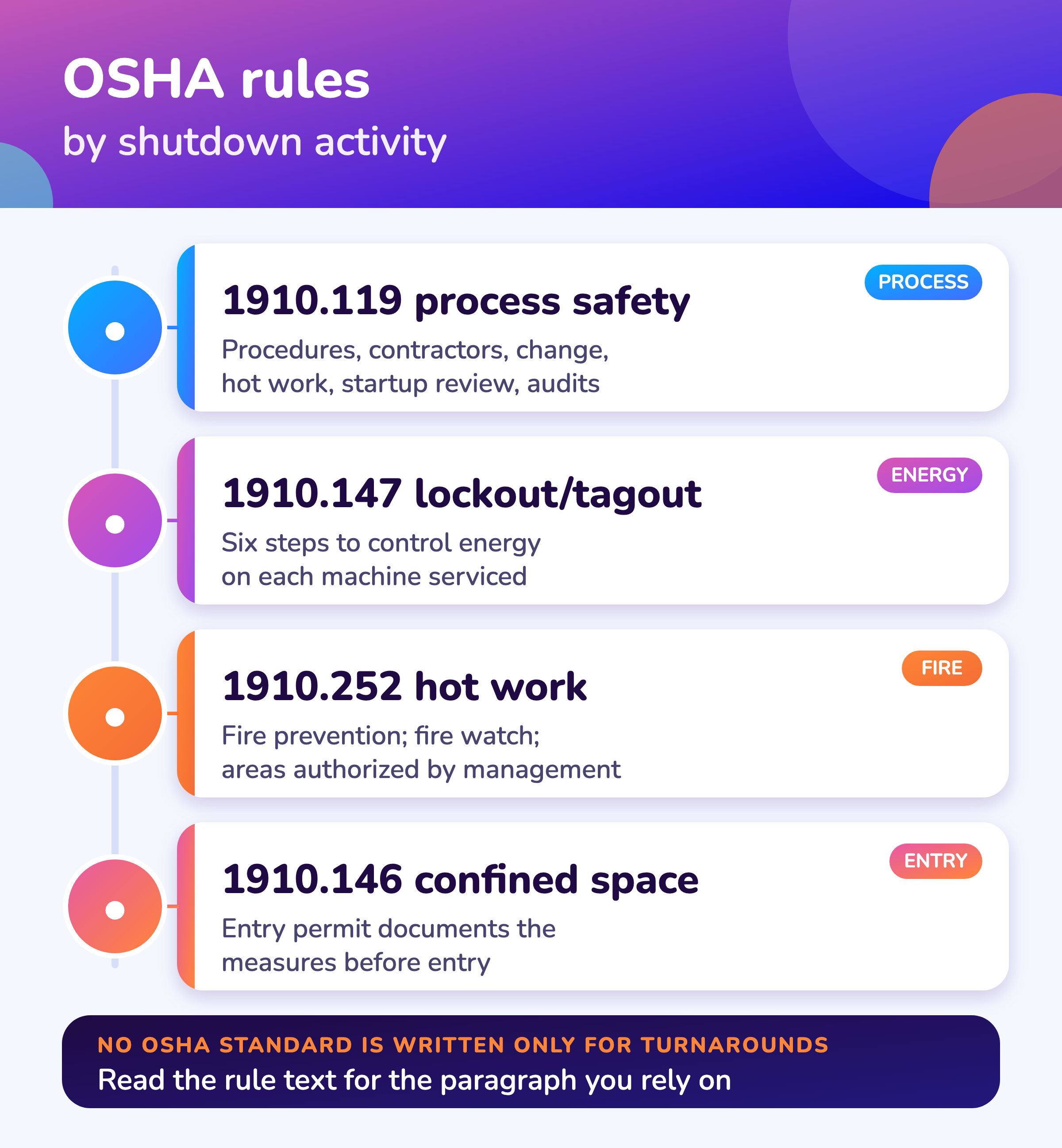
The two main US rules for a plant shutdown are OSHA 1910.119 process safety management, for covered processes, and 1910.147 lockout/tagout, with 1910.252 for hot work and 1910.146 for confined space entry. OSHA has no turnaround-specific standard; this page maps the rules to the work you plan.
How MaintWiz helps: Compliance is easier when permits and isolations are recorded as the work happens. The MaintWiz shutdown module shows permits and isolations from ePTW on each work order and blocks closing a package while a permit or isolation is open. See the module · Get the permit register
By Jai Balachandran · Published · Last reviewed
What MaintWiz adds:Permits and isolations from ePTWShown on each work orderPackage cannot close with an open permitApprovals by signed-in user
Rule map
Which OSHA standards apply to a plant shutdown or turnaround?
The OSHA process safety management standard (1910.119) and the lockout/tagout standard (1910.147) are the two main rules for a shutdown, with the hot work rule (1910.252) and the confined space rule (1910.146) applying to specific jobs. 1,2,4,3
A free Excel version is available: OSHA rule-to-activity matrix (.xlsx).
OSHA has no standard written only for turnarounds. The table maps the shutdown activities you manage to the rule text that bears on each, with a short statement of what it says, and the guide to read for the working detail. The paragraph references are to the US federal rules; states with their own OSHA-approved plans can add to them.
| Shutdown activity | Rule | What it says | Read next |
|---|---|---|---|
| Writing the restart procedure | 1910.119(f)(1)(i) | Operating procedures cover steps for each phase, including startup following a turnaround or after an emergency shutdown, and emergency shutdown | Plant start-up after shutdown |
| Bringing in contractors | 1910.119(h) | Applies to contractors performing maintenance or repair, turnaround, major renovation or specialty work on or adjacent to a covered process; the employer evaluates their safety performance, informs them of hazards, controls their entrance, presence and exit, and keeps an injury and illness log; the contract employer trains and documents | Contractor management |
| Hot work | 1910.119(k) and 1910.252(a) | A hot work permit is issued for hot work on or near a covered process; it documents that the 1910.252(a) fire prevention and protection requirements are in place, the dates and the object | Permit to work |
| Changes made during the stop | 1910.119(l) | Written procedures manage changes other than replacements in kind; considerations include the technical basis, safety and health impact, operating procedure changes, time period and authorization | Execution and change control |
| Restart after modification | 1910.119(i) | A pre-startup safety review applies to new facilities and to modified facilities when the modification is significant enough to require a change in process safety information | Pre-startup safety review |
| Inspection and repair of equipment | 1910.119(j) | Mechanical integrity covers pressure vessels and storage tanks, piping, relief and vent systems, emergency shutdown systems, controls and pumps: written procedures, trained staff, inspection and testing, and correction of deficiencies | Shutdown audit |
| Isolating energy for servicing | 1910.147 | Covers servicing and maintenance of machines and equipment; the energy control program has procedures, training and periodic inspections; outside employers and the host exchange their procedures | Lockout during shutdown |
| Entering a tank or vessel | 1910.146(e)(1) | Before entry is authorized, the employer documents completion of the required measures by preparing an entry permit | Shutdown safety plan |
| Checking the whole program | 1910.119(o) and (m) | Compliance audit at least every three years; incident investigation begun within 48 hours of an incident that resulted in, or could reasonably have resulted in, a catastrophic release | Lessons learned |
Coverage
Is a turnaround covered by OSHA process safety management?
A turnaround is covered by OSHA process safety management when the process is covered, that is, when it holds a listed chemical at or above its threshold quantity or 10,000 pounds or more of a flammable gas or liquid in one location (not counting hydrocarbon fuel used only for workplace consumption, or flammable liquids in atmospheric tanks kept below their normal boiling point); the standard names turnarounds but does not define the word. 1
1910.119(a)(1) sets the application: a process involving a chemical at or above the threshold quantities in Appendix A, or a flammable liquid or gas on site in one location in a quantity of 10,000 pounds or more. 1 Three exclusions follow: retail facilities, oil or gas well drilling or servicing operations, and normally unoccupied remote facilities. 1
The word "turnaround" appears in the standard three times: in the operating procedures paragraph (startup following a turnaround or after an emergency shutdown), in the contractors paragraph (contractors performing maintenance or repair, turnaround, major renovation or specialty work), and in Appendix C, the non-mandatory compliance guidelines. 1 Appendix C says that for existing processes shut down for turnaround or modification, the employer must assure that any changes other than replacement in kind made during the shutdown go through management of change; it is guidance, not the mandatory text. 1
I found no definition of "turnaround" in the standard. For how the terms differ in practice, see shutdown vs turnaround vs outage.
Software
Can software help with OSHA requirements in a shutdown?
Software does not make a plant compliant, but it can keep the permits, isolations, sign-offs and inspection records tied to each work order, so the evidence the rules call for is easy to find.
About MaintWiz. MaintWiz is an industrial AI platform with IoT, SAP integration and predictive maintenance (PdM) capabilities. Its shutdown and turnaround module helps plants plan, schedule, execute and close out shutdown work.
What the shutdown module covers
As described on the MaintWiz shutdown maintenance product page.
- Permits and isolations from ePTW shown on each work order, with a block on closing a package while one is open
- Readiness gates with waivers and sign-offs recorded with a reason, the name and the date
- Approvals recorded against the signed-in user with the name and the time
- Handover note and as-left summary on each work order
- Work order tasks with readings, limits and photos as inspection evidence
- Close-out and archive of past shutdowns
Proof
What MaintWiz customers report
Figures as published in MaintWiz case studies on maintwiz.com. They come from maintenance management projects, not shutdowns.
Comparison
What is the difference between OSHA 1910.119 and 1910.147 during a shutdown?
1910.119 manages the safety of a covered process as a whole, while 1910.147 controls hazardous energy on each machine being serviced; a shutdown of a covered process normally falls under both. 1,2
Lockout and tagout under 1910.147 controls hazardous energy; it is not process isolation. For a permit-required confined space, 1910.146 defines isolation as removing the space from service and protecting it against the release of energy and material, for example by blanking or blinding, a double block and bleed system, or disconnecting lines, in addition to lockout or tagout. 3
| Question | 1910.119 process safety management | 1910.147 lockout/tagout |
|---|---|---|
| What triggers it? | A covered process: a listed chemical at or above its threshold quantity, or 10,000 pounds or more of a flammable gas or liquid | Servicing and maintenance of machines and equipment where unexpected startup or release of stored energy could injure employees |
| What does it manage? | The process as a whole: procedures, hazard analysis, mechanical integrity, contractors, change, startup review, audits | The energy control for each machine or piece of equipment being serviced |
| Steps in a shutdown | Hot work permit, change control, contractor control, pre-startup review, inspection and testing | Preparation, shutdown, isolation, device application, stored energy, verification; then release before restart |
| Outside workers | Host evaluates, informs and controls contractors; contractors train their people | Host and outside employer inform each other of their procedures |
| Both apply? | Yes, on a covered process: lockout/tagout covers the energy isolation of equipment, and PSM covers the process around it | Yes |
1910.147 says normal production operations are not covered, but servicing during production is covered if a guard is removed or bypassed or a body part enters the point of operation; minor, routine, repetitive tool changes that are integral to equipment use are excluded if alternative protection is provided. 2 The six steps of 1910.147(d), preparation, shutdown, isolation, device application, stored energy and verification, must be followed in sequence. 2 See permit to work during a shutdown for how plants combine them.
Inspection codes
Which API inspection codes affect a turnaround scope?
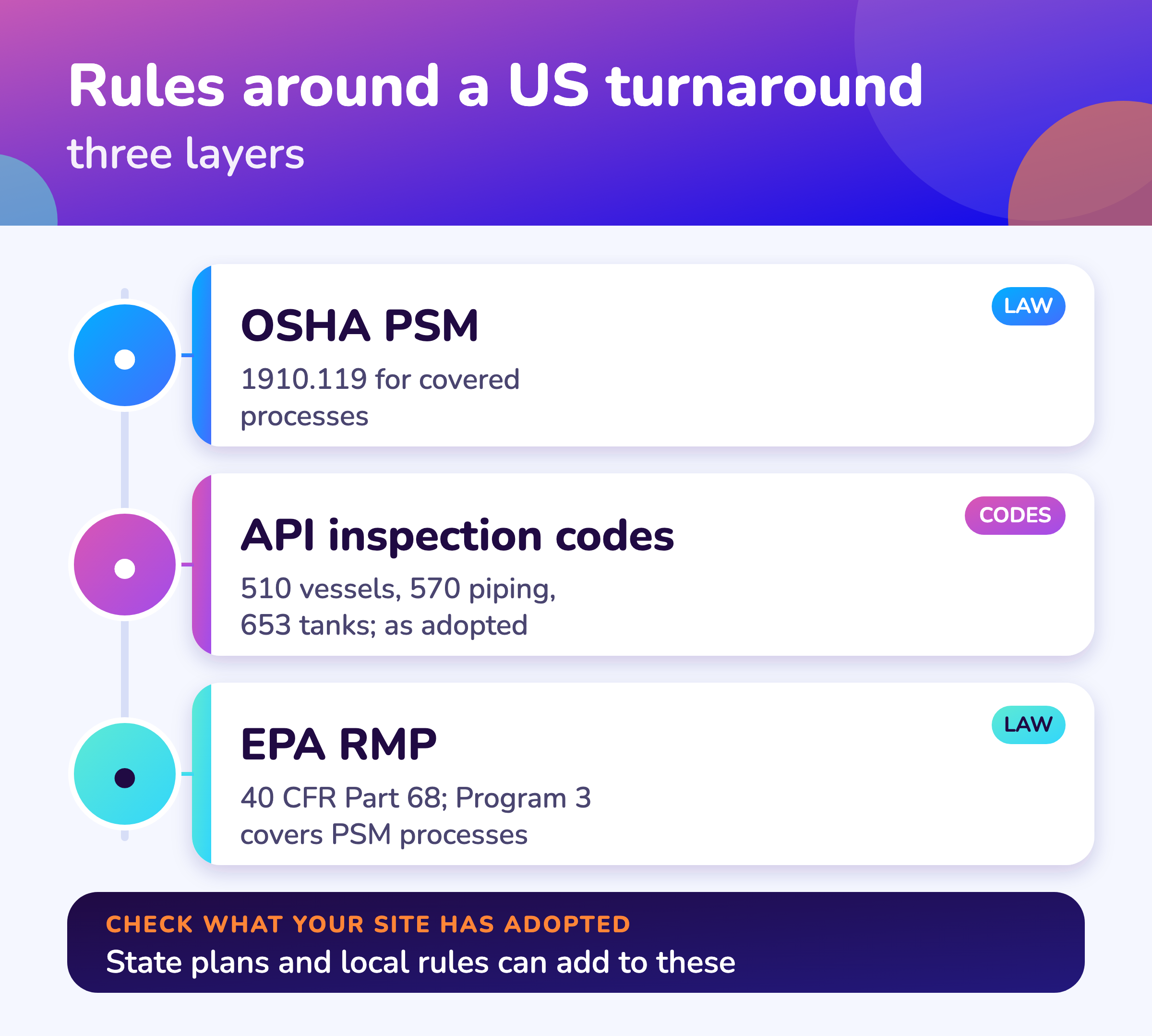
API 510, 570 and 653 are industry inspection codes for pressure vessels, piping and aboveground storage tanks that decide which equipment is opened and inspected, and OSHA mechanical integrity (1910.119(j)) requires inspections to follow manufacturers' recommendations and good engineering practices. 6,7,8,1
| Code | Covers | Note | Source |
|---|---|---|---|
| API 510 | In-service inspection, repair, alteration and rerating of pressure vessels | The edition that applies depends on what the owner or jurisdiction has adopted; the summary read was for the 10th edition | API 510 summary |
| API 570 | In-service piping inspection | Check the current edition on api.org | API 570 |
| API 653 | Steel aboveground storage tanks built to API 650 or API 12C | The summary read was for the 5th edition; check the current edition | API 653 summary |
The codes are not OSHA rules; they are industry standards that owners adopt. Jurisdictions may adopt them in law. Plan the inspections they require into the scope before the freeze. See shutdown scope management and refinery turnaround planning.
EPA
What is the EPA Risk Management Program and does it affect a shutdown?
The EPA Risk Management Program (40 CFR Part 68) applies to a stationary source with more than a threshold quantity of a regulated substance in a process, and a process subject to OSHA 1910.119 falls in Program 3 unless it meets Program 1 criteria, so many covered turnarounds sit under both. 5
Under 40 CFR 68.10, Program 1 applies if there has been no offsite-impact release in the last five years, the worst-case distance to an endpoint is less than the distance to any public receptor, and emergency response is coordinated with local organizations; Program 3 applies if the process is not eligible for Program 1 and is subject to 1910.119 or has a listed NAICS code; Program 2 covers the rest. 5
This page does not summarize the RMP's own maintenance, change or audit elements; check 40 CFR Part 68 for the requirements of your program level.
In the plan
Where do these rules fit in a shutdown plan?
Fit the US rules into the five phases of the 40-step checklist: inspections and codes in scope, change and contractor control in planning, lockout, permits and entry in readiness, the pre-startup review at restart, and incident and audit follow-up in close-out.
| Phase | Steps | Rule | Link |
|---|---|---|---|
| 1. Scope and strategy | 3, 7: scope and baseline | 1910.119(j) inspections; API codes | Scope management |
| 2. Plan and schedule | 13, 15: change control, contractors | 1910.119(l), (h) | Contractors |
| 3. Readiness | 18 to 21: isolation, lockout, permits, induction | 1910.147; 1910.119(k); 1910.146(e) | Permit to work |
| 4. Execute and restart | 34 to 38: blinds, walkdown, pre-startup review | 1910.119(i); (f)(1)(i)(G) | Start-up |
| 5. Close-out and review | 39, 40: lessons | 1910.119(m), (o) | Lessons learned |
A working map, not a compliance program. Your own process safety management program decides how each rule is met.
Visuals
Save the US rule charts
Two charts to share with your safety team. Click either for the full-size image.
FAQ
Frequently asked questions
Which OSHA standards apply to a plant shutdown?
Mainly 1910.119 process safety management for covered processes and 1910.147 lockout/tagout, with 1910.252 for hot work and 1910.146 for permit-required confined spaces. 1,2,4,3
Does OSHA define a turnaround?
I found no definition. The word appears three times in 1910.119: in operating procedures, in the contractors paragraph and in Appendix C. 1
Is a turnaround covered by process safety management?
It is when the process is covered: a listed chemical at or above its threshold quantity, or 10,000 pounds or more of a flammable gas or liquid in one location, subject to exclusions. 1
Do changes made during a shutdown need management of change?
Yes for covered processes, other than replacements in kind; Appendix C guidance says so for existing processes shut down for turnaround or modification. 1
Do contractor rules apply to turnaround crews?
1910.119(h) applies to contractors performing maintenance or repair, turnaround, major renovation or specialty work on or adjacent to a covered process. 1 See contractor management.
Is a pre-startup safety review required after a turnaround?
1910.119(i) requires one for new facilities and for modified facilities when the modification is significant enough to require a change in process safety information; using it after routine maintenance is a site decision. 1
What does 1910.147 add to 1910.119?
It controls hazardous energy on each machine being serviced, with six steps in sequence and an exchange of procedures between host and outside employers. 2
Does EPA Risk Management Program apply?
It applies to a source with more than a threshold quantity of a regulated substance in a process; a process subject to 1910.119 falls in Program 3 unless it meets Program 1 criteria. 5
Sources
Sources
OSHA 1910.119 was read in full text; 1910.147, 1910.146 and 1910.252 were read for the paragraphs cited; 40 CFR 68.10 for applicability. The API codes are cited from the publisher's summaries. Rules change: check the current text.
- OSHA, 29 CFR 1910.119, Process safety management of highly hazardous chemicals
- OSHA, 29 CFR 1910.147, The control of hazardous energy (lockout/tagout)
- OSHA, 29 CFR 1910.146, Permit-required confined spaces
- eCFR, 29 CFR 1910.252(a), Fire prevention and protection in welding, cutting and brazing (read via Cornell LII)
- eCFR, 40 CFR 68.10, Risk Management Program applicability (US EPA; read via Cornell LII)
- American Petroleum Institute, API 510 Pressure Vessel Inspection Code: in-service inspection, rating, repair and alteration (edition summary)
- American Petroleum Institute, API 570 Piping Inspection Code (standard announcement page)
- American Petroleum Institute, API 653 Tank Inspection, Repair, Alteration, and Reconstruction (edition summary)
Keep permits and isolations tied to the work
Book a demo and bring your permit process. We will show how ePTW permits and isolations appear on each work order.