Lessons learned
Shutdown Lessons Learned: Process, Agenda and Template
A shutdown lesson learned is a good practice or an adverse experience that is captured and shared, so the next stop repeats the good and avoids the bad. This guide gives the five-stage process, three review agendas and a template for the entry.
The review timings and template are working conventions, adapted from the DOE lessons learned process.
How MaintWiz helps: Lessons are lost when they live in a slide deck. The MaintWiz shutdown module keeps handover notes, lessons learnt and deferred items with an archive of past shutdowns. See the module · Get the lessons register
By Jai Balachandran · Published · Last reviewed
What MaintWiz adds:Handover notesLessons learntDeferred itemsArchive of past shutdowns
Definition
What is a lesson learned in a shutdown?
A lesson learned is a good work practice or an adverse experience that is captured and shared, so that others repeat the good and avoid the bad; the point is the sharing and use, not the record. 1
For why budgets overrun, see why shutdowns go over budget.
The US Department of Energy standard on lessons learned defines a lesson learned as a good work practice or innovative approach that is captured and shared to promote repeat application, or an adverse work practice or experience that is captured and shared to avoid recurrence. 1 For a shutdown that means a finding, a delay, a clever fix or a near miss recorded with enough context that the next planner can act on it. It is step 40 of the 40-step checklist.
The same standard says a lessons learned program has two processes. The development process covers identification, documentation, validation and dissemination. The utilization process covers identifying applicable lessons, distributing them, deciding actions and following up that the actions happened. 1 Many plants do the first and stop; the value is in the second.
Process
How do you run a shutdown lessons learned process?
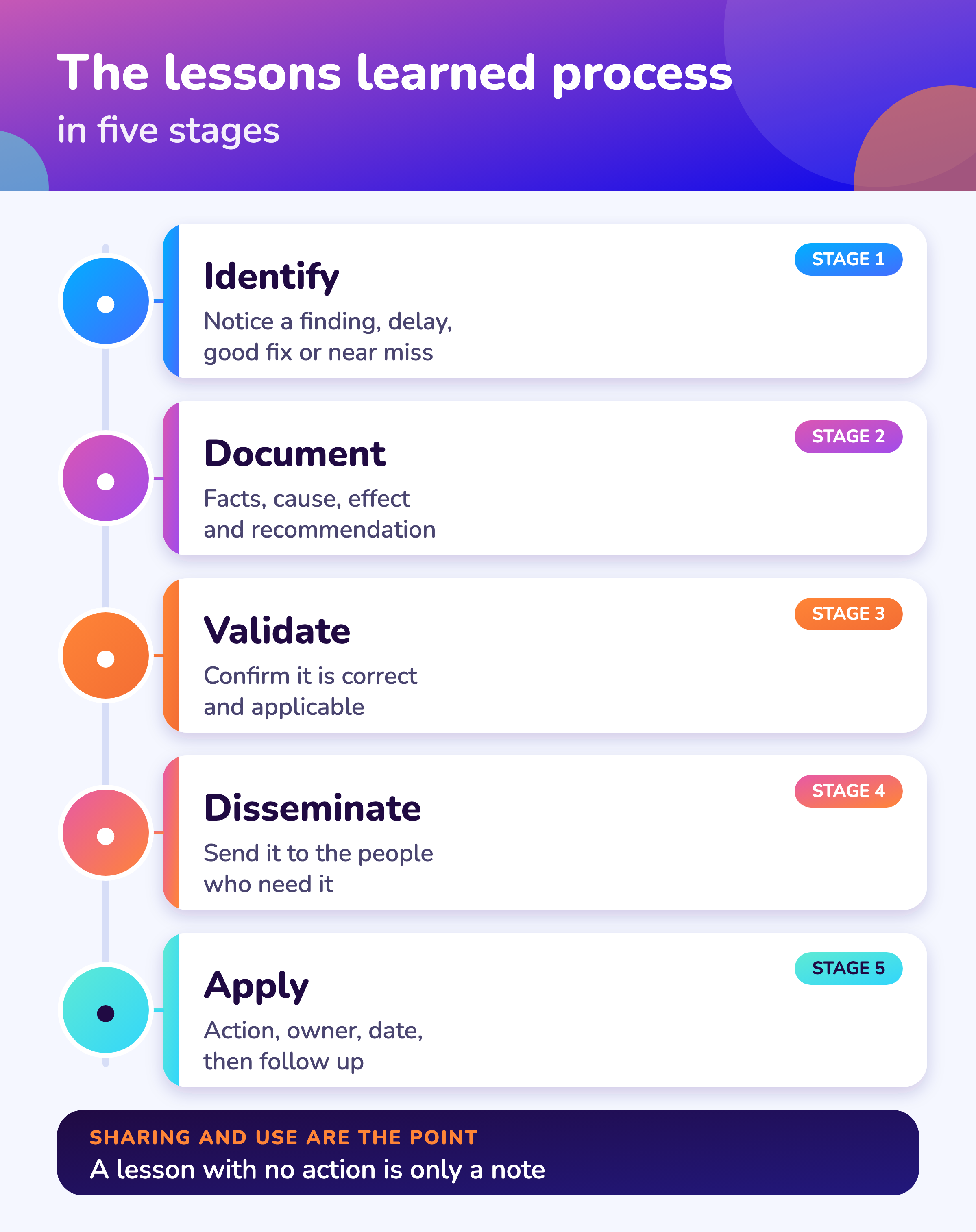
Run the process in five stages: identify the lesson, document it with its context, validate it, disseminate it to the people who need it, and apply it through a named action with an owner and a date. 1
| Stage | What it means | In a shutdown |
|---|---|---|
| Identify | Notice something worth sharing | Daily meeting actions, findings, delays, near misses, punch items, contractor feedback |
| Document | Write it with its context | Template entry with the job, the cause, the effect and the recommendation |
| Validate | Check that it is correct and applicable | Shutdown manager and the owner confirm the facts and the cause |
| Disseminate | Send it to the people who need it | Planners, area leads, contractors and the next stop team |
| Apply | Decide actions and follow up | Update job plans, checklists, scope, estimates and the risk register; assign an owner and a date |
The DOE standard also asks that the way of raising a lesson be simple, that lessons carry the context in which they were learned, and that there be no stigma or blame for the person who raises one. 1 That matters on a shutdown, where contractors and operations staff may hesitate to report their own errors.
The five-stage table is our adaptation of the DOE process to shutdowns, not DOE wording.
Software
Can software capture shutdown lessons?
Software helps most at the capture stage: findings, as-left notes and baseline changes are recorded as the work happens, so the review starts from data instead of memory.
About MaintWiz. MaintWiz is an industrial AI platform with IoT, SAP integration and predictive maintenance (PdM) capabilities. Its shutdown and turnaround module helps plants plan, schedule, execute and close out shutdown work.
Also see shutdown KPIs.
What the shutdown module covers
As described on the MaintWiz shutdown maintenance product page.
- Findings sent to the planner from the work order, with the cause and the effect
- Handover note and as-left summary on each work order
- Close-out and archive of past shutdowns, with deferred items
- Baselines that show what moved against the plan
- Reports and the tables behind the charts export to Excel
- Approvals and sign-offs recorded against the signed-in user
Proof
What MaintWiz customers report
Figures as published in MaintWiz case studies on maintwiz.com. They come from maintenance management projects, not shutdowns.
Agenda
What should a shutdown review meeting cover?
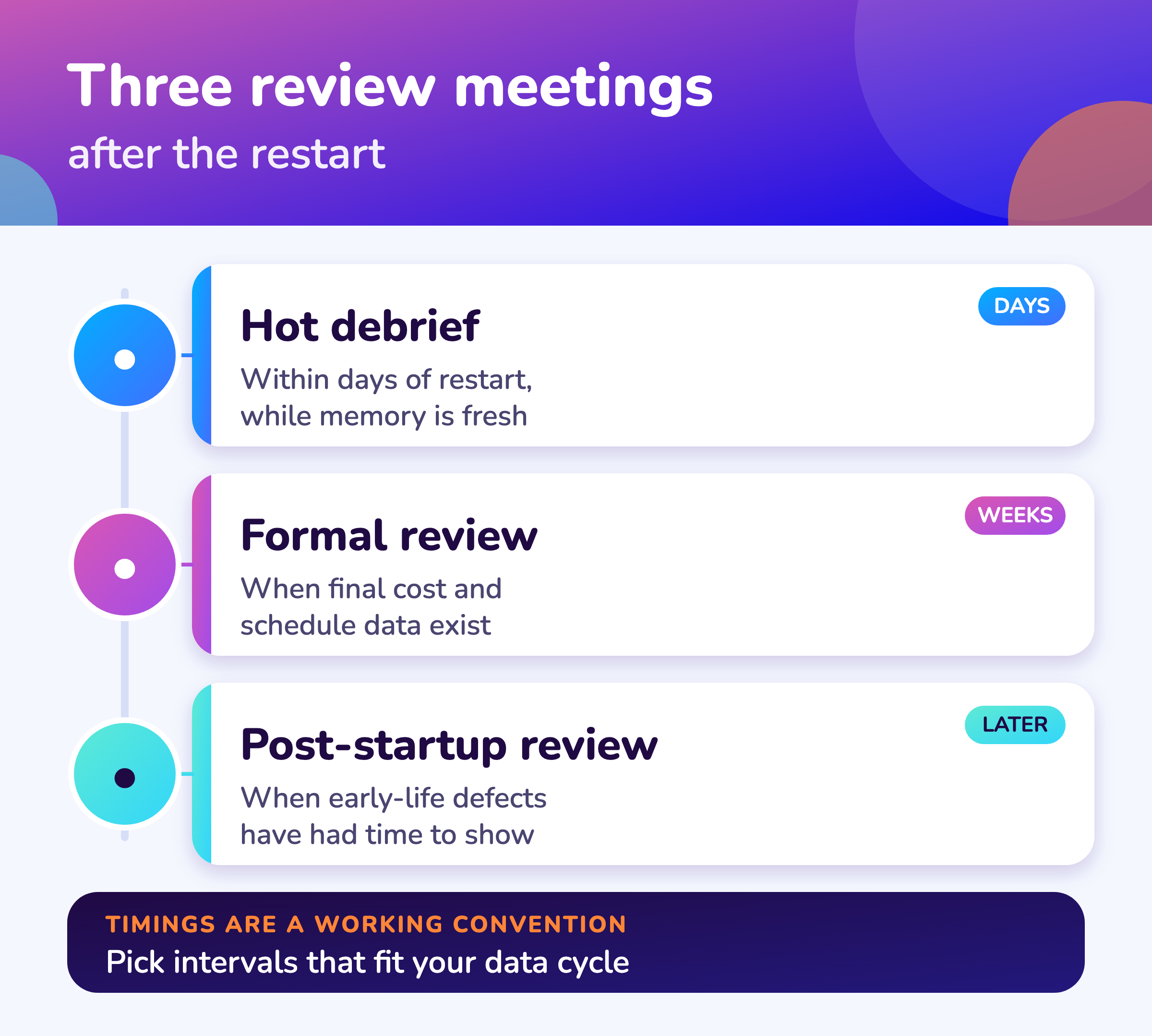
Hold three reviews: a hot debrief within days of restart, a formal review once the final cost and schedule data exist, and a post-startup review when early-life defects have shown; each has a different agenda.
| Meeting | When | Who | Agenda |
|---|---|---|---|
| Hot debrief | Within a few days of restart, while memory is fresh | Shutdown manager, area leads, operations, key contractors | What went well; what went wrong; top delays; safety events; immediate fixes. Capture lessons in the template; no solutions debate |
| Formal review | Within weeks of restart, after final cost and schedule data exist | Shutdown manager, planner, cost controller, safety, reliability, contracts | Planned versus actual schedule, cost and scope; scope growth; contractor performance; materials; permit and safety record; validate each lesson and assign actions |
| Post-startup review | After the plant has run long enough for early-life defects to show | Reliability engineer, operations, shutdown manager | Defects and repeat failures after restart; work that should have been in scope; update asset history and the next stop scope |
The timings are a working convention: no public standard fixes them. Choose intervals that fit your restart and data cycle. For the measures to review see shutdown KPIs.
Template
What does a lessons learned entry look like?
A good lessons learned entry has a title, the job, the facts, the cause, the effect, a recommendation and an action with an owner and a date, so the next planner can act on it without asking.
More free tools, including the 40-step checklist as a workbook, are in the shutdown planning templates. A worked review ending in actions: shutdown case study. A free Excel version is available: Lessons learned register (.xlsx).
| Field | What to write | Example (invented) |
|---|---|---|
| Title | Short, searchable name | Seal chamber damaged on removal |
| Job and area | Work package and equipment | WP-014, feed pump A, unit 2 |
| What happened | Facts only, in order | Seal chamber scored when the old seal was pulled; spare chamber not staged; job delayed one shift |
| Cause | Root cause, not blame | Job plan lacked a check of chamber condition; no spare listed |
| Effect | Time, cost, safety, quality | One shift lost on a critical-path job |
| Recommendation | What to do next time | Add chamber inspection step and a spare chamber to the package |
| Action, owner, date | Who changes what by when | Planner updates job plan by next planning round |
| Status | Open, validated, applied | Validated; applied after next review |
The example is invented to show the format. Keep the entry short, and keep the cause about the system rather than a person. A lesson with no action and no owner is only a note.
Inputs
Where do shutdown lessons come from?
The best lessons come from records you already keep: the daily meeting log, the emergent work register, the punch list, safety and near-miss records, planned-versus-actual data and defects after restart. 3
To measure the return from the actions, see shutdown program ROI. Regulated plants should also see pharmaceutical plant shutdowns. If you are moving to S/4HANA, keep the history: SAP S4HANA maintenance data migration.
| Source | What it gives you |
|---|---|
| Daily meeting minutes and action log | Delays, recurring problems and decisions as they happened |
| Emergent work and findings log | What the scope missed, and by how much; input to the next scope |
| Punch list and quality records | Where completion control was weak |
| Permit, safety and near-miss records | Controls that failed or worked |
| Planned versus actual schedule, hours and cost | Estimating accuracy; where the estimates were weak |
| Contractor and operations feedback | Access, materials, coordination and handover issues |
| Post-startup defects and repeat failures | Work that should have been in the stop |
Ask contractors and operations for feedback too. Shift handover problems are a common source; HSE describes handover as preparation, an exchange and a cross-check. 3 Feed validated lessons into the next shutdown plan, the scope and the risk register.
Rules
Do rules require shutdown lessons learned?
No rule requires a shutdown lessons learned report as such, but US process safety rules require documented responses to audit findings and incident investigations, and the DOE standard shows what a working program contains. 1,2
For the audit side, see shutdown audit checklists and findings.
| Topic | Rule or guidance | What it says | Source |
|---|---|---|---|
| Lessons learned program | DOE-STD-7501-99 | Defines a lesson learned and describes a program with a development process (identify, document, validate, disseminate) and a utilization process; applies to DOE and contractor organizations | DOE lessons learned standard |
| Audit findings | OSHA 1910.119(o)(4), US covered processes | The employer promptly determines and documents an appropriate response to each audit finding and documents that deficiencies are corrected | OSHA 1910.119 |
| Incident investigation | OSHA 1910.119(m), US covered processes | The employer investigates each incident that resulted in, or could reasonably have resulted in, a catastrophic release, begins within 48 hours, and sets up a system to address and resolve the findings and document how each was resolved | OSHA 1910.119 |
Visuals
Save the review charts
Two charts to share after the stop. Click either for the full-size image.
FAQ
Frequently asked questions
What is a shutdown lessons learned review?
A structured review after the stop that captures what worked and what did not, validates each lesson and turns it into an action. 1
When should the review happen?
In three steps: a hot debrief within days of restart, a formal review once final cost and schedule data exist, and a post-startup review after early-life defects have had time to show. The timings are a working convention.
Who should attend?
The shutdown manager, planner, area leads, operations, safety, contracts, cost control and reliability, and key contractors for the hot debrief.
What should a lessons learned entry contain?
A title, the job, what happened, the cause, the effect, a recommendation, and an action with an owner and a date.
How do you avoid blame?
Write the cause about the system, and keep the way of raising a lesson simple. The DOE standard says there should be no stigma or blame for the person who raises one. 1
Where do the lessons go afterward?
Into the next plan: job plans, checklists, estimates, the risk register and the scope of the next stop. See how to plan a plant shutdown and the 40-step checklist.
What is the difference between lessons learned and KPIs?
KPIs show how the stop performed; lessons explain why and what to change. Use both. See shutdown KPIs.
Is there a standard for lessons learned?
The US Department of Energy has a lessons learned program standard that many organizations use as a model. 1 No shutdown-specific standard was found.
Sources
Sources
- US Department of Energy, DOE-STD-7501-99, The DOE Corporate Lessons Learned Program
- OSHA, 29 CFR 1910.119, Process safety management of highly hazardous chemicals
- UK Health and Safety Executive, Human factors: Shift handover
- US Government Accountability Office, GAO Schedule Assessment Guide: Best Practices for Project Schedules (GAO-16-89G, December 2015)
Turn this shutdown into the next one's plan
Book a demo and bring your last close-out report. We will show how the module keeps lessons and deferred items.