AI for shutdowns
AI Shutdown Planning: Uses, Evidence and Limits
AI shutdown planning puts machine learning and language models to work on the slow, record-heavy parts of a shutdown: coding work requests, checking estimates, reviewing the schedule and summarizing daily progress. Planners keep the decisions and get a faster first pass. MaintWiz is an industrial AI platform, and AI agents support the shutdown module.
Evidence statements come from the sources listed below and carry their limits. Assessments are labeled as ours. MaintWiz statements describe the shutdown module as built; AI agents are described separately.
How MaintWiz helps: AI helps most when work orders, scope and schedule are in one system. The MaintWiz shutdown module moves the plan from spreadsheets into one system with a critical path, readiness gates, permits and spares status. See the module · Get the 40-step checklist
By Jai Balachandran · Published · Last reviewed
What MaintWiz adds:Critical path and floatReadiness gatesPermits and isolationsSpares status with SAP
Definition
What is AI shutdown planning?
AI shutdown planning means using machine learning or language models to help with the planning tasks of a shutdown, turnaround or outage, such as coding work-order text, checking scope and estimates, reviewing the schedule or summarizing risk, while people keep the decisions. In this guide STO means shutdown, turnaround and outage.
The phrase covers different techniques. A machine learning model learns patterns from past data, for example which jobs ran long. A language model reads and writes text, for example a technician’s note on a work order. A scheduling optimizer searches for a better sequence under constraints and may or may not use machine learning. A claim that a tool “uses AI” does not tell you which of these it is, what data it saw or how it was tested.
This page is written for planners, maintenance leads and buyers. It reports what we could verify, labels our own assessment, and does not promise results.
Evidence
Where is AI already working in maintenance planning?
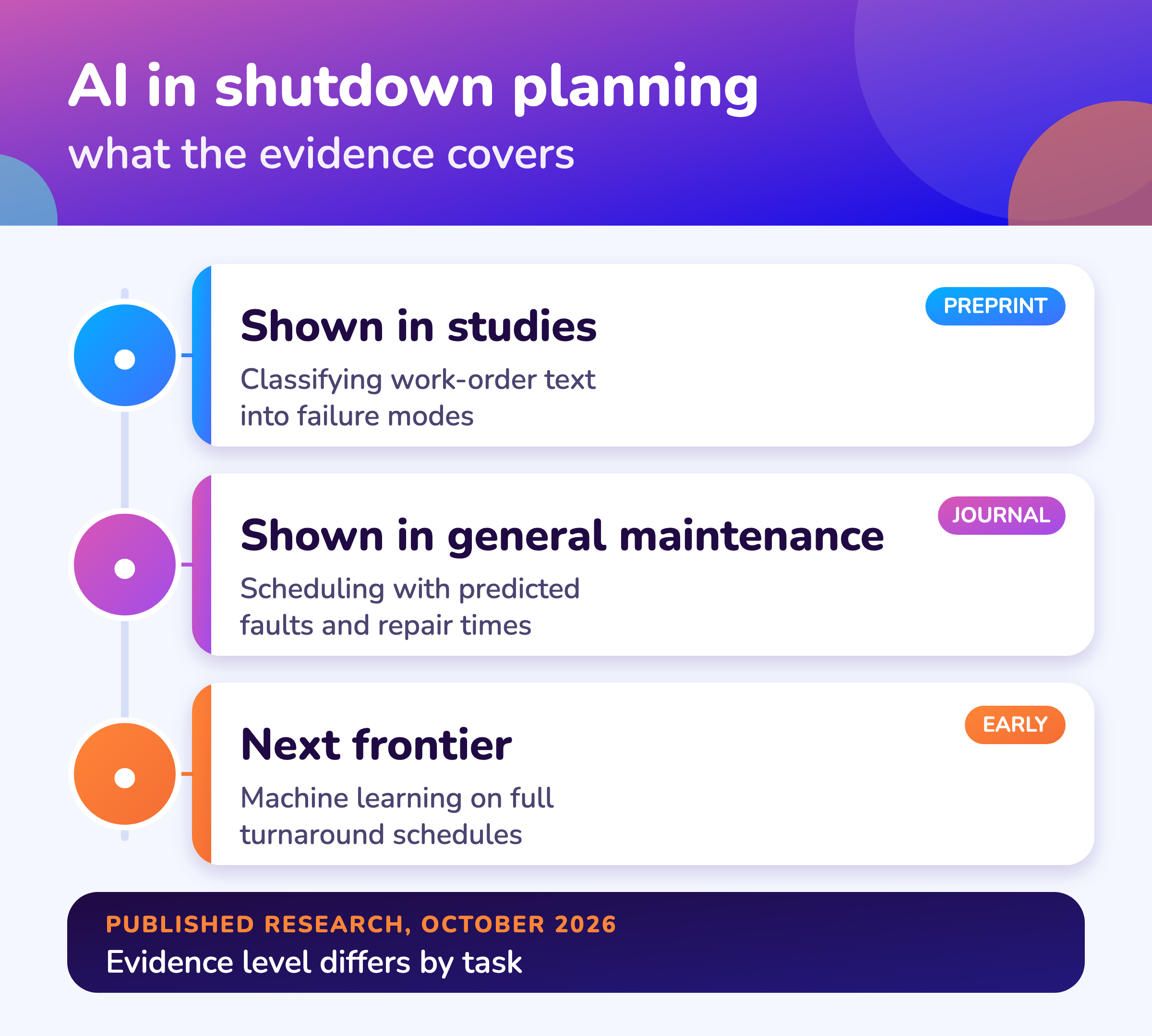
AI already does two planning jobs well in published research: a fine-tuned language model codes work-order text more accurately than a conventional classifier, and machine learning predictions of faults and repair times can drive a maintenance schedule. Turnaround scheduling is the next step. 1,2,3
| Task | Study | What it reports | Limit |
|---|---|---|---|
| Coding work-order text into failure modes | Stewart, Hodkiewicz and Li, 2023 | A fine-tuned GPT-3.5 model scored F1 0.80, a conventional text classifier trained on the same data scored 0.60 and the out-of-the-box model 0.46 | Preprint; one data set; the authors stress high-quality fine-tuning data 1 |
| Scheduling maintenance from predicted faults and repair times | Yeardley et al., 2022 | Machine learning predicts faults and repair times, and the predictions feed a maintenance schedule that optimizes cost within labor and layout limits | Tested on a simulated plant model, not a real turnaround; the repository summary gives no figures 2 |
| Turnaround maintenance planning research overall | Al-Turki, Duffuaa and Bendaya | A review of more than 80 papers names turnaround scheduling optimization and supply-chain risk methods as open research areas | Older review; read from the repository summary 3 |
The work-order result matters to shutdown planners because scope starts as thousands of free-text requests and findings. Turning those into consistent, searchable codes is slow by hand and is where AI helps first. Scheduling is harder: a turnaround is a one-off project of hundreds of linked tasks with a freeze date, permits and shared trades, so use AI there as a reviewer of the plan and prove it on your own past stops.
Published research on AI applied to full turnaround schedules is still early. Sources are limited to papers we could read, some from summaries, as noted.
MaintWiz
What does MaintWiz offer for AI in shutdown planning?
MaintWiz is an industrial AI platform. In the shutdown module today, planners get a schedule with critical path and float, readiness gates, spares status and findings that reach the planner, and AI agents handle the planning tasks on this page.
We publish no outcome percentages for the agents until they are tested on customer data. If you have a specific AI requirement for a shutdown, bring it to the demo; requirements from plants shape what is built next.
About MaintWiz. MaintWiz is an industrial AI platform with IoT, SAP integration and predictive maintenance (PdM) capabilities. Its shutdown and turnaround module helps plants plan, schedule, execute and close out shutdown work.
What the shutdown module covers
As described on the MaintWiz shutdown maintenance product page.
- AI agents for the planning tasks above
- Gantt chart with critical path and float, baselines and a float flag
- Seven readiness gates with signed waivers
- Spares status with the SAP request or order behind each short part
- Findings from technicians sent straight to the planner
- Earned value, cost and schedule indices
- Approvals recorded against the signed-in user with name and time
Proof
What MaintWiz customers report
Figures as published in MaintWiz case studies on maintwiz.com. They come from maintenance management projects, not shutdowns.
Uses
Where can AI help in a shutdown?
AI can help most where the work is reading, grouping, comparing or summarizing large volumes of records, such as work requests, past findings, estimates and daily reports, and least where the work is a signed safety decision such as a permit or an isolation.
| Phase | Possible use | Keep with a person | Check before trusting |
|---|---|---|---|
| Scope | Code and group work requests and past findings by equipment and failure mode | Approve what enters the scope; decide at the scope freeze | Compare codes with a reliability engineer on a sample |
| Estimating | Flag jobs whose estimates differ from similar past jobs | Set hours and cost; own the contingency | Test on a past stop whose actuals you know |
| Schedule | Suggest sequences and show what moves the finish date | Own the logic, the critical path and the baseline | Rebuild the logic by hand for the critical chain; see shutdown scheduling |
| Materials | Match parts to jobs and flag likely shortfalls | Confirm stock and orders in the system of record | Reconcile with spares planning |
| Risk and safety | Summarize past incidents and permits for a job | Decide controls; sign permits and isolations | Never replace the permit or isolation steps in permit management |
| Execution | Summarize daily progress and open issues | Decide to add, hold or cut effort | Check the summary against the source records |
| Close-out | Draft lessons from findings and delays | Edit and approve the lessons | Link every lesson to a record; see lessons learned |
This table is our assessment from the evidence above and from how shutdowns are run; it is not a finding from the studies.
Risks
What can go wrong with AI in shutdown planning?
The main risks are wrong but confident output, poor data, over-trust in a suggestion, drift into safety-critical steps and unclear accountability, and a risk framework such as the voluntary NIST AI Risk Management Framework gives a structure for managing them. 4
| Risk | What it looks like in a shutdown | Control |
|---|---|---|
| Made-up output | A language model gives a confident but wrong failure code, quantity or reference | Restrict answers to a code list; show the source record; sample-check |
| Poor data | Blank or inconsistent failure codes teach the model the wrong pattern | Fix coding first; the authors of the language-model study stress data quality 1 |
| Automation bias | Planners accept a suggested sequence without checking the logic | A named owner approves each change; keep the baseline |
| Safety drift | Suggestions touch permits, isolations or entry steps | Keep these steps out of scope; follow the regulation text |
| Unclear accountability | No one owns an AI-influenced decision | Write the approver into the process before the pilot |
| Data leaving the plant | Work orders or drawings are sent to an outside model | Agree what data may leave; use a contract that says so |
NIST published the AI Risk Management Framework in January 2023 for voluntary use and a Generative AI Profile in July 2024. 4 The framework is general, not specific to maintenance. For safety-critical steps, the regulation text applies, for example the OSHA process safety management standard for covered plants. 5
Evaluate
How do you evaluate an AI claim from a software vendor?
Ask which task the AI does, what data it used, how it was tested on work like yours, which metric it reports against what baseline, who approves each suggestion and where your data goes; a claim that cannot answer these is a marketing statement, not evidence.
For the wider software choice, see turnaround management software and the turnaround software RFP template.
| Question | Why it matters | A weak answer |
|---|---|---|
| Which task does it do? | Different tasks have different evidence | “It optimizes your shutdown” |
| What data was it trained or tuned on, and whose? | Data quality drives the result | No answer, or only public data |
| How was it tested and on what jobs? | A test on your type of work is what counts | A demo with invented data |
| Which metric, and compared with what? | A number needs a baseline | A percentage with no comparison |
| Who approves a suggestion and where is it logged? | Accountability and audit trail | It updates the plan automatically |
| What happens when it is wrong? | Failures should be visible and reversible | It never is |
| Where does our data go? | Confidentiality and contracts | Unclear |
Download the AI readiness and vendor claims scorecard to score your data and each claim. See also shutdown management software and the software vs CMMS vs P6 guide.
Data
What data does an AI tool need for shutdown planning?
An AI tool needs your own history: work orders with consistent codes and free text, past packages with planned and actual hours, scope changes with reasons, schedule logic and parts status; without this record the tool can only repeat general patterns.
| Data | Why | Check |
|---|---|---|
| Work-order history with failure codes and free text | Training and testing for text tasks | Share of orders with a code; code list in use |
| Past shutdown packages with planned and actual hours and days | Estimate checks and learning | Packages with both values |
| Scope changes after the freeze with reasons | Learning what grows scope | Log complete for the last two stops |
| Schedule logic and baselines of past stops | Schedule review | Files exist and open |
| Parts, reservations and order status | Shortfall flags | Matches the system of record; see SAP MM materials |
Pilot
How do you pilot AI in your next shutdown?
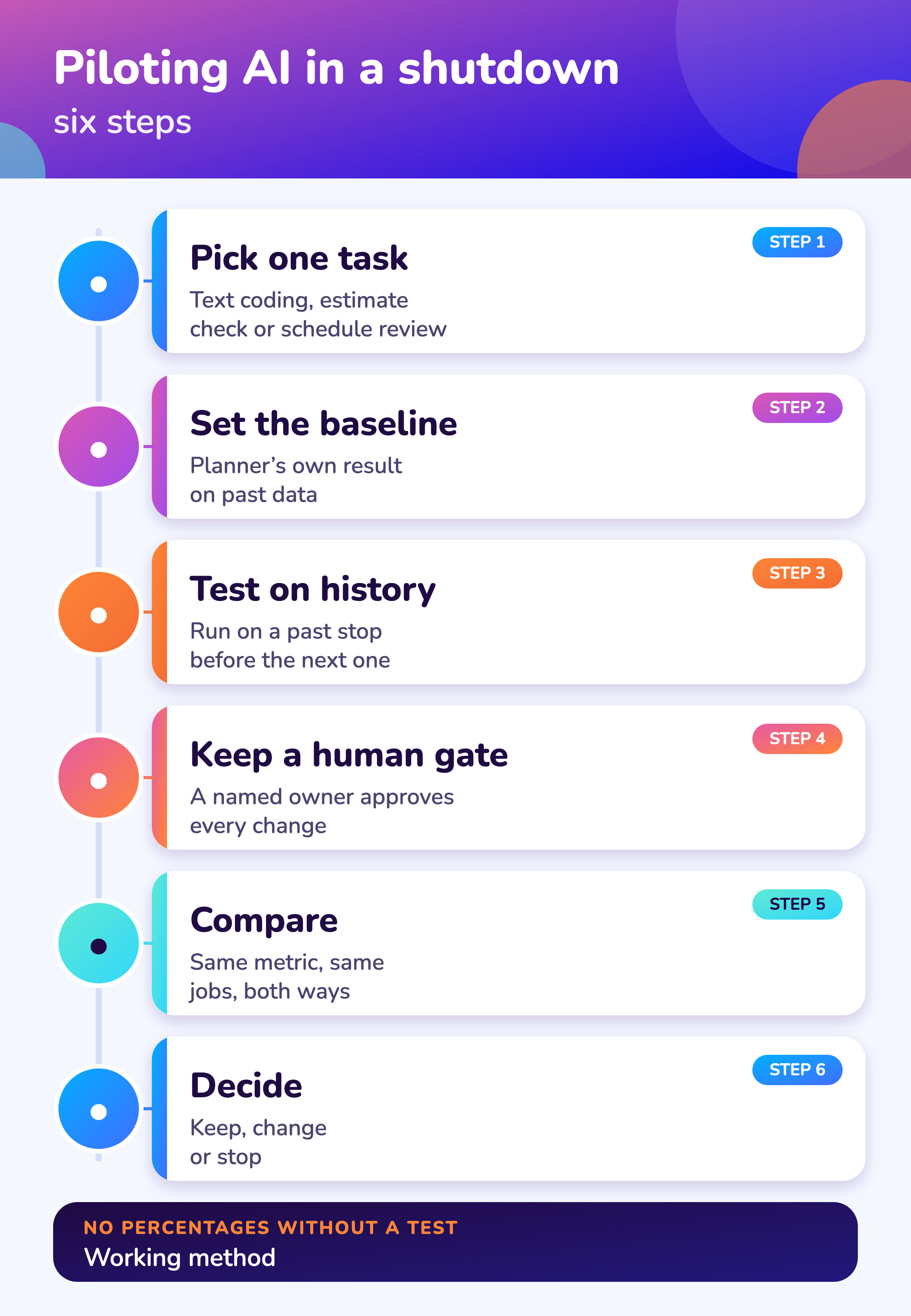
Pilot AI on one task, run it on a past stop first, compare it with the planner’s own result on the same jobs using one agreed metric, keep a named human approval step, and decide to keep, change or stop; do not quote a percentage gain until you have tested it.
- 1
Pick one task
For example coding work requests or checking estimates.
One task - 2
Set the baseline
Record what planners produce today on a past stop.
Baseline - 3
Test on history
Run the tool on that past stop before the next one.
No live risk - 4
Keep a human gate
Name who approves each change and where it is logged.
Accountable - 5
Compare
Same jobs, same metric, both ways.
Fair test - 6
Decide
Keep, change or stop, and write down why.
Decision
The method is our recommendation. It follows the idea in the NIST framework of measuring and managing AI risk before relying on it.
AI agents
What are AI agents in shutdown planning?
An AI agent in shutdown planning is software that takes one defined planning task, works through your records, and proposes a result for a named person to approve, such as grouping work requests into scope, flagging estimates, reviewing the schedule, summarizing the day or drafting lessons; MaintWiz AI agents are part of the module.
| Planning task | What an agent does | Who approves | Check |
|---|---|---|---|
| Scope | Reads work requests and past findings, groups them by equipment and failure mode, and proposes what belongs in scope | The planner, before anything enters the scope list | Sample the grouping against a reliability engineer |
| Estimates | Compares each job with similar past jobs and flags estimates that look high or low | The planner and the estimator | Test on a past stop whose actuals you know |
| Schedule | Reviews the network for missing links, long float and risky sequences, and shows what moves the finish date | The scheduler who owns the baseline | Rebuild the critical path by hand once |
| Daily progress | Summarizes progress, open permits, findings and look-ahead issues for the daily meeting | The turnaround manager | Compare with the source records |
| Close-out | Drafts lessons from findings, delays and deferred items | The turnaround manager | Link each lesson to a record |
The design rule is simple: agents propose, people approve, and every suggestion is logged against the person who accepted or rejected it. Agents stay away from permits and isolations. Tell us the task you want first and we will build around it: requirements from plants set the order.
The tasks above are the planning jobs described earlier on this page. Use the AI readiness and vendor claims scorecard to check your data before a pilot.
Visuals
Save the AI shutdown planning charts
Two charts to share with your planning team. Click either for the full-size image.
FAQ
Frequently asked questions
What is AI shutdown planning?
Using machine learning or language models to help with shutdown planning tasks such as coding work-order text, checking estimates or reviewing the schedule, with people keeping the decisions.
Can AI plan a turnaround on its own?
AI works best as the planner’s assistant: it does the first pass on records and drafts, and people own the scope, schedule logic and safety decisions. Published research so far covers narrower tasks than a full turnaround plan. 1,2,3
Does AI reduce turnaround cost or duration?
We publish no figure. A claim needs a test on your own history, with a baseline and an agreed metric.
Which turnaround task has the best evidence for AI?
Coding work-order text: one preprint reports F1 0.80 for a fine-tuned model against 0.60 for a conventional classifier. 1
Can a language model write the shutdown schedule?
It can draft text and suggest sequences, but the logic, critical path and baseline need an owner who can check them. Treat its output as a draft.
Should AI touch permits and isolations?
No. Keep permits, isolations and entry steps with the people and procedures the regulation requires. 5
What data do we need before a pilot?
Work orders with consistent codes and text, past packages with planned and actual hours, scope changes with reasons, and schedule files.
Is there a standard for managing AI risk?
The US NIST AI Risk Management Framework is voluntary and general. 4
Does MaintWiz offer AI agents for shutdowns?
AI agents support shutdown planning. The shutdown module today covers the schedule, readiness gates, spares status and findings.
What are AI agents in shutdown planning?
Software that takes one defined planning task, works through your records and proposes a result for a named person to approve. Examples are grouping work requests, flagging estimates, reviewing the schedule, summarizing the day and drafting lessons.
How do we test a vendor AI claim?
Ask which task, which data, which test, which metric against which baseline, who approves, and where the data goes. Use the scorecard file.
Sources
Sources
- Stewart, M., Hodkiewicz, M. and Li, S., Large Language Models for Failure Mode Classification: An Investigation (arXiv:2309.08181, September 2023; preprint, no peer-review status stated on the page)
- Yeardley, A. S., Ejeh, J. O., Allen, L., Brown, S. F. and Cordiner, J., Integrating machine learning techniques into optimal maintenance scheduling, Computers & Chemical Engineering, vol. 166, 107958 (2022; White Rose repository record, open access)
- Al-Turki, U. M., Duffuaa, S. O. and Bendaya, M., Trends in turnaround maintenance planning: literature review, Journal of Quality in Maintenance Engineering, vol. 25 (2019 listing at KFUPM; review of more than 80 papers; read from the repository summary, not the full text)
- US National Institute of Standards and Technology, AI Risk Management Framework (NIST AI 100-1, 26 January 2023; Generative AI Profile NIST AI 600-1, 26 July 2024)
- OSHA, 29 CFR 1910.119, Process safety management of highly hazardous chemicals
Move your shutdown plan out of spreadsheets
Book a demo and bring the spreadsheet you use today. We will show how the module covers the same ground.