
Equipment guide
Catalyst Change-Out and Fired Heater Turnaround Planning
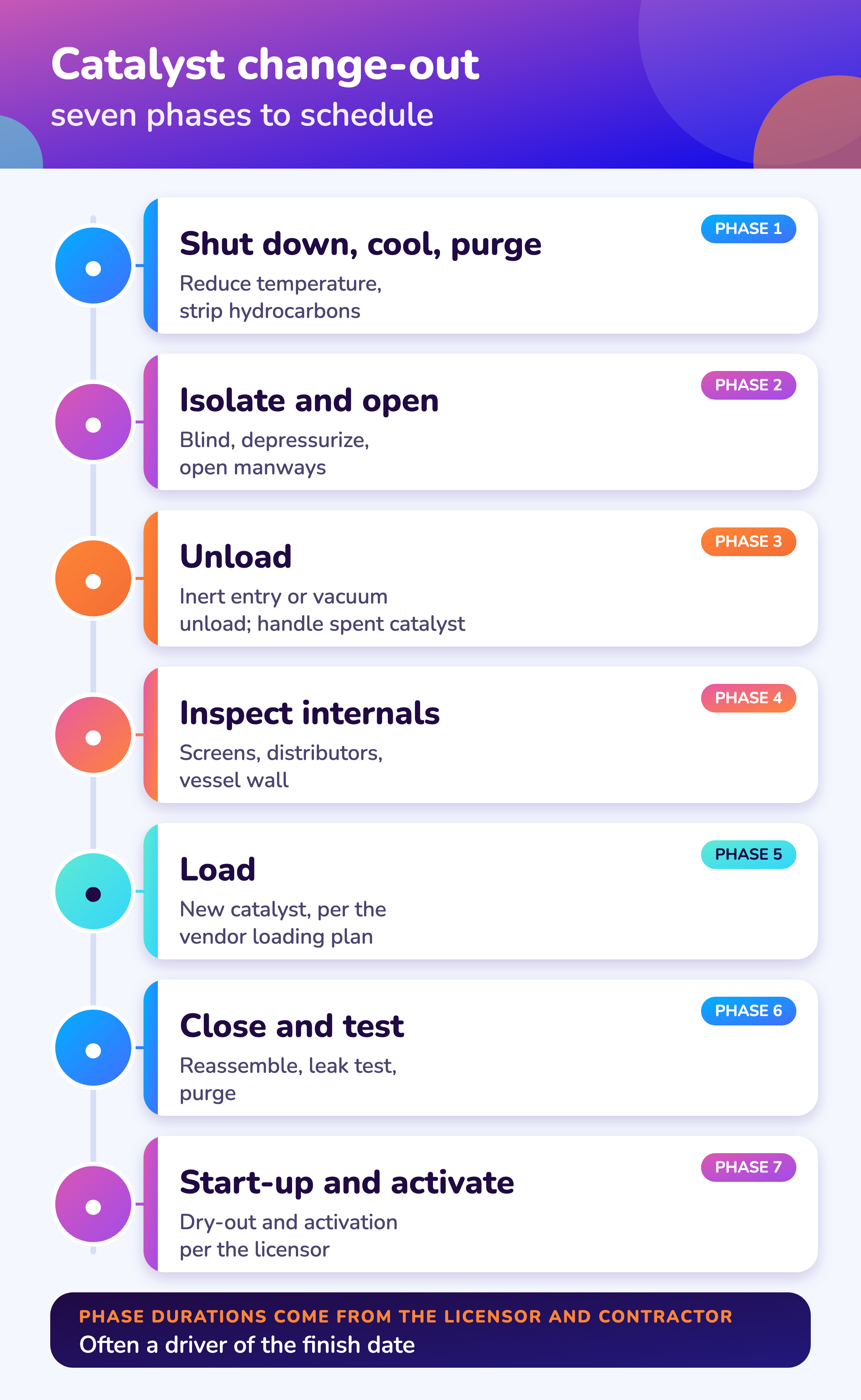
Catalyst change-out planning sequences seven phases, from shutdown and purge through unloading, inspection and loading to activation, and orders the catalyst and loading contractor first because their lead times are long. Fired heater planning adds tube, refractory and burner work and a controlled dry-out on the restart critical path. MaintWiz schedules the phases with permits, parts and contractors in one plan.
STO means shutdown, turnaround and outage. Phase durations and methods come from the licensor, the catalyst vendor and the contractor.
How MaintWiz helps: Long-lead catalyst and specialist contractors set the finish date. The MaintWiz shutdown module gives plant teams one plan for scope, schedule, permits, spares and execution, from the first work package to close-out. See the module · Get the change-out skeleton
By Jai Balachandran · Published · Last reviewed
What MaintWiz adds:Scope, schedule and permits in one planSpares status with SAPReadiness gatesFindings to the planner
Definition
What is catalyst change-out and fired heater turnaround planning?
Catalyst change-out planning schedules the unloading of spent catalyst, inspection of the reactor internals, loading of new catalyst and the closing, testing and activation steps, while fired heater planning covers tube, refractory and burner work and the dry-out before restart; both are specialist work run through contractors. In this guide STO means shutdown, turnaround and outage.
Reactor catalyst change-outs and heater work are often among the longest activities in a refinery or chemical turnaround, so their sequence and lead times decide how long the unit is down. The detailed method comes from the catalyst licensor, the catalyst vendor and the loading contractor. The planner’s job is to fit their phases, permits, materials and lead times into the stop.
Download the free catalyst change-out schedule skeleton (Excel) to lay out the phases and check the lead times. It contains no durations: take them from your licensor and contractor.
Phases
What are the phases of a catalyst change-out?
A reactor catalyst change-out runs through shutdown and cool-down, purge and isolation, opening, unloading spent catalyst, inspecting internals, loading new catalyst, closing and leak testing, and start-up with any dry-out and activation, and each phase has its own contractor, permit and duration.
- 1
Shut down, cool and purge
Reduce temperature and strip hydrocarbons per the unit procedure.
Operations - 2
Isolate and open
Blind, depressurize and open manways under permit.
Permit - 3
Unload
Spent catalyst is removed by specialist contractors, with inert entry where the catalyst needs it.
Contractor - 4
Inspect internals
Screens, distributors, vessel wall and supports.
Inspector - 5
Load
New catalyst loaded to the vendor’s loading plan.
Contractor - 6
Close and test
Reassemble, leak test and purge.
Fitters - 7
Start up and activate
Dry-out and activation per the licensor.
Operations
Keep every phase duration in the schedule from the licensor and contractor plans. See shutdown scheduling.
MaintWiz
How does MaintWiz plan specialist contractor work?
MaintWiz schedules the change-out phases on the critical path with the long-lead catalyst, the contractor and the permits tied to each work order and gates the start of each package on readiness; AI agents support shutdown planning.
Bring your change-out plan to a demo and we will load the phases. Tell us how you manage licensor and contractor durations: plant requirements shape what we build next.
About MaintWiz. MaintWiz is an industrial AI platform with IoT, SAP integration and predictive maintenance (PdM) capabilities. Its shutdown and turnaround module helps plants plan, schedule, execute and close out shutdown work.
What the shutdown module covers
As described on the MaintWiz shutdown maintenance product page.
- Gantt chart with critical path, float and baselines
- Spares status with the SAP request or order behind each short part
- Permits and isolations shown on each work order
- Contractor and trade availability by week
- Seven readiness gates with signed waivers
- Handover notes and as-left summary
Proof
What MaintWiz customers report
Figures as published in MaintWiz case studies on maintwiz.com. They come from maintenance management projects, not shutdowns.
Safety
What are the main safety risks in a catalyst change-out?
The main risks are spent catalyst or sulfide scale that heats or ignites in air, entry into an inert atmosphere, incomplete isolation, dust and chemical exposure, and fire near hot work, so the plan must carry specialist contractors, rescue, gas testing and a restart review.
| Point | Why it matters | Planning action |
|---|---|---|
| Spent catalyst and scale can self-heat | Some spent catalysts and sulfide scale react with air and can ignite | Plan inert handling or controlled wetting as the contractor and licensor specify |
| Inert atmosphere entry | A nitrogen atmosphere cannot sustain life; entry needs breathing air and rescue | Specialist contractor, permit and rescue plan; see permit management 1 |
| Isolation | Lines to the reactor must be positively isolated | Blind list and proving; see scaffolding planning for access and the HSE isolation guidance 2 |
| Dust and chemical exposure | Catalysts can be toxic or irritant | Occupational hygiene plan and respiratory protection per the safety data sheet |
| Fire and explosion | Hydrocarbons and pyrophoric material near hot work | Gas testing and hot work control; see the OSHA rule on fire prevention in welding and cutting 4 |
| Pre-startup review | Changes and repairs need a check before start-up | Include the change-out in the restart review 3 |
This table is a planning prompt, not a procedure. Follow the licensor, the catalyst safety data sheet, your confined space program and the regulations that apply.
Lead times
What lead times matter for a catalyst change-out?
Order the new catalyst and book the loading contractor first, since both have long lead times; then arrange vacuum unloading, nitrogen, replacement internals, spent catalyst disposal or reclaim, and the refractory and burner spares, working back from the date the reactor opens.
- New catalyst: order and delivery
- Inert-entry and loading contractor: booked early
- Vacuum unloading unit and nitrogen supply
- Spent catalyst disposal or reclaim route
- Replacement screens and internals
- Refractory and burner spares for the heater
Track each item in the long-lead list. See spares planning and the lead-time sheet in the download.
Fired heater
What does a fired heater turnaround include?
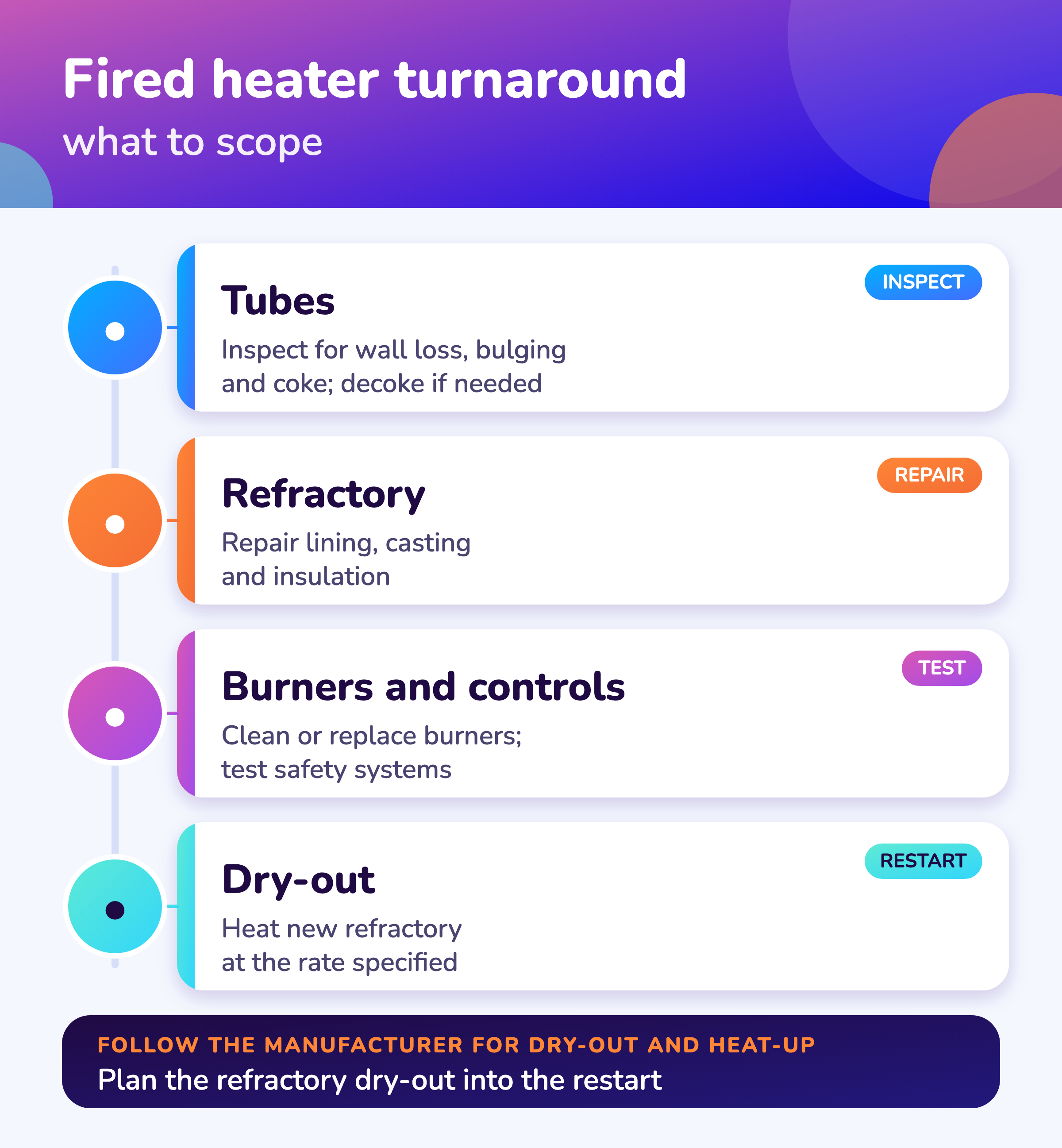
A fired heater turnaround inspects and repairs the tubes, repairs the refractory, cleans or replaces burners and tests the safety systems, then dries out new refractory and heats up at the rate the manufacturer specifies, which puts dry-out on the restart critical path.
| Area | Typical work | Planning note |
|---|---|---|
| Tubes | Visual inspection, thickness checks, signs of bulging or coke; decoking or replacement | Decoke method from the unit procedure; inspection plan agreed with the engineer |
| Refractory | Repair of lining, castable and insulation | New refractory needs a controlled dry-out before normal firing |
| Burners and controls | Clean or replace burners; test flame detection and safety shutdown systems | Include in the restart readiness check |
| Structure and stack | Check supports, casing, stack and dampers | Needs scaffold and access |
| Dry-out and heat-up | Heat at the rate the manufacturer or licensor specifies | Put it in the restart schedule and on the critical path |
See start-up after a shutdown for the restart review.
Visuals
Save the change-out planning visuals
Two visuals for the turnaround team. Click either for the full-size image.
FAQ
Frequently asked questions
What are the phases of a catalyst change-out?
Shut down and purge, isolate and open, unload, inspect internals, load, close and test, then start up with dry-out and activation as the licensor specifies.
How long does a catalyst change-out take?
It depends on the reactor, the catalyst and the contractor. Take phase durations from the licensor and contractor plans and put them in the schedule.
Why is spent catalyst hazardous?
Some spent catalysts and sulfide scale can heat or ignite in air, and catalysts can be toxic or irritant. Follow the licensor and the safety data sheet.
Why is inert entry planned separately?
An inert atmosphere cannot support life, so entry needs breathing air, a permit and a rescue plan run by a specialist contractor. 1
What lead times matter most?
The new catalyst and the loading contractor. Order and book them first, then work back for unloading, nitrogen, internals and disposal.
What does a fired heater turnaround include?
Tube inspection and repair, refractory repair, burner cleaning or replacement, safety system tests and a controlled dry-out before normal firing.
Why does refractory dry-out matter for the schedule?
New refractory must be heated at the rate the manufacturer specifies before normal firing, so the heat-up is part of the restart critical path.
Is there a free change-out schedule template?
Yes. The catalyst change-out schedule skeleton (Excel) sequences ten phases and checks the lead times. You supply the durations.
Does MaintWiz schedule specialist contractor work?
It puts the phases on the critical path and gates each package on readiness. AI agents are part of the module. See AI shutdown planning.
Sources
Sources
This page gives planning practice only. Methods, durations and safety limits come from the licensor, the catalyst vendor, the contractor and the regulations that apply. The OSHA page covers fire prevention in welding and cutting.
- OSHA, 29 CFR 1910.146, Permit-required confined spaces
- OSHA, 29 CFR 1910.147, The control of hazardous energy (lockout/tagout)
- OSHA, 29 CFR 1910.119, Process safety management of highly hazardous chemicals
- eCFR, 29 CFR 1910.252(a), Fire prevention and protection in welding, cutting and brazing (read via Cornell LII)
Plan your next shutdown in one system
Book a demo and tell us about your plant. We will show how the module handles your shutdown.