
Shutdown budget
How to Estimate a Shutdown Budget: Cost and Contingency
A shutdown budget is built bottom-up: estimate each work package, add support costs, then add contingency sized by risk, and track actual cost against the baseline during execution. There is no universal contingency percentage; GAO says there are no set rules for what level is sufficient.
Budget here means direct and support cost. Lost production is counted separately as the cost of delay.
How MaintWiz helps: Budgets slip when cost is seen after the work, not during it. The MaintWiz shutdown module tracks earned value, cost and schedule indices and shows budget, actual and forecast cost in one view. See the module · Get the budget template
By Jai Balachandran · Published · Last reviewed
What MaintWiz adds:Earned value and cost indicesBudget, actual and forecast costCost by project and packageCumulative spend
Categories
What costs go into a shutdown budget?
A shutdown budget includes labor, contractors, materials and spares, equipment and access, inspection and testing, logistics, engineering and planning, and contingency. Lost production is counted separately. These are working categories, not a standard list.
A budget and contingency workbook is among the free shutdown templates. Parts and long-lead costs are covered in shutdown spare parts planning. Parts demand in SAP: SAP MM shutdown materials.
The work being costed is shutdown maintenance; the cost of the stop itself is covered in planned vs unplanned shutdown cost.
An illustrative budget, in units
- Labor: 240
- Contractors: 280
- Materials and spares: 180
- Equipment and access: 80
- Inspection and testing: 50
- Logistics and site services: 40
- Contingency: 130
Made-up numbers to show how the parts add up. Not a typical split or percentage.
| Category | What it includes | How to estimate it |
|---|---|---|
| Labor | Own maintenance and operations staff, including overtime and shift allowances | Hours per work package multiplied by the rate |
| Contractors | Contract labor, supervision, mobilization and demobilization | Quoted price, unit rates or hours by trade, depending on the contract |
| Materials and spares | Parts, consumables and long-lead items | Bill of materials per work package, plus freight and handling |
| Equipment and access | Cranes, scaffolding, temporary power, rental tools | Days on site multiplied by the daily rate |
| Inspection and testing | Non-destructive testing, pressure tests, statutory inspections | Quoted or scheduled per item |
| Logistics and site services | Gate and induction, accommodation, waste, welfare | Headcount multiplied by days multiplied by the rate |
| Engineering and planning | The shutdown team, engineering, planning and scheduling | Team size multiplied by months |
| Contingency | An amount for uncertainty within the defined scope | Set by risk analysis at the confidence level management chooses |
| Lost production | Output that is not made during the stop | Kept separate from the direct budget; see the cost of a day of delay below |
Method
How do you estimate a shutdown budget?
A shutdown budget is estimated bottom-up from the work packages, plus support costs, cross-checked against your own history, with contingency set by risk. This is a practical method; GAO's cost guide organizes its best practices for program estimates into 12 steps.1
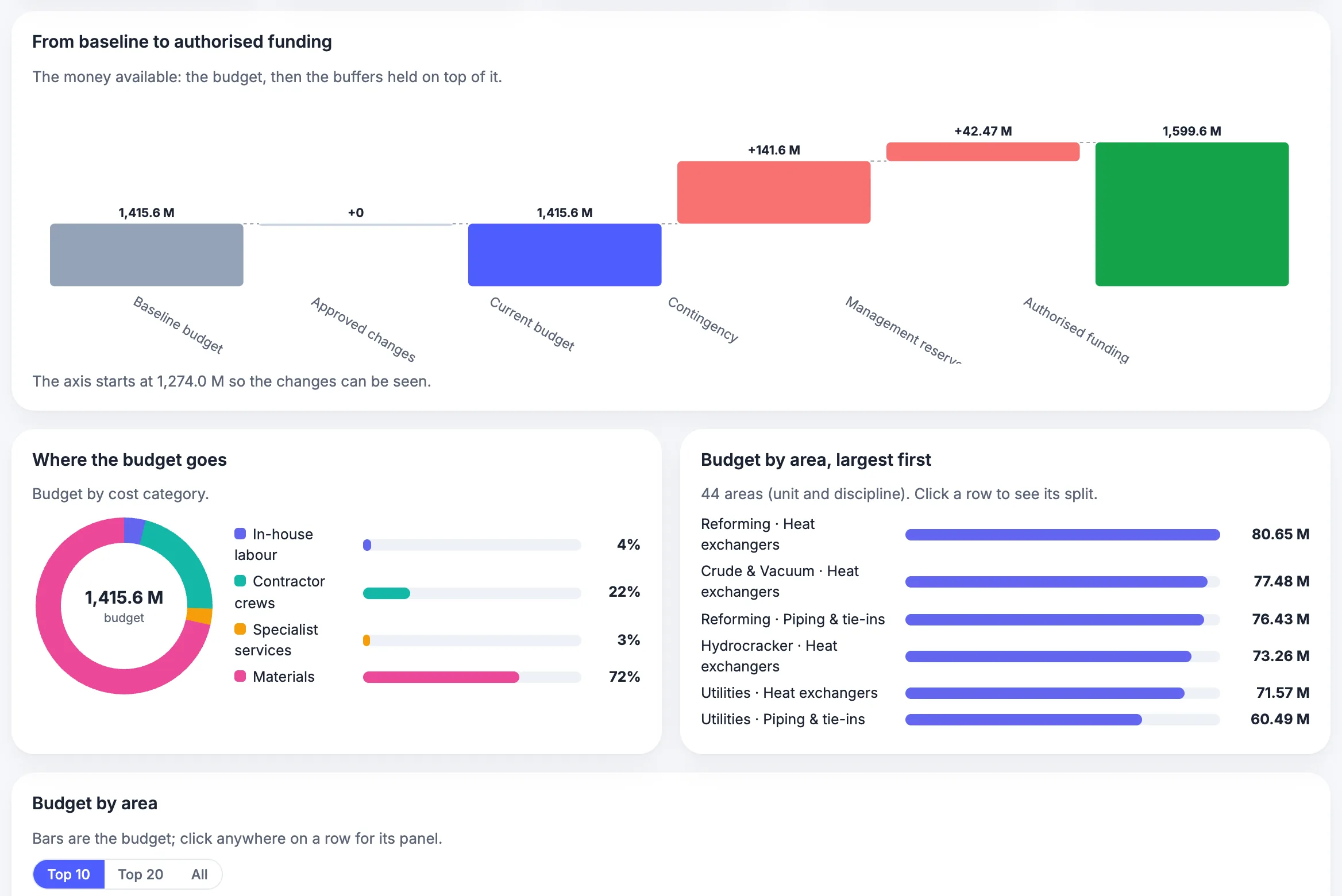
Past stop costs are history to keep: SAP S4HANA maintenance data migration. Estimate classes and the basis of estimate are explained in turnaround cost estimate and AACE classes.
- 1
Fix the scope
Start from the frozen scope and work packages. An estimate can only be as firm as the scope behind it.
- 2
Estimate bottom-up
Cost each work package: hours and rates, materials, equipment, inspection.
- 3
Add support and indirect costs
Logistics, site services, engineering, planning and management of the stop.
- 4
Cross-check
Compare the total with the cost of previous shutdowns of similar scope in your own records.
- 5
Analyze risk and set contingency
Identify what could change the cost and set contingency at a confidence level management chooses. 1
- 6
Document and approve
Record assumptions, what is in and out of scope, and who approved the number.
- 7
Baseline it
Fix the approved work budget as the baseline you will measure progress against.
Related: shutdown scope · work packages · risk assessment.
Software
Where should the shutdown budget be tracked?
The shutdown budget should be tracked next to the work packages and schedule, so that actual cost and progress come from the same records.
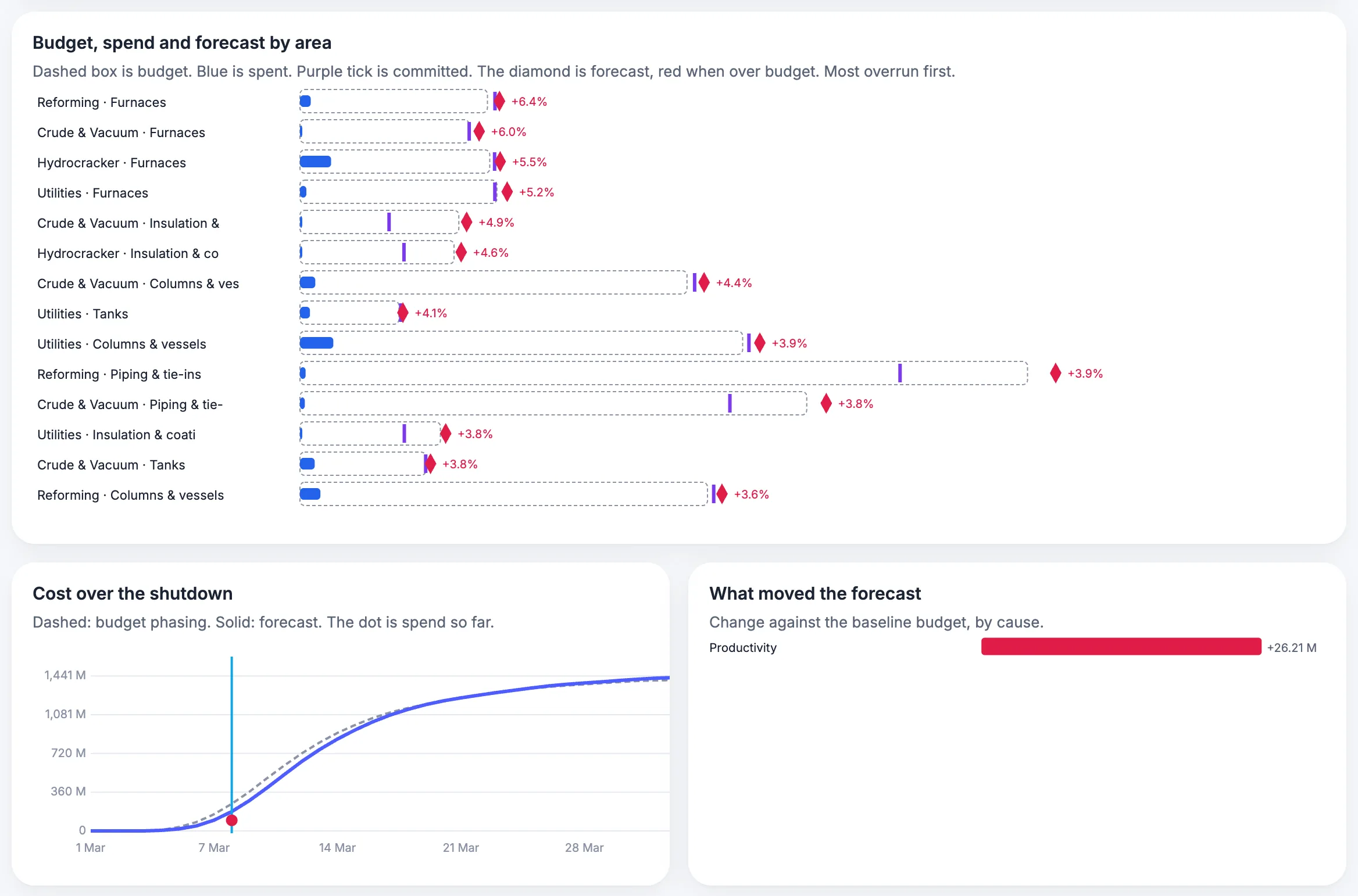
For choosing tools see shutdown software vs CMMS vs Primavera P6.
About MaintWiz. MaintWiz is an industrial AI platform with IoT, SAP integration and predictive maintenance (PdM) capabilities. Its shutdown and turnaround module helps plants plan, schedule, execute and close out shutdown work.
What the shutdown module covers
As described on the MaintWiz shutdown maintenance product page.
- Shutdown calendar and critical-path scheduling, with work order sequencing and dependencies
- Resource planning for people, spares, heavy equipment such as cranes, and outsourced vendors
- Real-time progress monitoring: schedule adherence, cost variance, quality metrics and risk factors
- Step-by-step checklists, pre-restart testing protocols and post-shutdown analysis
Proof
What MaintWiz customers report
Figures as published in MaintWiz case studies on maintwiz.com. They come from maintenance management projects, not shutdowns.
Accuracy
How accurate is a shutdown estimate, and why does scope definition matter?
The better a shutdown scope is defined, the narrower the estimate range. A US Department of Energy protocol says estimate uncertainty is expected to decrease as project definition improves and the project matures, and publishes ranges by estimate class. These come from capital projects; a shutdown estimate may differ, but the direction holds: a frozen scope tightens the range.2
For why estimates fall short, see why shutdowns go over budget.
| Estimate class | Low range | High range |
|---|---|---|
| Class 5: concept screening | -20% to -50% | +30% to +100% |
| Class 4: study or feasibility | -15% to -30% | +20% to +50% |
| Class 3: budget authorization | -10% to -20% | +10% to +30% |
| Class 2: control or bid | -5% to -15% | +5% to +20% |
| Class 1: check estimate | -3% to -10% | +3% to +15% |
The classes are the professional-society ranges as reproduced in the DOE protocol for capital asset projects. They are not shutdown benchmarks.
Contingency
How much contingency should a shutdown budget carry?
No universal contingency percentage exists for a shutdown budget. Set it from a risk analysis at the confidence level management chooses, and reduce it as the scope firms up. The 130 units in the example come from an assumed risk analysis, not from a rule.
See turnaround cost estimate and AACE classes for how to size and hold contingency.
No universal percentage
GAO says that because each program is different, there are no set rules as to what level of contingency is sufficient. 1
Set it by risk
GAO describes the required contingency as the difference between the point estimate and the estimate at the confidence level decision-makers choose. 1
Define what it is for
GAO describes contingency as funds added to an estimate for items, conditions or events whose state, occurrence or effect is uncertain and that experience shows are likely to cost more. 1
Keep it separate from scope changes
Discovered work is outside the original scope in NERC's reporting rules, so decide up front whether contingency covers it or whether it goes through change control. 3
Cost of delay
How do you calculate the cost of one extra day of shutdown?
The cost of one extra day of shutdown is the margin lost for each extra day without production plus the extra cost of keeping the shutdown running. Use margin, not revenue, and count a fixed cost only if the delay adds to it.
For a published example of outage length, see nuclear refueling outage durations. For planned against unplanned cost, see planned vs unplanned shutdown cost.
Cost of one extra day
Daily cost = lost margin + extra running cost
Add the margin lost for each day production is out, and the extra daily cost of keeping the crews, equipment and services on site.
Lost margin per day
Daily output x (price - variable cost)
Use contribution margin, not revenue. Output that is only deferred and sold later is not fully lost.
Do not double count
Count a fixed cost only if the delay adds to it
Fixed costs that are paid anyway are not caused by the delay.
| Item | Per day | Note |
|---|---|---|
| Lost contribution margin | 120 | Output not made, valued at price less variable cost |
| Crews and equipment kept on site | 25 | Extra daily cost caused by the delay |
| Site services | 5 | Only the part that continues because of the delay |
| Cost of one extra day | 150 | Sum of the three lines |
The numbers are made up to show the arithmetic. No source gives a typical cost of delay for any industry.
Try it: cost of delay
Enter your own numbers. Nothing is sent or stored; the sums run in your browser. The starting values are the made-up numbers from the worked example.
Cost control
How do you control cost during the shutdown?
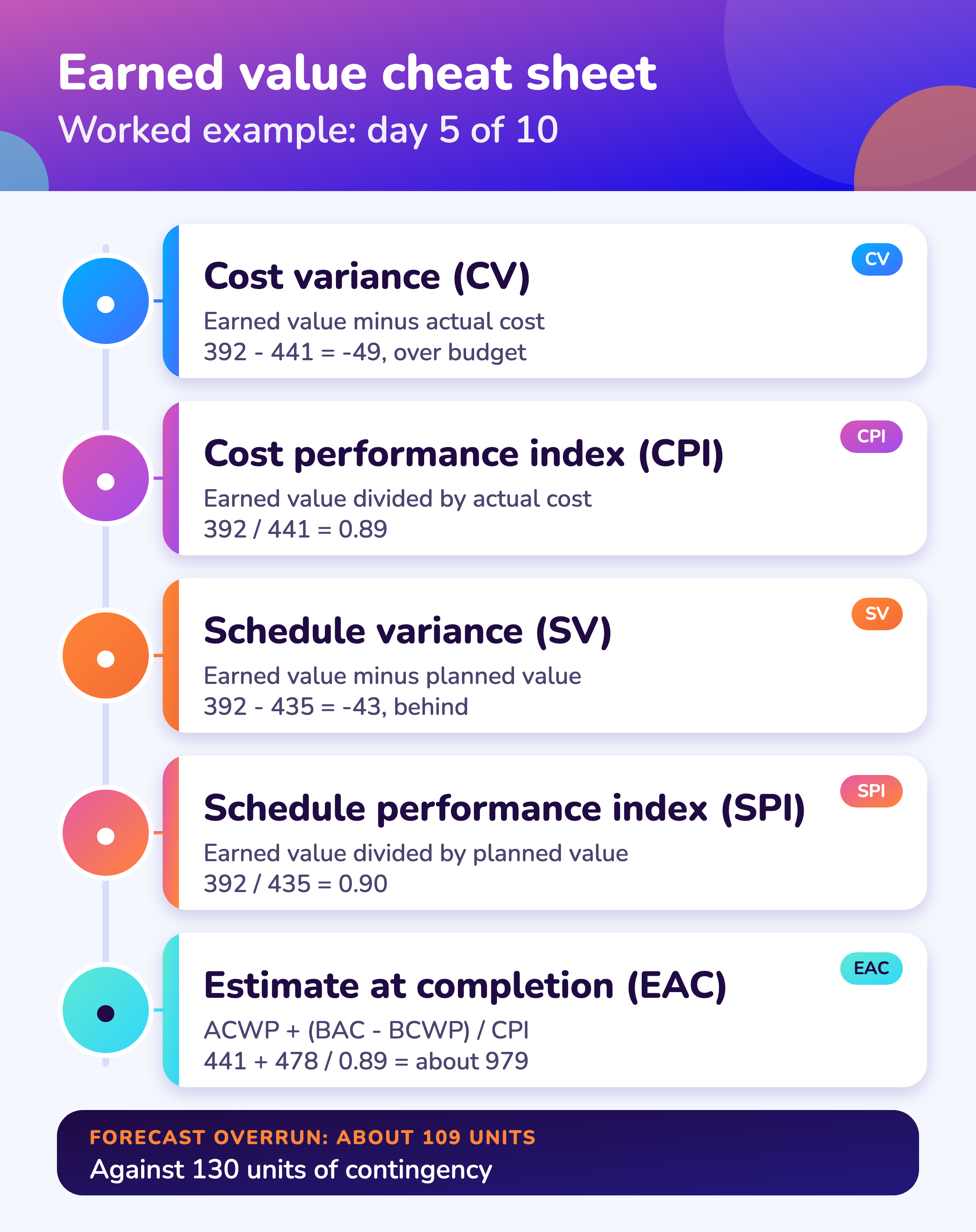
Cost control during the shutdown means measuring earned value against planned value and actual cost, and forecasting the final cost from performance to date. GAO describes earned value management as comparing the value of work accomplished with the actual cost and with the work planned, and measures differences as cost and schedule variances.1
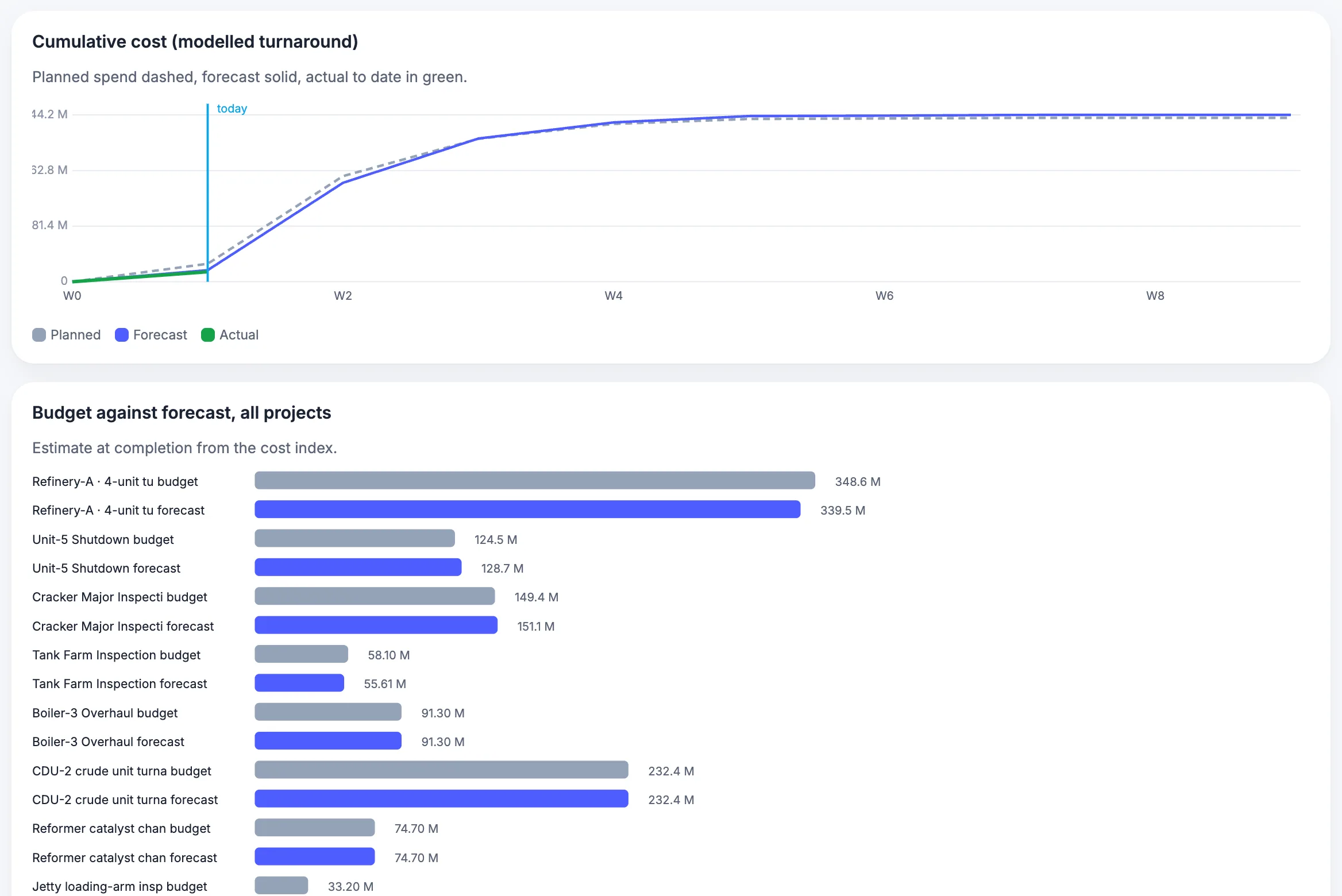
For measuring the return on a shutdown program, see shutdown program ROI. The cost measures in a worked example: shutdown case study. A free Excel file for this page: budget and contingency workbook (.xlsx). If a software line is in the budget, see turnaround software cost. Cost-control tools compared: Cleopatra Enterprise alternatives.
Cost variance (CV)
CV = BCWP - ACWP
Earned value minus actual cost. Positive is favorable.
Cost performance index (CPI)
CPI = BCWP / ACWP
Above 1.0 the work cost less than planned.
Schedule variance (SV)
SV = BCWP - BCWS
Earned value minus planned value. Positive is ahead.
Schedule performance index (SPI)
SPI = BCWP / BCWS
Above 1.0 more work was done than planned.
Estimate at completion (EAC)
EAC = ACWP + (BAC - BCWP) / efficiency index
The forecast final cost, adjusted by past performance.
| Measure | Value | How it is found |
|---|---|---|
| Budget at completion (BAC) | 870 | The baseline for the work, excluding contingency |
| Planned value (BCWS) | 435 | Work planned by day 5 (half the baseline) |
| Earned value (BCWP) | 392 | Budget of the work actually completed |
| Actual cost (ACWP) | 441 | What has been spent |
| Cost variance | -49 | 392 - 441: over budget |
| CPI | 0.89 | 392 / 441 |
| Schedule variance | -43 | 392 - 435: behind plan |
| SPI | 0.90 | 392 / 435 |
| EAC (using CPI) | about 979 | 441 + (870 - 392) / 0.89 |
| Forecast overrun | about 109 | 979 - 870, against 130 of contingency |
GAO defines BCWP (earned value) as the budget for completed work, BCWS as the budget for work scheduled, and ACWP as actual cost. A CPI below 1.0 means the work cost more than planned, and GAO notes an unreliable earned value system gives unreliable results, so keep progress reporting honest. 1 Set variance thresholds that trigger action to suit your own history; no source gives a universal one.
Related: cost variance analysis · shutdown ROI · shutdown KPIs.
Visuals
Save the budget charts
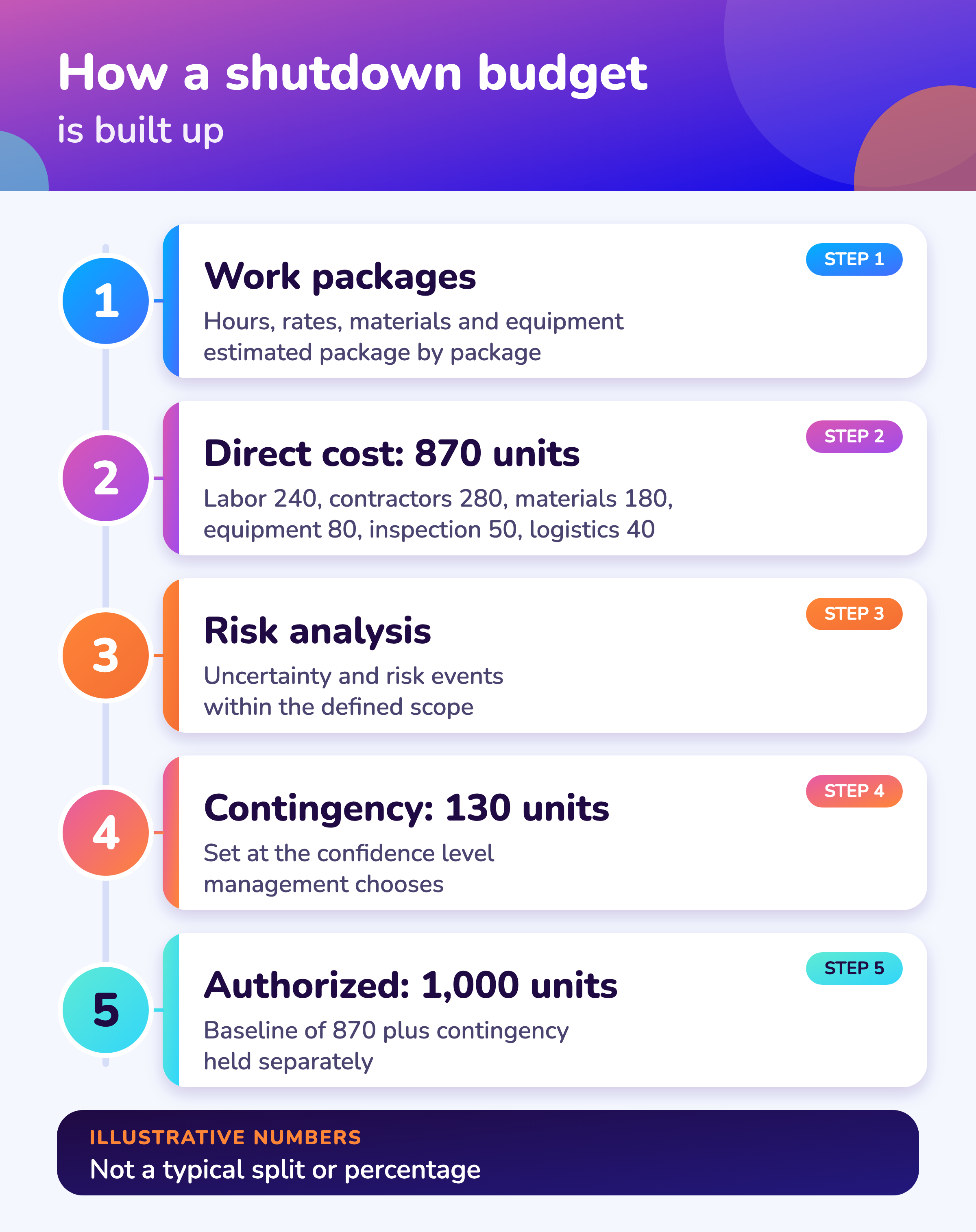
Two budget charts to save or share. Click either to see it at full size.
FAQ
Frequently asked questions
How do you estimate a shutdown budget?
Estimate each work package bottom-up (hours, rates, materials, equipment, inspection), add support and indirect costs, cross-check against your own history, then add contingency from a risk analysis and baseline the approved work budget. GAO organizes its cost-estimating best practices into 12 steps. 1
What costs are included in a shutdown budget?
Labor, contractors, materials and spares, equipment and access, inspection and testing, logistics and site services, engineering and planning, and contingency. Lost production is counted separately as the cost of delay. These are working categories, not a standard list.
How much contingency should a shutdown budget have?
There is no universal percentage. GAO says there are no set rules as to what level of contingency is sufficient, and that the required amount is the difference between the point estimate and the estimate at the chosen confidence level. 1
How accurate is a shutdown cost estimate?
It depends on how well the scope is defined. A DOE protocol says estimate uncertainty is expected to decrease as project definition improves, and lists ranges by estimate class for capital projects, from -20% to -50% and +30% to +100% for a concept screening estimate to -3% to -10% and +3% to +15% for a check estimate. 2
How do you calculate the cost of one extra day of shutdown?
Add the contribution margin lost for the day (output multiplied by price less variable cost) to the extra daily cost of keeping the crews, equipment and services on site. Count a fixed cost only if the delay adds to it. The worked example above uses made-up numbers.
What is earned value?
Earned value (BCWP) is the budget for the work actually completed. Comparing it with actual cost gives cost variance and CPI; comparing it with planned value gives schedule variance and SPI. 1
How do you read a CPI of 0.89?
It means the work completed so far cost about 12% more than budgeted for that work (1 / 0.89). A CPI below 1.0 means work cost more than planned. 1
Why do shutdown budgets overrun?
A common cause is work found after the scope is fixed: NERC's generator reporting rules treat discovery work as outside the original scope of work. Freeze the scope, hold contingency for uncertainty, and put later work through change control. See shutdown scope definition. 3
Sources
Sources
Sourced figures on this page come from the public sources below. The budget, delay and earned-value numbers are made-up illustrations and are labeled that way. Check the source for updates before relying on any figure.
- US Government Accountability Office, GAO Cost Estimating and Assessment Guide (GAO-20-195G, March 2020)
- US Department of Energy, EM Protocol for Application of Contingency and Management Reserve for the Acquisition of Capital Asset Projects (final, 12 April 2010)
- North American Electric Reliability Corporation, Generating Availability Data System (GADS) Data Reporting Instructions, effective 1 January 2026
See cost and schedule performance in one view
Book a demo and bring your shutdown budget. We will show earned value and forecast cost in the module.