
Cost estimating
Turnaround Cost Estimate: AACE Classes and Basis of Estimate
A turnaround cost estimate is built at a stated AACE class, from Class 5 (concept) to Class 1 (check estimate), with a written basis and a separately held contingency. A Class 3 budget estimate typically carries -10% to -20% on the low side and +10% to +30% on the high side. MaintWiz tracks budget, actual and forecast cost against the estimate you approve.
STO means shutdown, turnaround and outage. The class ranges are typical figures from the AACE process-industry practice, not guarantees.
How MaintWiz helps: An estimate without a basis cannot be reviewed or updated. The MaintWiz shutdown module tracks earned value, cost and schedule indices and shows budget, actual and forecast cost in one view. See the module · Get the estimate template
By Jai Balachandran · Published · Last reviewed
What MaintWiz adds:Earned value and cost indicesBudget, actual and forecast costCost by project and packageCumulative spend
Definition
What is a turnaround cost estimate?
A turnaround cost estimate is the forecast of labor, materials, equipment, services and owner costs for the stop, plus contingency, built at a stated level of scope definition and written with a basis that lets someone else review it. 3
The same stop is estimated several times. The first figure, made when the scope is a list of ideas, is a rough range. The last, made when packages are issued, is tight. The AACE estimate class names that level of definition so that everyone reads the number the same way. In this guide STO means shutdown, turnaround and outage.
Download the free basis of estimate template (Excel) for a basis sheet, estimate lines with contingency and the typical range for the class you choose.
Estimate classes
What are the AACE estimate classes?
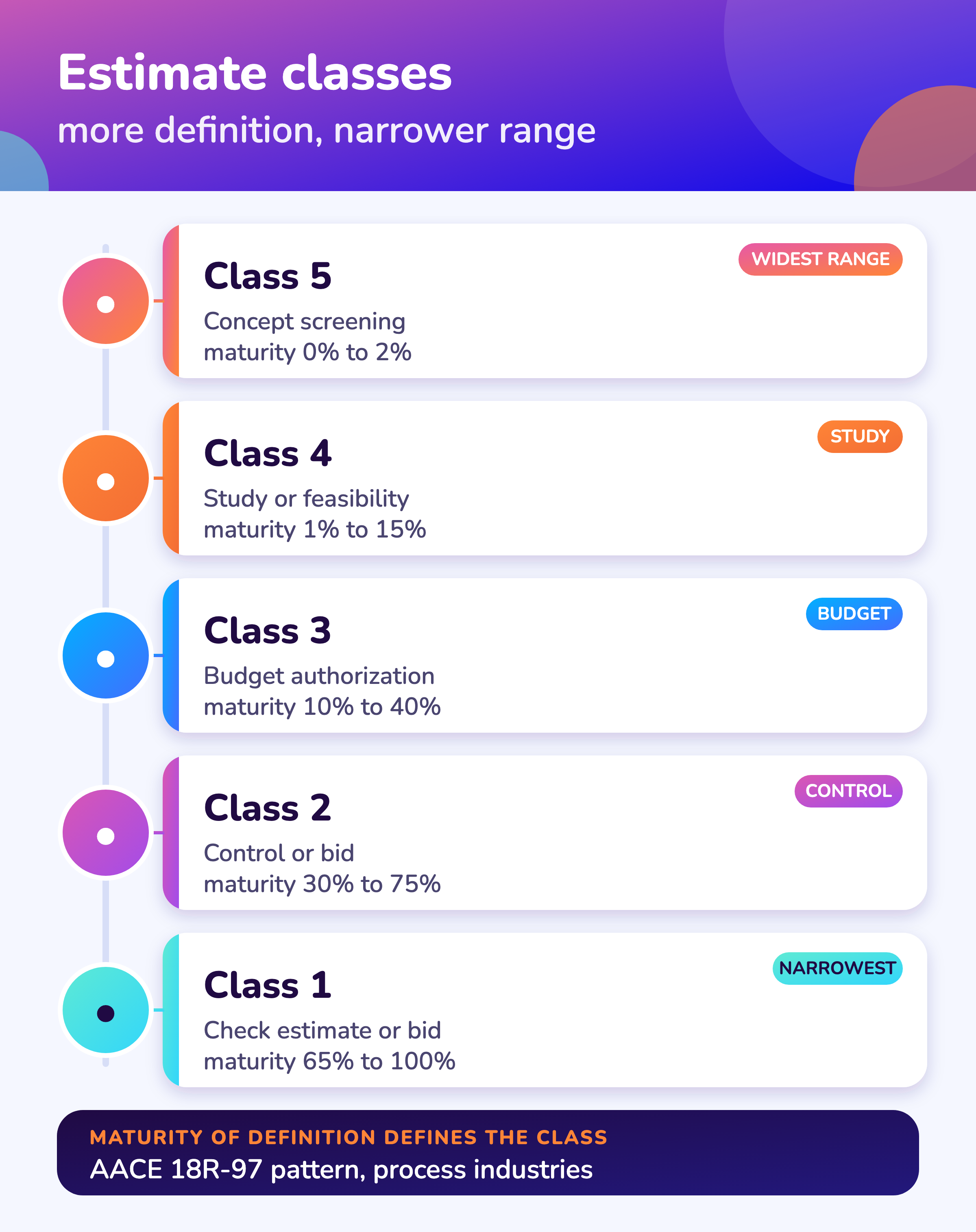
AACE International classifies estimates from Class 5 to Class 1 by how much of the project is defined, from concept screening at 0% to 2% definition with a very wide range to a check estimate at 65% to 100% definition with a narrow one. 1,2
| Class | Typical use | Maturity of definition | Typical low range | Typical high range |
|---|---|---|---|---|
| 5 | Concept screening | 0% to 2% | -20% to -50% | +30% to +100% |
| 4 | Study or feasibility | 1% to 15% | -15% to -30% | +20% to +50% |
| 3 | Budget authorization | 10% to 40% | -10% to -20% | +10% to +30% |
| 2 | Control or bid | 30% to 75% | -5% to -15% | +5% to +20% |
| 1 | Check estimate or bid | 65% to 100% | -3% to -10% | +3% to +15% |
Maturity of definition is what sets the class. The ranges are typical for the process industries and depend on the quality of the estimating and the risk, so treat them as a guide for your own history, not as a promise.
Map the class to your gates. As our assessment, a stop at scope-defined is usually a Class 4 estimate, at plan approval a Class 3, and after the scope freeze a Class 2. See readiness gates.
MaintWiz
How does MaintWiz track the estimate against actual cost?
MaintWiz keeps the budget, actual and forecast cost with earned value, cost and schedule indices by project and package, so the estimate you approved is compared with spend every day; AI agents support shutdown planning.
Bring your last estimate to a demo and we will load it as the baseline. Tell us how you hold contingency: plant requirements shape what we build next.
About MaintWiz. MaintWiz is an industrial AI platform with IoT, SAP integration and predictive maintenance (PdM) capabilities. Its shutdown and turnaround module helps plants plan, schedule, execute and close out shutdown work.
What the shutdown module covers
As described on the MaintWiz shutdown maintenance product page.
- Budget, actual and forecast cost in one view
- Earned value, cost and schedule indices
- Cost by project and package
- Cumulative spend
- Baselines show what moved
- Findings from technicians sent straight to the planner
Proof
What MaintWiz customers report
Figures as published in MaintWiz case studies on maintwiz.com. They come from maintenance management projects, not shutdowns.
Basis of estimate
What is a basis of estimate?
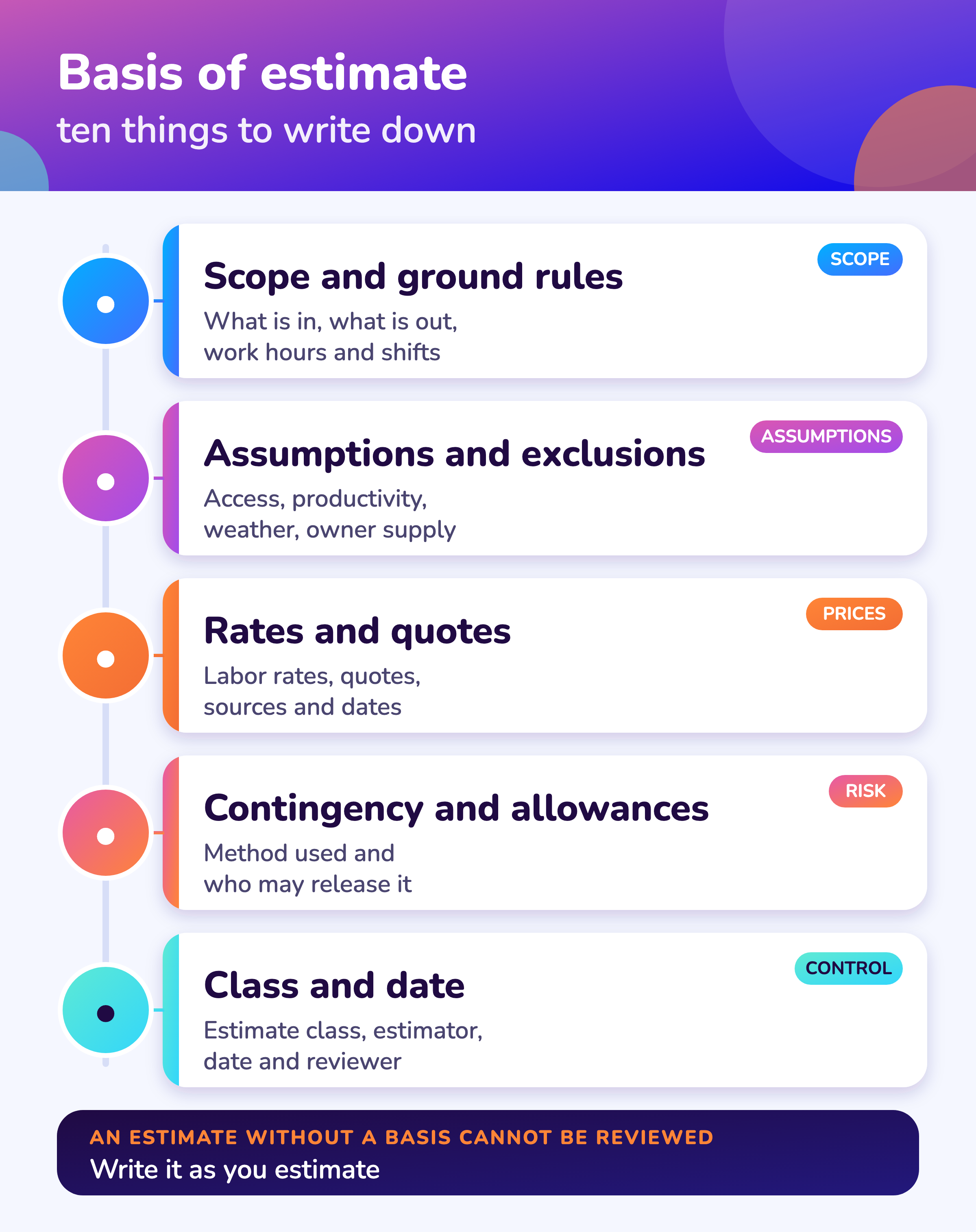
A basis of estimate is the written record of how the estimate was made: scope, ground rules, assumptions, exclusions, quantities, rates and quote sources, allowances, contingency method, escalation, class and reviewer, so that the number can be checked and updated. 3
| Section | What to write |
|---|---|
| Scope and ground rules | What is in and out, work hours, shifts, calendar, owner-supplied items |
| Assumptions and exclusions | Access, productivity, weather, permits, anything not priced |
| Quantities and method | Unit-rate from past stops, factored, or bottom-up from work packages |
| Rates and quotes | Labor rates, contractor quotes, material prices, dates and sources |
| Allowances | What is covered by a lump allowance and why |
| Contingency | Method, amount and who may release it |
| Escalation | Price changes between estimate date and execution |
| Class, date and reviewer | Estimate class, version, estimator and reviewer |
Write the basis while you estimate, not after. When the stop overruns, the basis shows whether the estimate was wrong or the scope changed.
Breakdown
How do you break down a turnaround cost estimate?
Break a turnaround estimate into direct labor, supervision and indirect costs, materials and spares, equipment, scaffold and insulation, inspection and testing, services, engineering and owner costs, and contingency, each with its own source.
| Cost group | Includes | Common source |
|---|---|---|
| Direct labor | Trades on the work packages | Package hours × rate |
| Supervision and indirect | Supervisors, planners, safety, site services | Ratio from past stops |
| Materials and spares | Parts, gaskets, fasteners, consumables | Bill of materials and quotes |
| Equipment | Cranes, hydroblasters, lifts, temporary power | Hire quotes and duration |
| Scaffold, insulation, coating | Access and finishing trades | Scaffold register; see scaffolding planning |
| Inspection and testing | NDE, hydrotest, third-party inspectors | Inspection plan |
| Services | Cleaning, waste, catalyst handling | Contractor quotes |
| Engineering and owner costs | Design, project team, permits | Budget lines |
| Contingency | Allowance for emergent and uncertain work | Method in the basis |
Link the breakdown to the budget. See shutdown budget planning and cost variance analysis.
Contingency
How much contingency should a turnaround estimate carry?
Set turnaround contingency from your own past overruns and from a risk review of the scope, hold it separately from the base estimate, and name the person who can release it; the amount should fall as the class improves. 4
- 1
Price the base scope
Quantities and rates, with no padding.
Base - 2
Add allowances
For known work not yet defined, such as insulation.
Allowances - 3
Review the risks
Emergent work, access, weather, supplier delays.
Risk - 4
Size contingency
Use past stops: how much did emergent work add?
History - 5
Hold and release
One owner; releases are logged with a reason.
Control
Emergent work is the usual reason a stop overruns. See scope management and why shutdowns go over budget.
Visuals
Save the cost estimating visuals
Two visuals for the estimating team. Click either for the full-size image.
FAQ
Frequently asked questions
What is an AACE estimate class?
A label from Class 5 to Class 1 that shows how much of the project is defined when the estimate is made. Less definition means a wider range. 1
What is a Class 3 estimate?
A budget authorization estimate, made at about 10% to 40% project definition, with a typical range of -10% to -20% low and +10% to +30% high. 1
What is a basis of estimate?
The written record of scope, assumptions, rates, quantities, contingency method, class and reviewer that lets someone else check and update the number.
How much contingency does a turnaround need?
It depends on scope maturity and history. Set it from your own past overruns and a risk review, and reduce it as the class improves.
What class should a turnaround estimate be at each stage?
Our assessment: Class 4 at scope defined, Class 3 at plan approval and Class 2 after scope freeze. Check against your company practice.
What is the difference between allowance and contingency?
An allowance covers known work not yet defined. Contingency covers uncertainty and emergent work. Keep them separate in the basis.
How do you estimate turnaround labor?
Take hours from the work packages, convert to people with shift hours and time on tools, and price by trade rate.
Is there a free turnaround estimate template?
Yes. The basis of estimate template (Excel) has a basis sheet, estimate lines with contingency and the typical range by class.
Does MaintWiz track estimates against actual cost?
It tracks budget, actual and forecast cost with earned value and cost and schedule indices. AI agents are part of the module. See AI shutdown planning.
Sources
Sources
The estimate classes follow the AACE International cost estimate classification as reproduced in a US Department of Energy newsletter. The AACE page lists the recommended practices. Read the full recommended practice before relying on the ranges.
- US Department of Energy, Project Management Newsletter, December 2019 (reproduces the AACE International cost estimate classification, Table 1)
- AACE International, Recommended practices (cost estimate classification system 18R-97 for the process industries is listed here)
- US Government Accountability Office, GAO Cost Estimating and Assessment Guide (GAO-20-195G, March 2020)
- US Department of Energy, EM Protocol for Application of Contingency and Management Reserve for the Acquisition of Capital Asset Projects (final, 12 April 2010)
See cost and schedule performance in one view
Book a demo and bring your shutdown budget. We will show earned value and forecast cost in the module.