
Shutdown ROI
Shutdown ROI: Formula, Benefits and Calculator
Measure the return on a shutdown program by comparing its measured benefits with its full cost over a stated period. ROI is benefit minus cost, divided by cost; payback is cost divided by the yearly benefit. This guide lists the benefits worth counting and gives a calculator for your own numbers.
There is no published benchmark for shutdown program ROI, so every figure here is your own or an invented placeholder.
How MaintWiz helps: The case for better planning is stronger with your own numbers. The MaintWiz shutdown module tracks earned value, cost and schedule indices and shows budget, actual and forecast cost in one view. See the module · Get the budget template
By Jai Balachandran · Published · Last reviewed
What MaintWiz adds:Earned value and cost indicesBudget, actual and forecast costCost by project and packageCumulative spend
The formula
How do you measure the ROI of a shutdown program?
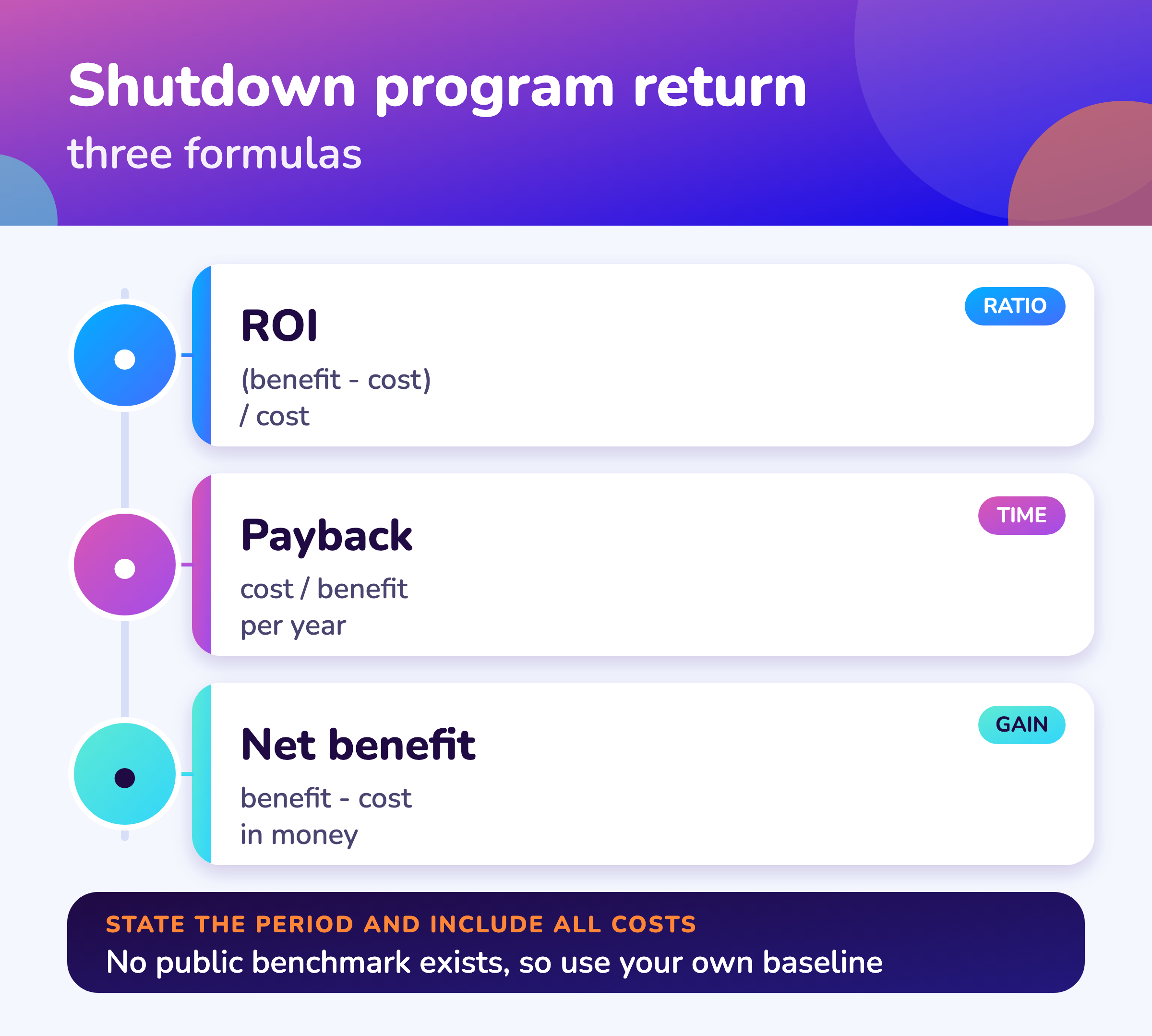
Measure the return on a shutdown program by comparing its measured benefits with its full cost over a stated period: ROI is the benefit minus the cost, divided by the cost, and payback is the cost divided by the yearly benefit.
For the cost side, see how to estimate a shutdown budget.
The arithmetic is simple; the hard part is deciding what counts as a benefit and proving it came from the program. Use the plant's own baseline from past stops, state the period, and include all costs: software, training, planning time and change effort.
Return on investment
ROI = (benefit - cost) / cost
The net gain as a share of what you spent, over a stated period. 0.5 means 50 percent.
Payback period
payback = cost / benefit per year
How long the benefit takes to repay the cost. State it in months or years.
Net benefit
net = benefit - cost
The gain in money. Useful beside the ratio, because a small program can show a high ratio and a small gain.
For the cost side of a stop see the budget planning guide and for the measures see the KPI guide.
The formulas are standard arithmetic. There is no published benchmark for the return on a shutdown program, so this page gives none.
Benefits
What benefits should a shutdown ROI count?
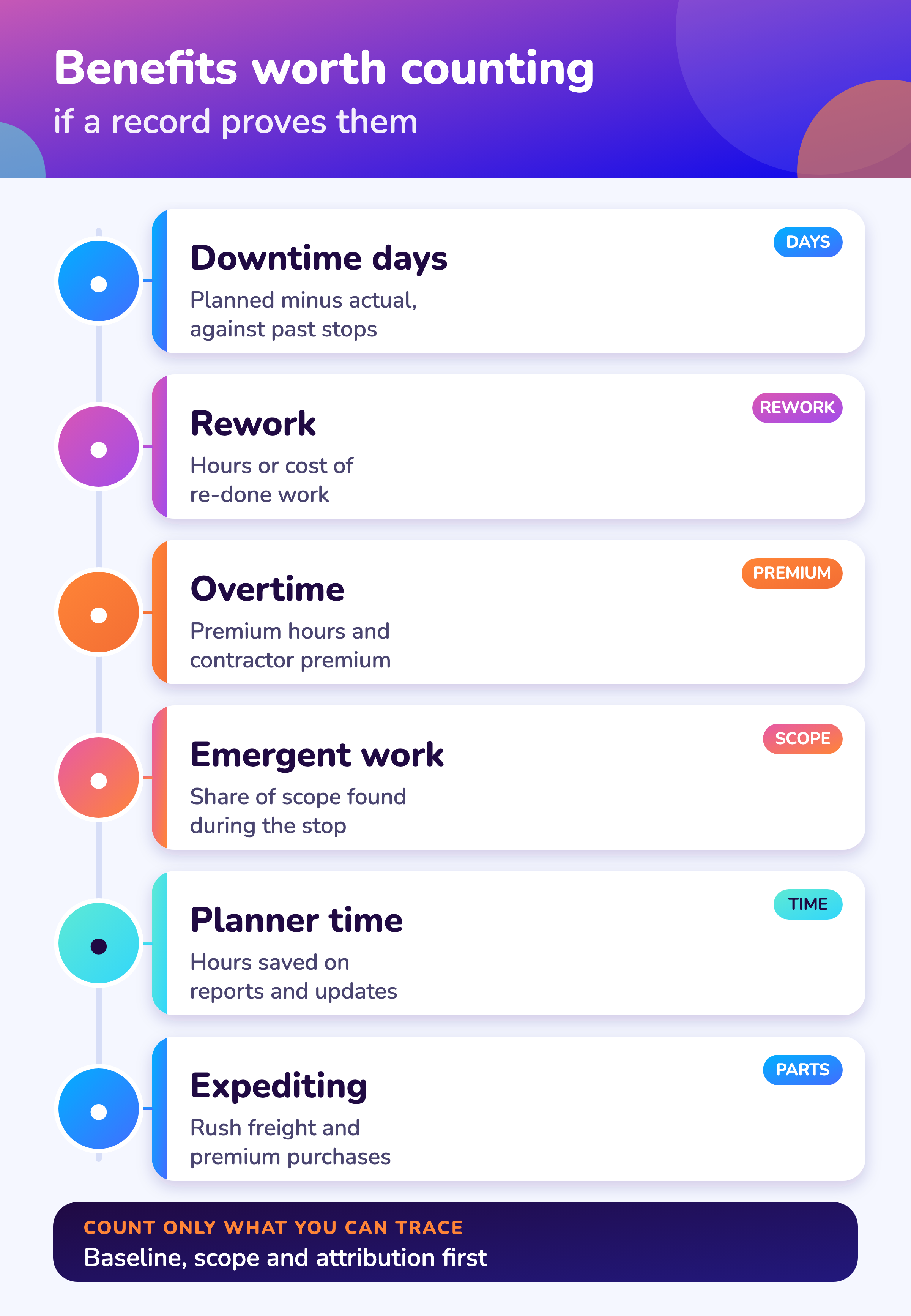
Count only benefits you can measure against a baseline from your own past stops: days of downtime, rework, overtime and contractor premium, emergent work, planner time and expediting costs.
For the cost components, see planned vs unplanned shutdown cost.
| Benefit | How to measure it | Data you need | Caution |
|---|---|---|---|
| Fewer days of downtime | Planned days minus actual days against your own past stops | Schedule actuals; value of a lost production day from finance | Count only days saved by the program, not by a smaller scope |
| Less rework | Hours or cost of re-done work against the past stop | Rework tags in work orders | Needs a consistent rework definition |
| Less overtime and contractor premium | Premium hours or cost against the past stop | Timesheets and contractor invoices | Adjust for scope size |
| Fewer emergent jobs | Emergent work as a share of the scope | Emergent work log | Better scoping also lowers it; credit only what you can show |
| Planner and admin time saved | Hours saved on reports and updates | Time study or interview | Self-reported estimates are weak; sample actual tasks |
| Parts and expediting costs | Rush freight and premium purchases against the past stop | Purchasing records | Parts prices move; compare like with like |
Put a plant-specific money value on a production day with your finance team. No public source gives a general value, and figures quoted elsewhere have no traceable basis. Why shutdowns go over budget explains the common cost drivers.
The table is a working template. Do not claim a benefit you cannot trace to a record.
Software
How does software help prove shutdown ROI?
Software supplies the baseline: planned against actual schedule, cost and hours for each stop are kept, so a program can be compared with the last stop on the same measures.
About MaintWiz. MaintWiz is an industrial AI platform with IoT, SAP integration and predictive maintenance (PdM) capabilities. Its shutdown and turnaround module helps plants plan, schedule, execute and close out shutdown work.
Planned for later releases: daily actual cost storage.
What the shutdown module covers
As described on the MaintWiz shutdown maintenance product page.
- Earned value: planned, earned and actual cost with the cost and schedule indices
- Budget, actual cost and forecast for each project
- Planned against actual schedule with baselines that show what moved
- Findings and emergent work logged per work order
- Reports and the tables behind the charts export to Excel
- Close-out and archive of past shutdowns for baselines
Proof
What MaintWiz customers report
Figures as published in MaintWiz case studies on maintwiz.com. They come from maintenance management projects, not shutdowns.
Calculator
Can you calculate a shutdown program ROI?
Yes: enter the days of downtime avoided, the value of a production day, other yearly benefits and the total program cost, and the calculator returns the yearly benefit, the net benefit, the ROI and the payback in months.
More tools are on the shutdown calculator tools page. A free Excel version is available: Shutdown program ROI workbook (.xlsx).
Try it: a worked ROI with your own numbers
Enter your own figures. The sample values are invented placeholders, not a benchmark. Nothing is sent or stored.
With the invented defaults the yearly benefit is 70,000 (one day at 50,000 plus 20,000), the cost is 40,000, the ROI is 75 percent and the payback is about 6.9 months. Change every input to your own values before you use the result, and show the inputs next to the answer.
Caution
Why do shutdown ROI claims fail review?
ROI claims fail review when they have no baseline, change the scope, claim credit for several changes at once, ignore hidden costs or rest on unreliable data; the GAO cost guide itself cautions about unreliable earned value data. 1
For a worked review with invented figures, see the shutdown case study. Set the software cost against the return using turnaround software cost.
| Problem | Example | Fix |
|---|---|---|
| No baseline | "We saved two days" with no past stop to compare | Use the planned and actual days of the last comparable stops |
| Scope changed | A smaller stop looks faster | Compare per unit of scope, or the same scope |
| Attribution | Several changes happened together | List them all, and credit the program only with what a record supports |
| Hidden costs | Ignoring training and planning effort | Include all costs over the same period |
| Unreliable data | Earned value built on poor progress data | Check the data before you trust the indices |
If you use earned value for the cost side, the GAO cost guide defines the measures: cost variance is earned value minus actual cost, and the cost performance index is earned value divided by actual cost. 1 The DOE FEMP maintenance guide estimates facility-level savings for preventive over reactive maintenance, but it is not a shutdown measure and should not be applied to one. 2
Measures
Which cost measures can a shutdown ROI use?
A shutdown ROI can draw its cost side from the standard earned value measures, budget at completion, cost variance, cost performance index and estimate at completion, which the HHS glossary and the GAO cost guide define. 4,1
| Measure | Definition | Source |
|---|---|---|
| Budget at completion | The total budget planned to accomplish the work of a work package or project | HHS earned value glossary |
| Cost variance | Earned value minus actual cost; positive is favorable | HHS earned value glossary |
| Cost performance index | Earned value divided by actual cost | HHS earned value glossary, GAO cost guide |
| Estimate at completion | Actual cost to date plus the estimate to complete; the GAO guide gives EAC = ACWP + (BAC - BCWP) / efficiency index | HHS earned value glossary, GAO cost guide |
ROI itself is arithmetic on your own benefits and costs; no source fixes a typical value.
Visuals
Save the ROI charts
Two charts to share with finance. Click either for the full-size image.
FAQ
Frequently asked questions
What is shutdown program ROI?
The net gain from a shutdown program as a share of its cost over a stated period: benefit minus cost, divided by cost.
How do I calculate payback?
Divide the cost by the yearly benefit. A cost of 40,000 and a yearly benefit of 70,000 pays back in about 0.57 years, or 6.9 months.
What is the biggest benefit to count?
For most plants it is the days of downtime avoided, valued with your own finance figure for a production day. Count only what a record shows.
Is there a typical ROI for shutdown software?
There is no published benchmark, so this page gives none. Build your own from your baseline.
What data do I need?
Planned and actual schedule, hours and cost from past stops, rework and emergent work records, and the cost of the program. See the KPI guide.
Can I use earned value?
Yes, for the cost side: cost variance is earned value minus actual cost, and the cost performance index is earned value divided by actual cost; check the data first. 1
Why do ROI claims fail?
No baseline, a changed scope, several changes at once, hidden costs or unreliable data.
Where do overruns come from?
Sources
Sources
The earned value definitions come from the US GAO cost guide. The DOE FEMP figure is facility-level and is not a shutdown measure. The formulas are standard arithmetic; the benefit table, the calculator defaults and every number in the worked example are working frameworks or invented placeholders. No customer outcome figures appear on this page.
- US Government Accountability Office, GAO Cost Estimating and Assessment Guide (GAO-20-195G, March 2020)
- U.S. Department of Energy FEMP / Pacific Northwest National Laboratory, O&M Best Practices: Maintenance Approaches
- US Government Accountability Office, GAO Schedule Assessment Guide: Best Practices for Project Schedules (GAO-16-89G, December 2015)
- US Department of Health and Human Services, Earned Value Management, Appendix D: Glossary of Terms
See cost and schedule performance in one view
Book a demo and bring your shutdown budget. We will show earned value and forecast cost in the module.