Pharmaceutical and life sciences
Pharmaceutical Plant Shutdown: Requalification, GMP
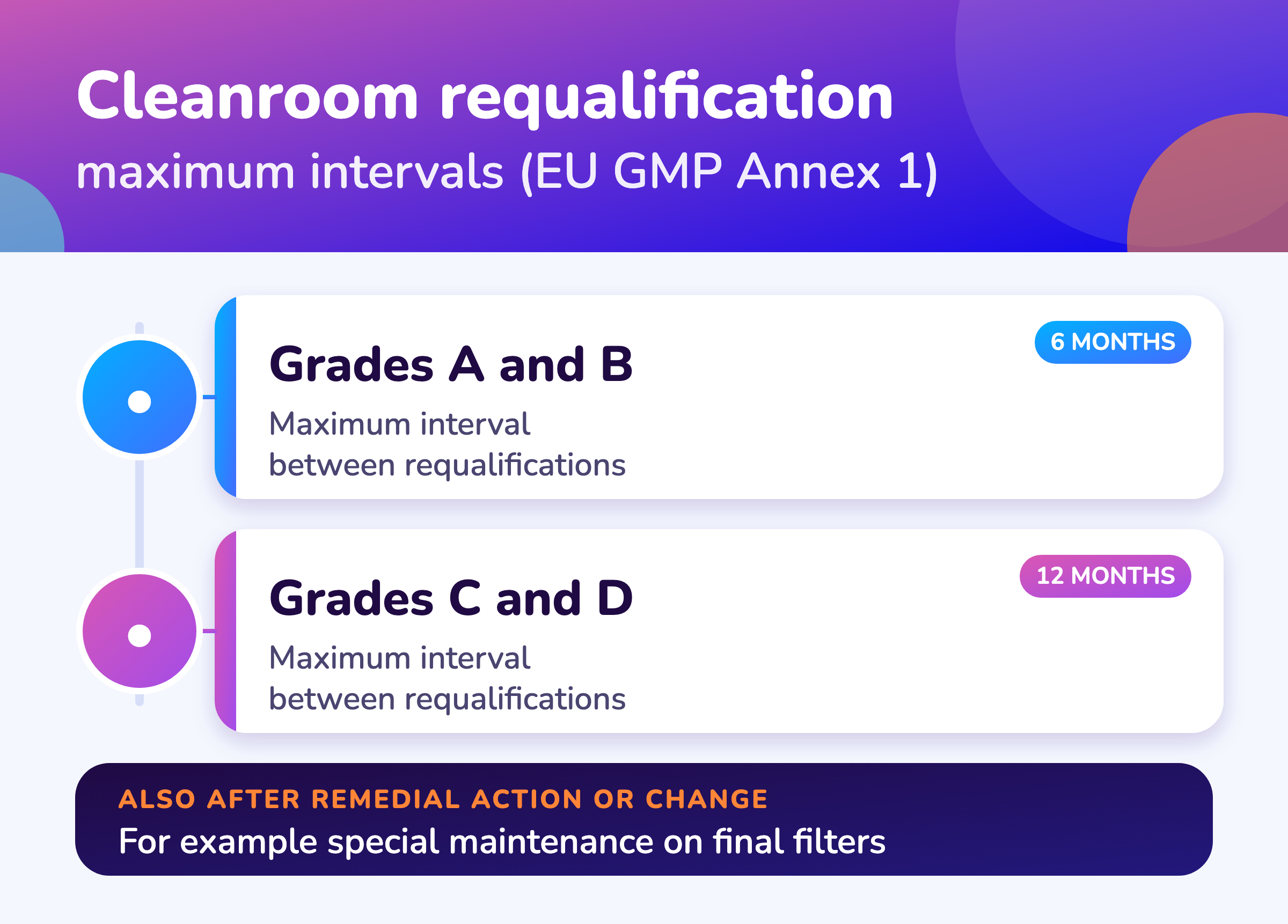
A pharmaceutical plant shutdown is planned around requalification: EU GMP Annex 1 sets a maximum interval of 6 months for grade A and B areas and 12 months for grade C and D areas, and extra requalification after changes. Maintenance also runs under change control and written procedures, and return to use should be approved.
Sources are EU GMP Annexes 1 and 15 and 21 CFR 211.67; other regulators and non-sterile products are not covered.
How MaintWiz helps: Requalification starts only when every package closes cleanly. The MaintWiz shutdown module checks seven readiness gates before a package starts and records waivers with a typed reason, name and date. See the module · Get the readiness checklist
By Jai Balachandran · Published · Last reviewed
What MaintWiz adds:Seven readiness gatesSigned waivers with name and dateKeyboard operationLook-ahead by gate
Fact block
What do public GMP sources say about pharmaceutical shutdowns?
EU GMP rules treat a shutdown as a change to be risk-assessed and followed by requalification, with fixed maximum requalification intervals for sterile product cleanrooms of 6 months (grades A and B) and 12 months (grades C and D). 1,2
For UK pressure systems and HSE guidance see HSG253 safe isolation for shutdowns.
| Item | What public sources say | Source |
|---|---|---|
| Usual term | Shutdown or planned maintenance, followed by requalification before return to use | EU GMP Annex 1, EU GMP Annex 15 |
| Requalification interval (sterile products) | EU GMP Annex 1 (2022) sets a maximum interval of 6 months for grade A and B areas and 12 months for grade C and D areas | EU GMP Annex 1 |
| Triggers for extra requalification | Remedial action on an out-of-compliance condition, or changes to equipment, facility or processes, for example an interruption of air movement or special maintenance such as a change of final filters | EU GMP Annex 1 |
| Planning requalification after change | Quality risk management is used to evaluate planned changes and to plan any necessary validation, verification or requalification | EU GMP Annex 15 |
| Return to use | Sterilisers, air handling and water systems are subject to qualification, monitoring and planned maintenance; return to use after maintenance should be approved | EU GMP Annex 1 |
| US written procedures | Written procedures must be established and followed for cleaning and maintenance of equipment, with responsibility, schedules and methods (21 CFR 211.67(b)) | 21 CFR 211.67 |
| How long a shutdown takes | No public, vendor-neutral benchmark found | Searched; see sources |
Read with care. The intervals apply to cleanrooms and clean air equipment for sterile products. Other areas follow their own justified frequency.
Triggers
What triggers requalification after a maintenance shutdown?
Requalification is required after remedial action on an out-of-compliance condition and after changes to equipment, facility or processes, and Annex 1's examples include an interruption of air movement and special maintenance such as changing final filters. 1
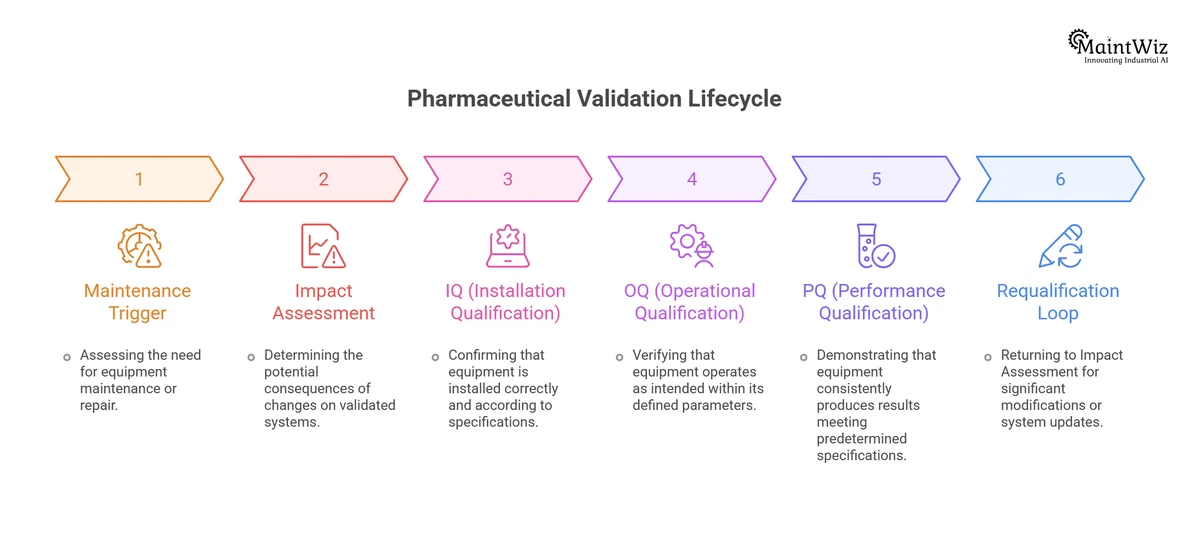
Annex 15 asks that re-qualification, where done at a specific period, have a justified period and defined evaluation criteria, and that equipment and systems be evaluated at an appropriate frequency to confirm they remain in a state of control. 2 Plan the requalification tests into the shutdown schedule, not after it; see shutdown scheduling.
Software
Can software help with a pharmaceutical shutdown?
Software can link maintenance work orders to change records and requalification tests, so the evidence for return to use sits with the work it covers.
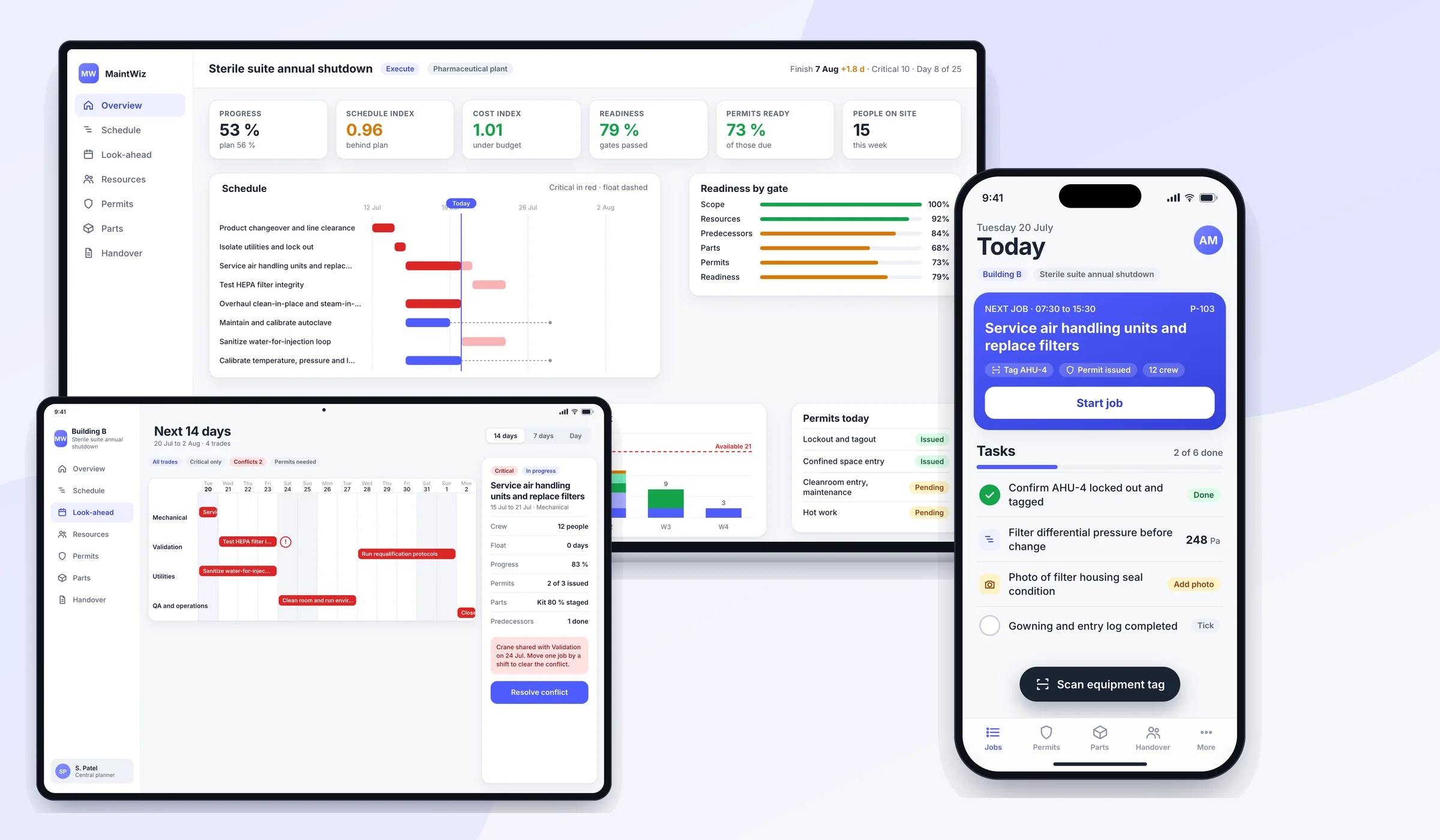

About MaintWiz. MaintWiz is an industrial AI platform with IoT, SAP integration and predictive maintenance (PdM) capabilities. Its shutdown and turnaround module helps plants plan, schedule, execute and close out shutdown work.
Also: product data sheet.
What the shutdown module covers
As described on the MaintWiz shutdown maintenance product page.
- Shutdown calendar and critical-path scheduling, with work order sequencing and dependencies
- Asset prioritization, so the most critical equipment is scoped first
- Resource planning for people, spares, heavy equipment such as cranes, and outsourced vendors
- Electronic permits to work, risk management and contingency plans
- Real-time progress monitoring: schedule adherence, cost variance, quality metrics and risk factors
- Step-by-step checklists, pre-restart testing protocols and post-shutdown analysis
Proof
What MaintWiz customers report
Figures as published in MaintWiz case studies on maintwiz.com. They come from maintenance management projects, not shutdowns.
Change control
How does change control apply to shutdown maintenance?
Use quality risk management to evaluate planned changes for their effect on product quality, documentation, validation, calibration and maintenance, and to plan the validation, verification or requalification effort that follows. 2
Changes should be authorized and approved by the responsible persons in line with the pharmaceutical quality system. 2 Late work found during the shutdown follows the same logic; see shutdown execution and shutdown scope management.
Return to use
Who approves the return to use after maintenance?
Annex 1 says the return to use of sterilisers, air handling and water systems should be approved on completion of maintenance, and in the US 21 CFR 211.67(b) requires written, followed procedures for equipment cleaning and maintenance. 1,3
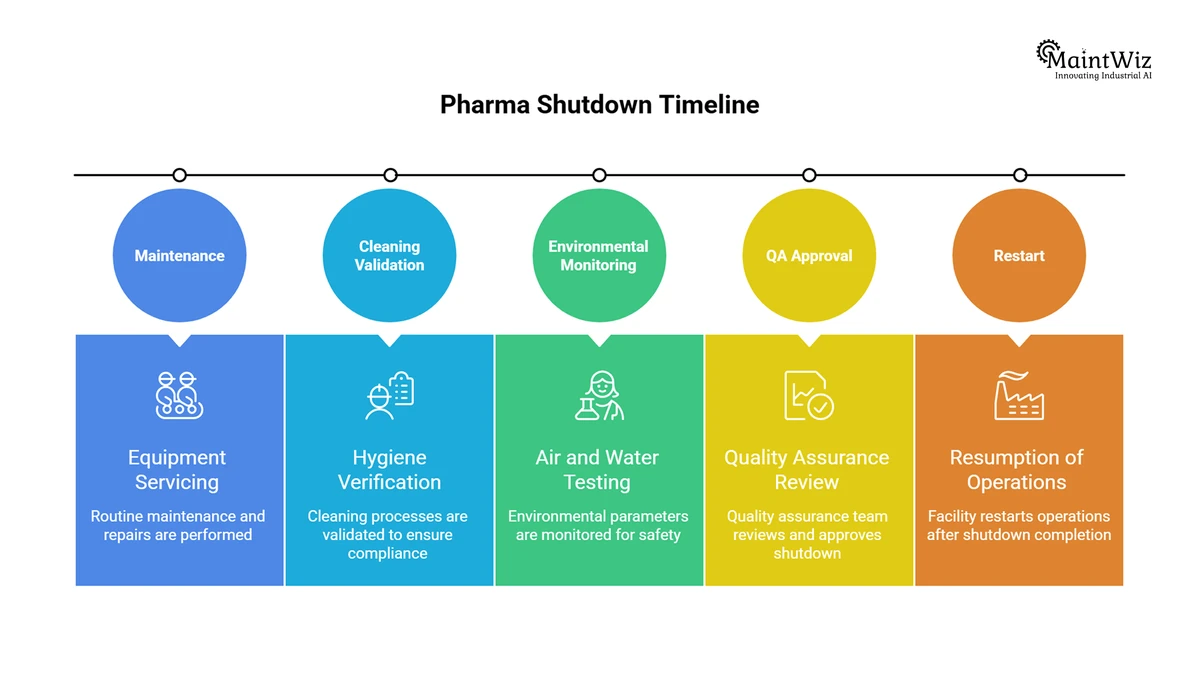
Treat approval as a gate with evidence, in the way plant start-up after shutdown describes for any restart. Who signs is set by your quality system; this page does not assign roles.
Checklist
What belongs on a pharmaceutical shutdown checklist?
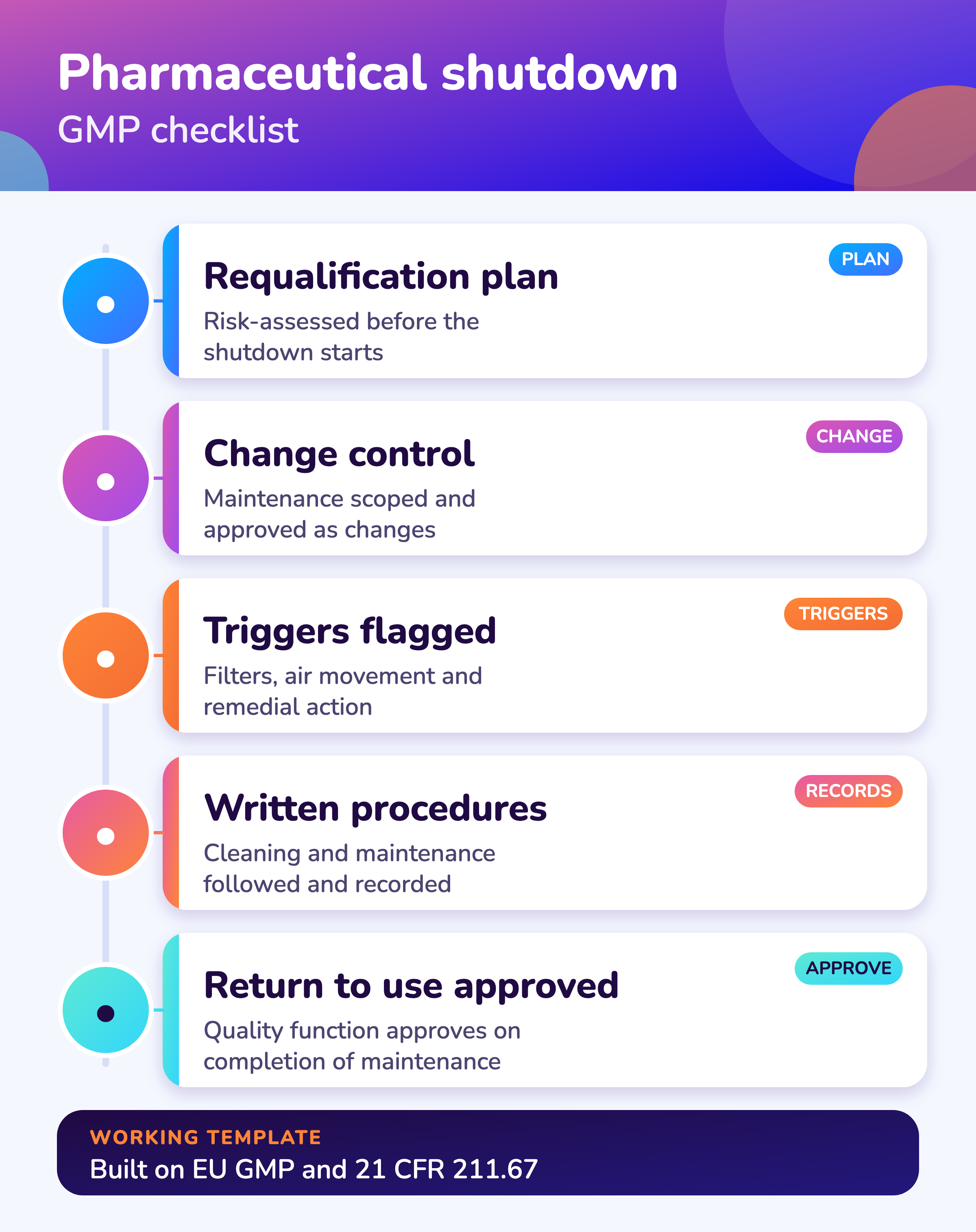
A pharmaceutical shutdown checklist should cover the requalification plan, change control, requalification triggers, air movement logs, written maintenance procedures, approval for return to use and the safety controls for the work itself.
For food and beverage hygiene sequences, see food and beverage plant shutdowns. A free Excel version is available: Pharmaceutical plant shutdown checklist (.xlsx).
| Check | Basis |
|---|---|
| Requalification plan agreed before the shutdown, using risk assessment | Annex 15: use quality risk management to plan requalification effort |
| Maintenance work scoped against the change control system | Changes should be authorized and approved in line with the quality system |
| Special maintenance on HVAC and filters flagged as requalification triggers | Annex 1 lists a change of final filters among the examples |
| Air movement interruptions logged | Annex 1 lists interruption of air movement as a trigger |
| Written cleaning and maintenance procedures followed and recorded | 21 CFR 211.67(b) |
| Return to use approved by the quality function | Annex 1: return to use should be approved |
| Lockout and confined space controls for the work itself | OSHA 1910.147 and 1910.146 apply to US sites |
A working template based on the sources cited. The general list is the 40-step shutdown checklist. This is not regulatory advice.
Visuals
Save the GMP shutdown charts
Two charts for the quality and maintenance meeting. Click either for the full-size image.
FAQ
Frequently asked questions
How often must cleanrooms be requalified?
EU GMP Annex 1 sets a maximum interval of 6 months for grade A and B areas and 12 months for grade C and D areas. 1
What triggers requalification after maintenance?
Remedial action on an out-of-compliance condition and changes to equipment, facility or processes; examples include interruption of air movement and a change of final filters. 1
How is requalification planned?
Annex 15 says to use quality risk management to evaluate planned changes and plan any necessary validation, verification or requalification effort. 2
Does maintenance need written procedures?
In the US, 21 CFR 211.67(b) requires written procedures for cleaning and maintenance of equipment, with responsibility, schedules and methods. 3
Who approves return to use after maintenance?
Annex 1 says the return to use should be approved; who signs is set by your quality system. 1
How long does a pharmaceutical shutdown take?
There is no published benchmark. Duration follows scope, requalification tests and approvals.
Do OSHA rules apply?
In the US, lockout and confined space rules apply to the maintenance work itself. 4,5
Does this cover regulators outside the EU and US?
No. Check the regulator and guidance that applies to your product and site.
Sources
Sources
Intervals and requirements come from the EU GMP Annexes and 21 CFR 211.67 as cited, for sterile products where stated. The checklist is a working template. Check the sources for later revisions; this is not regulatory advice.
- European Commission, EU GMP Annex 1: Manufacture of Sterile Medicinal Products (2022)
- European Commission, EU GMP Annex 15: Qualification and Validation (2015)
- eCFR, 21 CFR 211.67, Equipment cleaning and maintenance
- OSHA, 29 CFR 1910.147, The control of hazardous energy (lockout/tagout)
- OSHA, 29 CFR 1910.146, Permit-required confined spaces
Start each package only when it is ready
Book a demo and bring a work package. We will walk through the seven readiness gates.