
Contractor management
Shutdown Contractor Management: Mobilization Guide
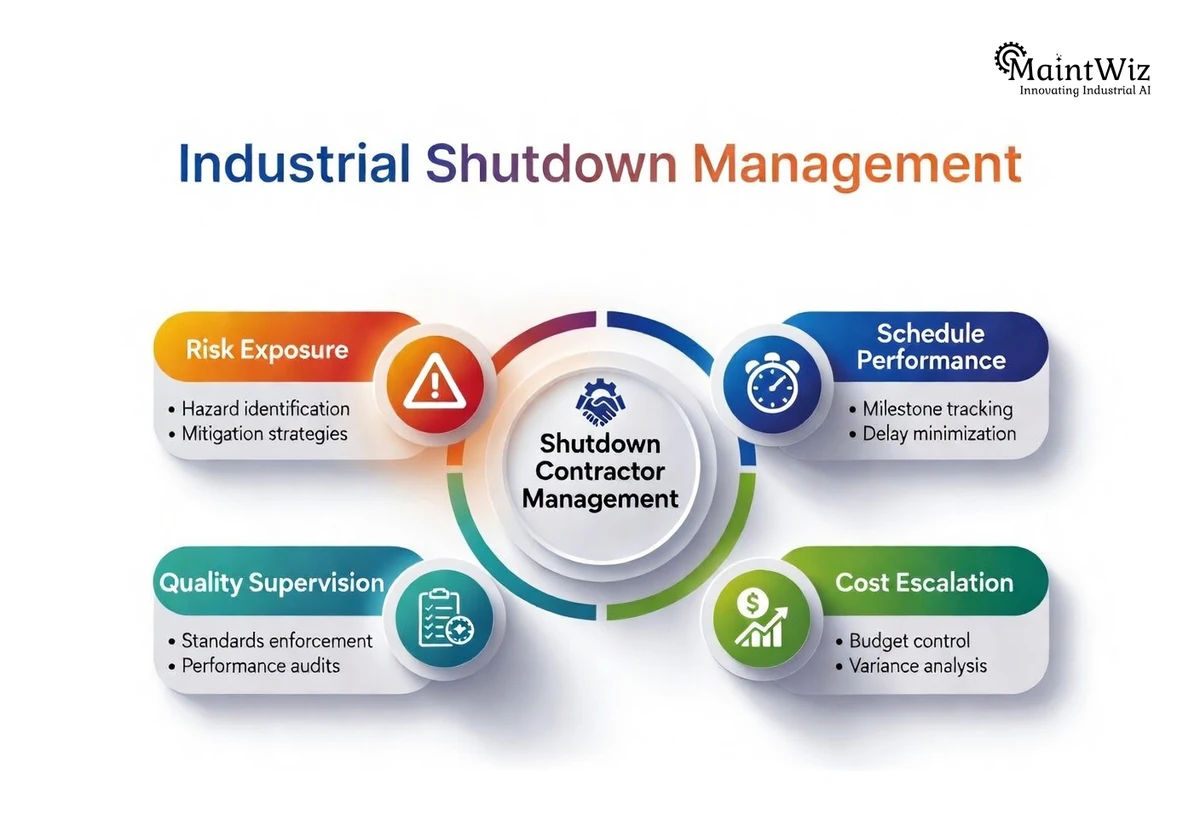
Managing shutdown contractors means planning the job, choosing competent contractors, mobilizing them against a checklist, checking the work on site and reviewing performance. For covered processes OSHA requires the host to select, inform, control and evaluate contractors; HSE sets out the same logic in five steps.
There is no published ratio of contractors to staff, so this page gives none.
How MaintWiz helps: Contractors work best when crews, permits and packages are clear. The MaintWiz shutdown module shows availability of trades and common tools by week across projects, with blackout windows from the admin calendar. See the module · Get the mobilization template
By Jai Balachandran · Published · Last reviewed
What MaintWiz adds:Trade and tool availabilityWeekly availability viewBlackout windowsRate cards and shifts
Duties
What do regulators expect of the host and the contractor?
Under OSHA's process safety standard, the host employer must select, inform, control and evaluate contractors, and the contractor must train, document and report hazards; the paragraph applies to maintenance, repair, turnaround and specialty work on or adjacent to a covered process. 1
The US contractor rule is mapped with the other OSHA rules in OSHA PSM turnaround rules.
| Who | Duty |
|---|---|
| Host employer | Obtain and evaluate information on the contract employer's safety performance and programs when selecting a contractor |
| Host employer | Inform contract employers of the known fire, explosion and toxic release hazards related to the work and the process |
| Host employer | Explain the applicable provisions of the emergency action plan |
| Host employer | Develop and implement safe work practices that control the entry, presence and exit of contractors in covered process areas |
| Host employer | Periodically evaluate contractor performance, and keep an injury and illness log for contract employees' work in process areas |
| Contract employer | Train each contract employee in the work practices needed to do the job safely, and instruct them in the hazards and emergency plan |
| Contract employer | Document that each contract employee received and understood the training, and make sure each follows the facility's safety rules |
| Contract employer | Advise the host of any unique hazards its work presents, including hazards found while working |
For energy control, OSHA 1910.147 requires the on-site and outside employers to inform each other of their lockout or tagout procedures, and the on-site employer to make sure its own employees comply with the restrictions of the outside employer's program. 2
These are US federal requirements for covered processes. Other jurisdictions and sites differ; check the law that applies where your plant is located.
Five steps
What does a five-step process for managing contractors look like?
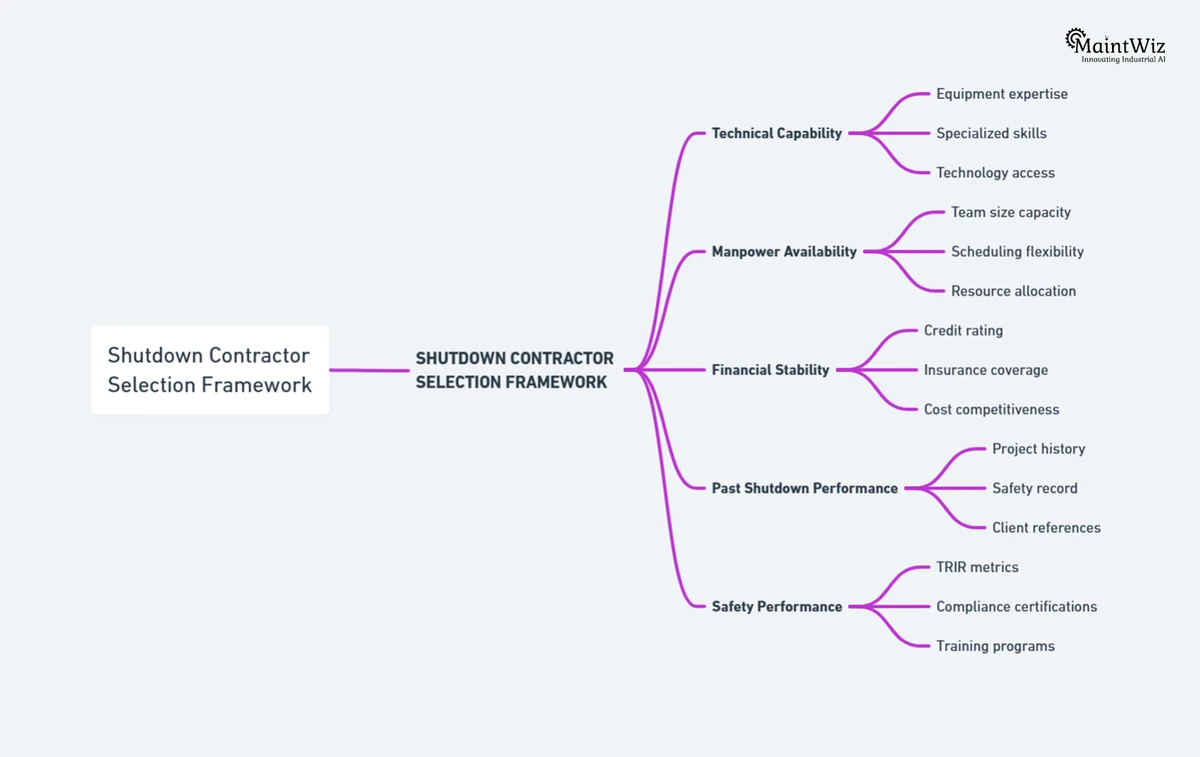
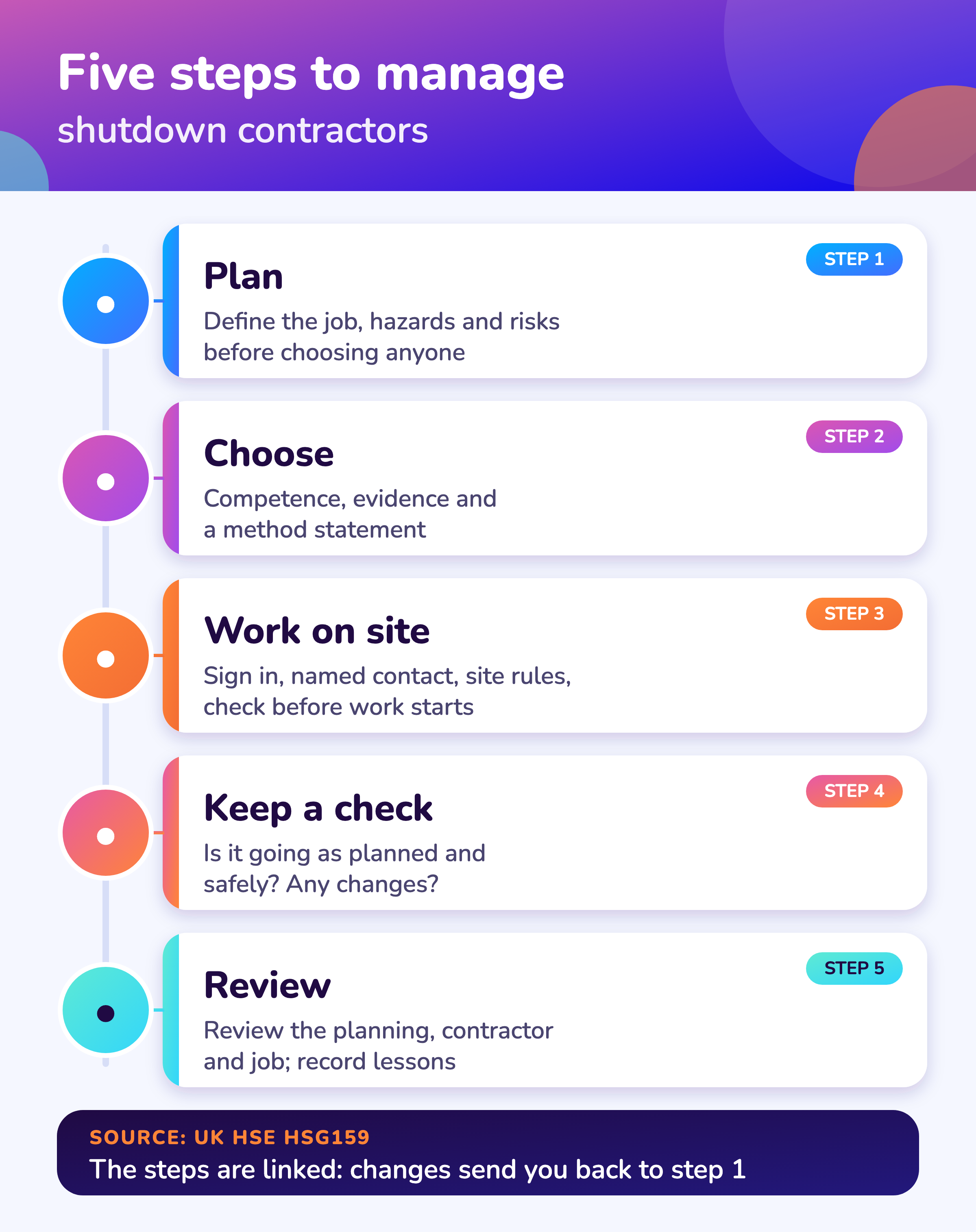
HSE's guide to managing contractors sets out five steps: plan, choose a contractor, manage the contractors working on site, keep a check on the work, and review the work. The steps are linked, so a change on site sends you back to planning. 3
Role definitions are in shutdown team roles and RACI.
- 1
Plan
Define the job, identify the hazards, assess the risks, reduce them and specify health and safety conditions before choosing anyone.
HSE step 1: planning - 2
Choose
Decide what safety and technical competence the job needs, ask questions, get evidence, ask for a method statement and decide whether subcontracting is acceptable.
HSE step 2: choosing a contractor - 3
Work on site
All contractors sign in and out, a site contact is named, safety information and site rules are reinforced, and the job is checked before work starts.
HSE step 3: contractors working on site - 4
Keep a check
Decide how much contact is needed, and ask whether the job is going as planned, safely, with any incidents or changes in personnel.
HSE step 4: keeping a check - 5
Review
Review the planning, the contractor and the job, and record the lessons.
HSE step 5: reviewing the work
Software
Can software help manage shutdown contractors?
Software can hold contractor resource plans, link people to permits and work orders and show who is on site and on which job, but it does not replace the induction, supervision and evaluation described above.
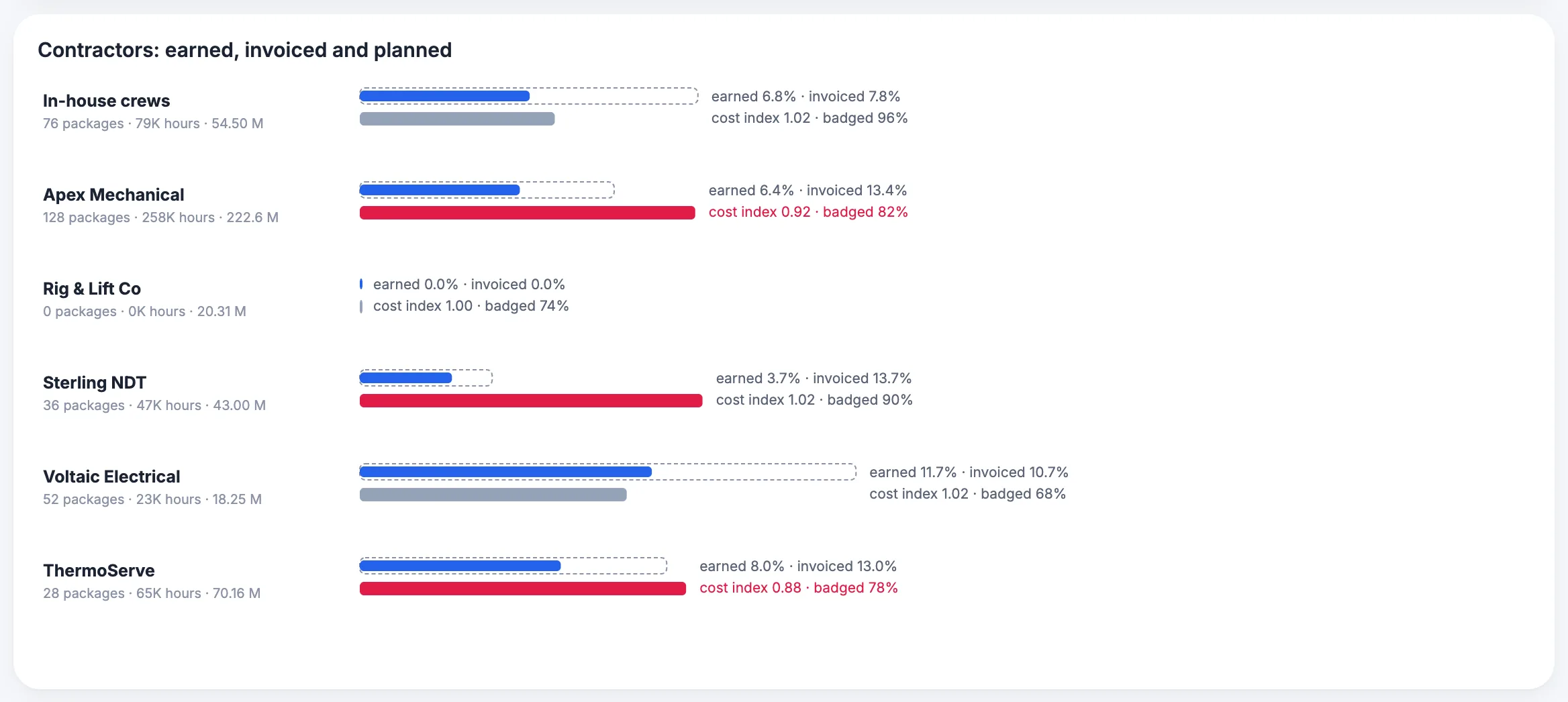
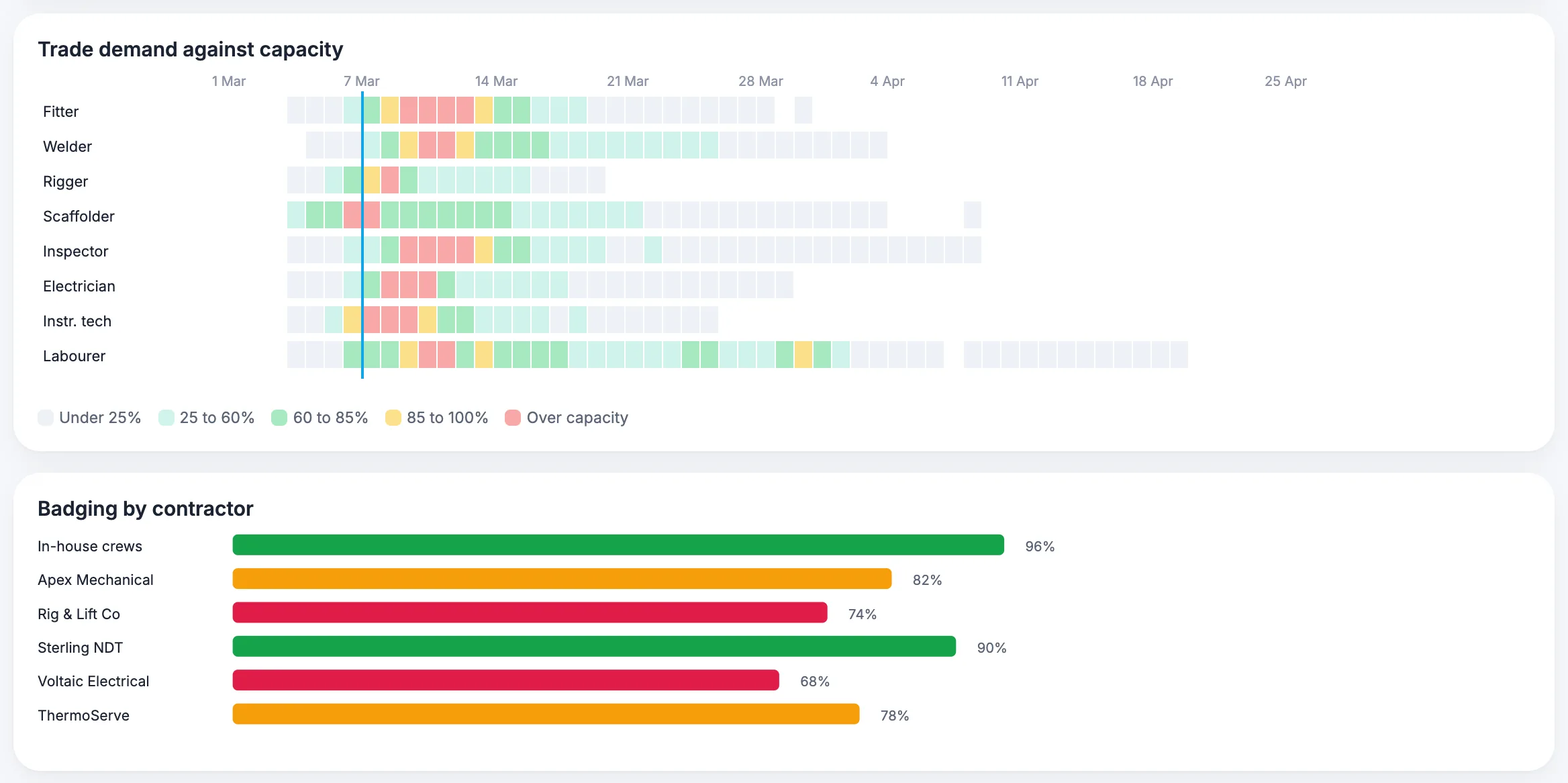
The shutdown management software page describes work orders and readiness gates. Questions on roles and access are in the shutdown module FAQ.
About MaintWiz. MaintWiz is an industrial AI platform with IoT, SAP integration and predictive maintenance (PdM) capabilities. Its shutdown and turnaround module helps plants plan, schedule, execute and close out shutdown work.
Also: product data sheet.
What the shutdown module covers
As described on the MaintWiz shutdown maintenance product page.
- Shutdown calendar and critical-path scheduling, with work order sequencing and dependencies
- Asset prioritization, so the most critical equipment is scoped first
- Resource planning for people, spares, heavy equipment such as cranes, and outsourced vendors
- Electronic permits to work, risk management and contingency plans
- Real-time progress monitoring: schedule adherence, cost variance, quality metrics and risk factors
- Step-by-step checklists, pre-restart testing protocols and post-shutdown analysis
Proof
What MaintWiz customers report
Figures as published in MaintWiz case studies on maintwiz.com. They come from maintenance management projects, not shutdowns.
Mobilization
What should a contractor mobilization checklist include?
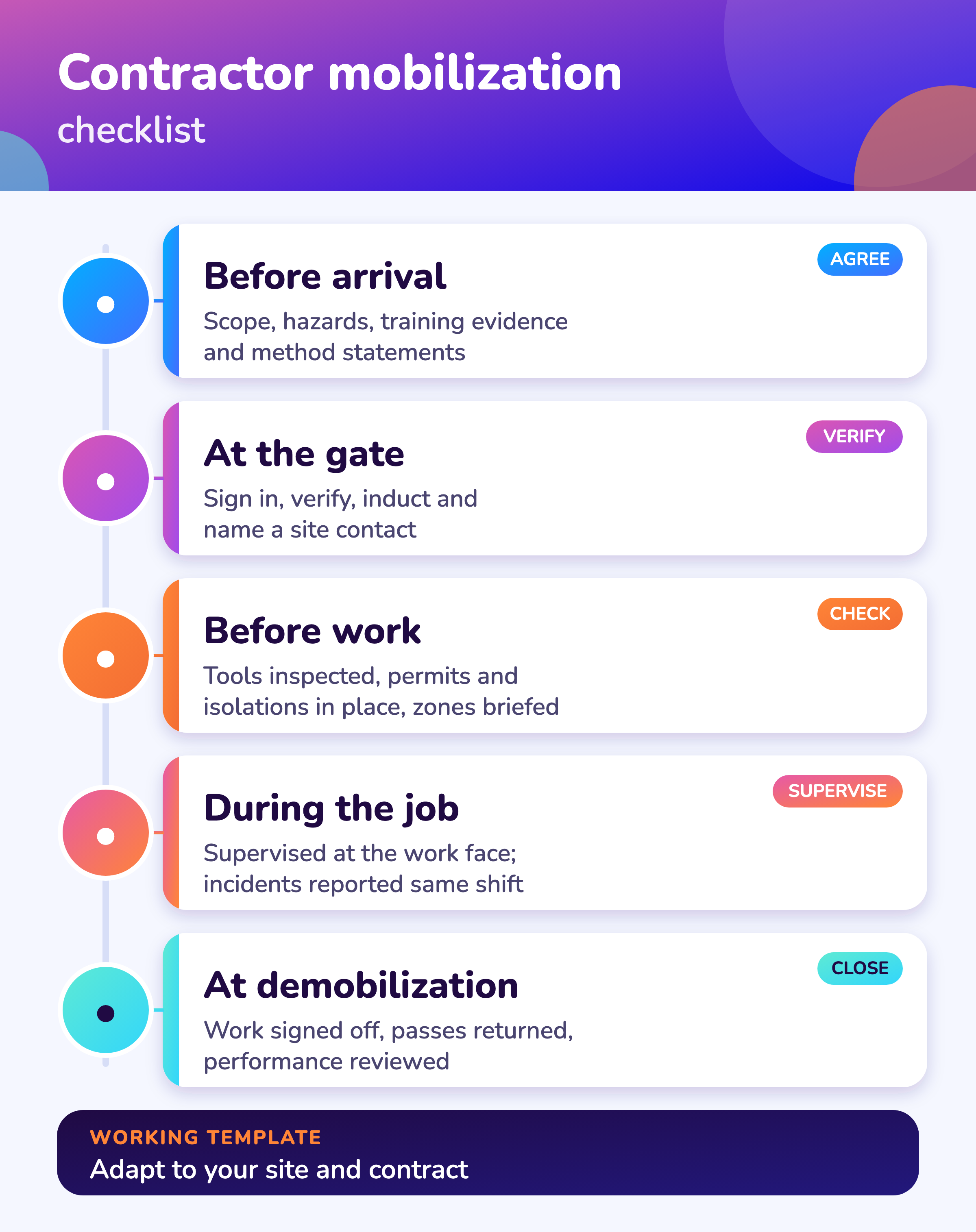
A mobilization checklist covers what is agreed before arrival, what is verified at the gate and before work, what is checked while the job runs and what is closed at demobilization.
A free Excel version is available: Contractor mobilization and time on tools (.xlsx). Size the crews with the turnaround manpower plan and labor histogram, and plan access with turnaround scaffolding planning.
| Stage | Check |
|---|---|
| Before arrival | Contract and scope agreed; hazards and site rules shared; training evidence received; method statements reviewed |
| At the gate | Each person signs in; identity and training verified; induction given; a named site contact assigned |
| Before work | Tools and equipment inspected; permits and isolations in place; emergency plan explained; work area and exclusion zones briefed |
| During the job | Supervisor checks the job at the work face; changes in personnel reported; incidents and near misses reported the same shift |
| At demobilization | Work signed off; tools and passes returned; site left clean; contractor performance reviewed and lessons recorded |
The sign-in, named site contact and site-rule steps come from HSE's five-step guide. 3 Permit supervision matters here: HSE notes supervision can thin out when one person controls many permits, and names shutdowns as an example. 4
Time on tools
What is time on tools and how do you calculate it?
Time on tools is the share of hours on site spent doing hands-on work: hands-on hours divided by hours on site, times 100. No published standard defines it, so agree one definition in the contract before measuring.
The calculator is listed with the others on the shutdown calculator tools page.
Try it: time on tools
Enter the hours a crew was on site and the hours lost to waiting. The starting numbers are made up. Nothing is sent or stored; the sums run in your browser.
Hands-on hours here are on-site hours less the hours recorded as lost. If your site records waiting time differently, change the categories. Permit and isolation delays are the part permit-desk staffing in permit to work during shutdown addresses.
Performance
How should contractor performance be evaluated?
Evaluate contractors periodically on safety, permit discipline, schedule and quality, because OSHA's standard requires host employers to periodically evaluate how contract employers fulfill their obligations. 1
Useful measures include the recordable injury rate, calculated as cases times 200,000 divided by hours worked (8), and leading indicators such as the share of work done in line with permit conditions. 7 The wider set is in shutdown KPIs.
Scale
How many contractors should you expect in a shutdown?
There is no published ratio of contractors to permanent staff, so this page gives none; measure your own peak headcount against permanent headcount from the last shutdown.
A mill reline, where one large crew sets the path, is described in mining mill reline shutdown planning. The peak headcount is found in the turnaround manpower plan and labor histogram.
Public investigations show only the totals for two events: 266 employees and contract workers were on site at the Kuraray plant when a startup after a turnaround went wrong, and about 800 to 900 people, employees and contractors, were on site at the Husky Superior refinery during its turnaround. 5,6 Neither report gives a ratio. Earlier versions of this page quoted multipliers and a percentage with no source; they were removed.
A working measure for your own planning: peak contractor headcount divided by permanent headcount.
Visuals
Save the contractor charts
Two cards for the contractor office. Click either for the full-size image.
FAQ
Frequently asked questions
What is shutdown contractor management?
Planning the job, choosing competent contractors, controlling their work on site, checking progress and safety and reviewing the result. HSE sets out these five steps. 3
What does OSHA require for contractors in turnarounds?
For covered processes, the host employer must evaluate contractor safety performance, inform contractors of hazards and the emergency plan, control entry and exit, periodically evaluate performance and keep an injury and illness log. Contract employers must train and document each worker. 1
How should lockout be coordinated with outside contractors?
OSHA requires the on-site and outside employers to inform each other of their lockout or tagout procedures, and the on-site employer to ensure its employees comply with the outside employer's restrictions. 2
What goes in a mobilization checklist?
Agreements and training evidence before arrival, sign-in and induction at the gate, tool and permit checks before work, supervision during the job and sign-off at demobilization.
What is time on tools?
Hands-on hours divided by hours on site, times 100. There is no published standard definition, so fix one in the contract. The calculator above does the sum.
How many contractors will a shutdown need?
There is no published ratio. The CSB reports show totals only: 266 people on site at the Kuraray plant and 800 to 900 at Husky Superior during a turnaround. 5,6
How do you evaluate contractor performance?
Periodically, on safety, permit discipline, schedule and quality. OSHA requires periodic evaluation for covered processes, and the injury rate is cases times 200,000 divided by hours worked. 1,8
Why keep nonessential contractors out during startup?
In the Kuraray case the CSB found welding by nonessential contractors likely ignited an ethylene release, and that no formal exclusion zone had been set. 5
Sources
Sources
- OSHA, 29 CFR 1910.119, Process safety management of highly hazardous chemicals
- OSHA, 29 CFR 1910.147, The control of hazardous energy (lockout/tagout)
- UK Health and Safety Executive, Managing contractors: a guide for employers (HSG159, 2nd edition, 2011)
- UK Health and Safety Executive, Guidance on permit-to-work systems: a guide for the petroleum, chemical and allied industries (HSG250, 2005)
- US Chemical Safety and Hazard Investigation Board, Ethylene Release and Fire at Kuraray America, Inc. EVAL Plant, Pasadena, Texas (No. 2018-03-I-TX, 16 December 2022)
- US Chemical Safety and Hazard Investigation Board, FCC Unit Explosion and Asphalt Fire at Husky Superior Refinery (No. 2018-02-I-WI, 23 December 2022)
- UK Health and Safety Executive, Developing process safety indicators: a step-by-step guide for chemical and major hazard industries (HSG254, 2006)
- US Bureau of Labor Statistics, How to compute your firm's incidence rate for safety management
Plan trades and tools across every shutdown
Book a demo and bring your crew plan. We will show availability by trade and week.