
Water and wastewater
Water Plant Outage Planning: Bypass and Isolation
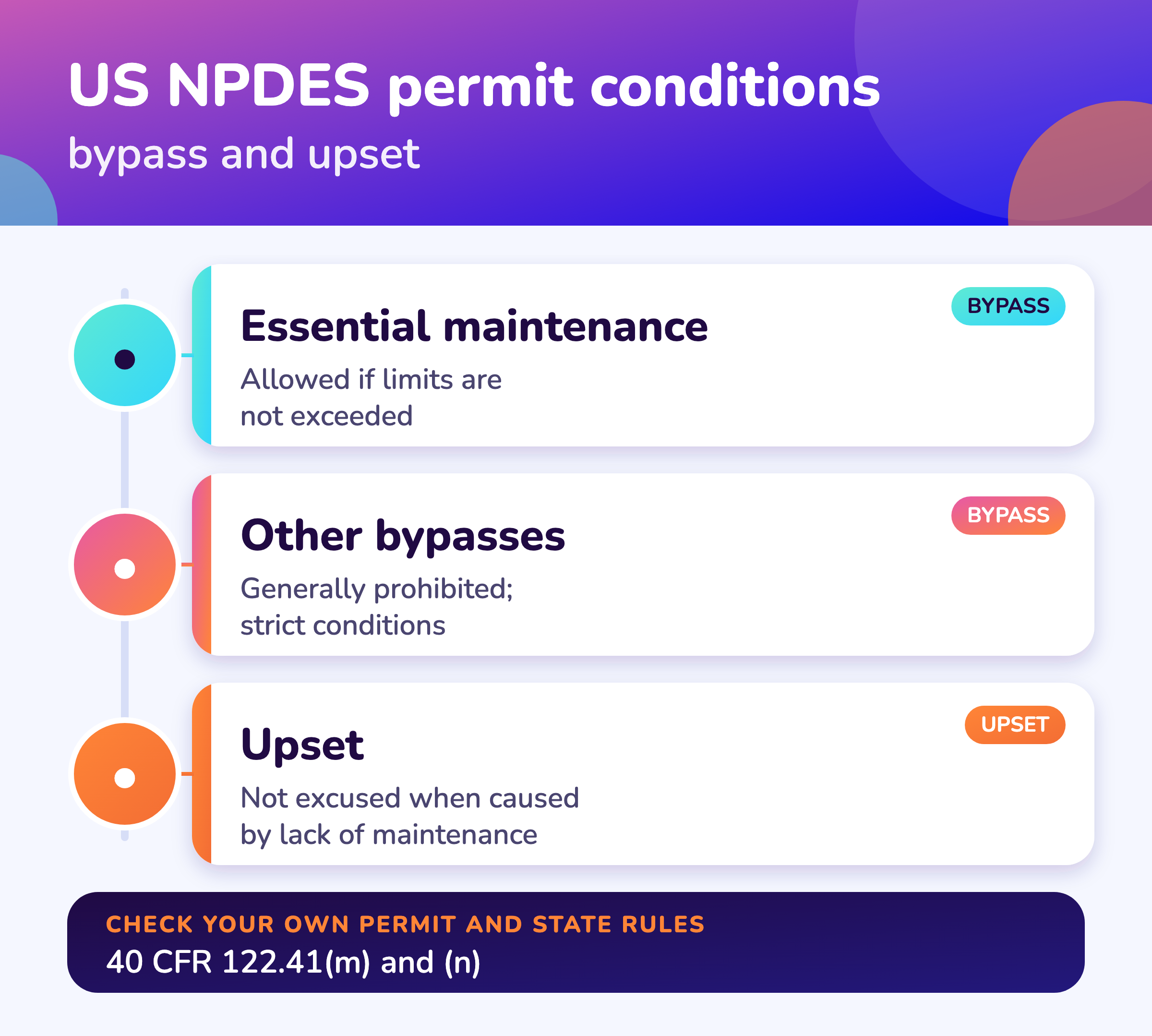
A water or wastewater plant cannot simply stop, so a planned outage takes one unit out at a time while the rest carry the flow and the permit limits still hold. Under US NPDES permit conditions a bypass for essential maintenance is allowed only if it does not cause effluent limits to be exceeded, and an upset is not excused if it results from lack of preventive maintenance.
Sources are 40 CFR 122.41 and OSHA 1910.146 and 1910.147 for the US; other jurisdictions and drinking water systems are not covered.
How MaintWiz helps: Phased isolations must protect service while work proceeds. The MaintWiz shutdown module shows permits and isolations from ePTW on each work order and blocks closing a package while a permit or isolation is open. See the module · Get the permit register
By Jai Balachandran · Published · Last reviewed
What MaintWiz adds:Permits and isolations from ePTWShown on each work orderPackage cannot close with an open permitApprovals by signed-in user
Fact block
What do public sources say about water and wastewater outages?
US permit conditions allow a bypass for essential maintenance only if effluent limits are not exceeded, treat other bypasses as generally prohibited, and exclude lack of preventive maintenance from the upset defense, so outage plans have to show capacity and maintenance records. 1
| Item | What public sources say | Source |
|---|---|---|
| Usual term | Planned outage or planned shutdown of a unit, basin or process train; forced or unplanned outage when it is not planned. Terms are not standardized; define them in your permit and plan | Searched; see sources |
| Bypass (US NPDES permits) | Deliberate diversion of waste streams around any part of a treatment facility (40 CFR 122.41(m)) | 40 CFR 122.41 |
| Bypass for essential maintenance | Allowed if it does not cause effluent limitations to be exceeded and is needed for essential maintenance to assure efficient operation; such bypasses are exempt from the notice and approval conditions | 40 CFR 122.41 |
| Other bypasses | Generally prohibited unless the permittee shows the bypass was unavoidable to prevent loss of life, personal injury or severe property damage, there was no feasible alternative, and it gave the required notices; inadequate backup equipment is not an accepted reason | 40 CFR 122.41 |
| Notice of a bypass | Prior notice, if possible at least ten days ahead, when the need is known in advance; 24-hour notice for an unanticipated bypass | 40 CFR 122.41 |
| Upset | An exceptional incident causing temporary noncompliance with technology-based effluent limits, beyond the permittee's reasonable control; it does not include noncompliance caused by operational error, improperly designed facilities, inadequate treatment facilities, lack of preventive maintenance, or careless or improper operation | 40 CFR 122.41 |
| Reporting (EPA manual) | EPA's permit writers' manual says a bypass for essential maintenance that does not cause the effluent to exceed limits needs no notice or 24-hour report, while an unanticipated bypass or an upset exceeding limits needs 24-hour reporting, and the permittee has the burden of proving an upset | EPA permit writers manual ch. 10 |
| Operation and maintenance | The permittee shall at all times properly operate and maintain all facilities and systems of treatment and control (40 CFR 122.41(e)) | 40 CFR 122.41 |
| Records | Monitoring records are retained for at least three years from the sample, measurement, report or application, and longer on request of the Director (122.41(j)(2)) | 40 CFR 122.41 |
| Confined space entry | Before entry is authorized, the employer documents completion of the required measures by preparing an entry permit (OSHA 1910.146(e)(1)) | OSHA 1910.146 |
| Lockout | OSHA 1910.147 applies to servicing and maintenance where unexpected energization or release of stored energy could injure employees | OSHA 1910.147 |
| How long an outage takes | No public, vendor-neutral benchmark found | Searched; see sources |
Read with care. 40 CFR 122.41 sets conditions for US NPDES permits; your own permit and state rules can be stricter. Drinking water systems, and countries outside the US, follow other rules.
Phased isolation
How do you isolate part of a treatment plant without stopping it?
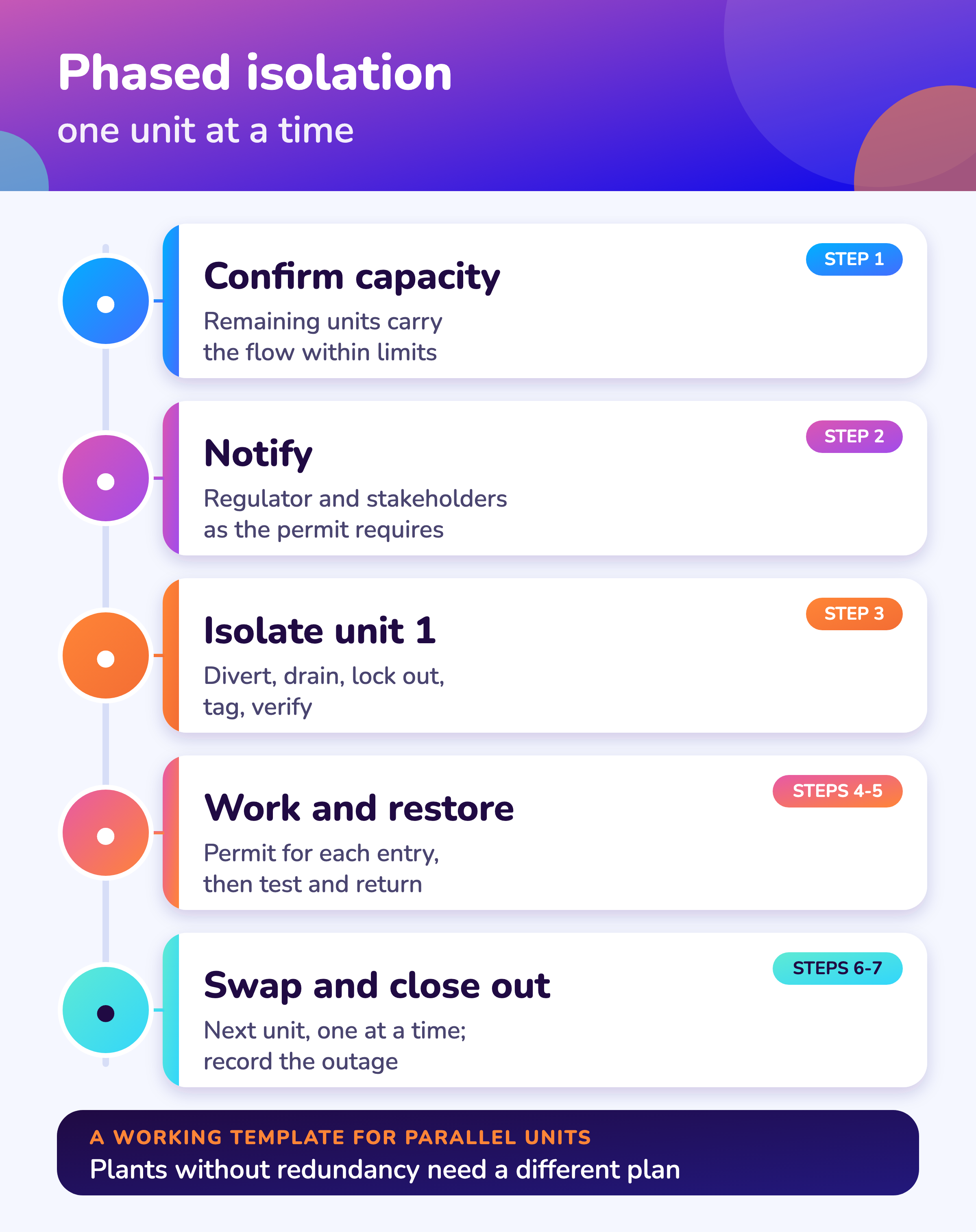
Isolate part of a treatment plant by taking one unit out at a time while the others carry the flow: confirm capacity, notify, isolate and lock out the unit, work it on permit, restore and test it, then move to the next.
For permits and isolation registers see permit to work during a shutdown and for US rules OSHA PSM turnaround rules.
| Step | What happens | Control |
|---|---|---|
| 1. Confirm capacity | Check flows and loads so the remaining units carry the plant while one is out | Effluent limits still met with the unit out (122.41(m)) |
| 2. Notify | Notify the regulator and stakeholders as the permit and law require | Notice period set by the permit |
| 3. Take unit 1 out | Divert flow, isolate, drain, lock out and tag | Isolation verified before entry |
| 4. Work unit 1 | Inspect, repair, replace; confined space entries on permit | Permit before entry (OSHA 1910.146) |
| 5. Restore unit 1 | Refill, test, commission and return to service | Performance check before releasing the next unit |
| 6. Swap to unit 2 | Repeat for the next unit, one at a time | Never two units out unless the plan shows capacity |
| 7. Close out | Record the outage, any bypass, and lessons | Records kept for the permit |
A working template for parallel basins or trains. Plants without redundancy need a different plan; see the types of shutdown. This is not engineering advice.
Software
Can software help with a water plant outage?
Software can keep the work orders, isolations, permits and maintenance history for each unit together, so the records a permit or an upset defense depends on are in one place.
About MaintWiz. MaintWiz is an industrial AI platform with IoT, SAP integration and predictive maintenance (PdM) capabilities. Its shutdown and turnaround module helps plants plan, schedule, execute and close out shutdown work.
Also: product data sheet.
What the shutdown module covers
As described on the MaintWiz shutdown maintenance product page.
- Shutdown calendar and critical-path scheduling, with work order sequencing and dependencies
- Asset prioritization, so the most critical equipment is scoped first
- Resource planning for people, spares, heavy equipment such as cranes, and outsourced vendors
- Electronic permits to work, risk management and contingency plans
- Real-time progress monitoring: schedule adherence, cost variance, quality metrics and risk factors
- Step-by-step checklists, pre-restart testing protocols and post-shutdown analysis
Proof
What MaintWiz customers report
Figures as published in MaintWiz case studies on maintwiz.com. They come from maintenance management projects, not shutdowns.
Planned vs forced
What is the difference between a planned and a forced water plant outage?
A planned outage is scheduled with capacity, notices and isolations prepared, while a forced outage is unplanned and has to be managed under the permit's bypass and upset conditions, where lack of preventive maintenance weakens an upset defense. 1
Terms are not standardized across the sector, so define them in your plan and your permit. The planned form lets you pick the season, line up capacity and give notice. See shutdown vs turnaround vs outage for how other sectors use the words.
Checklist
What belongs on a water plant outage checklist?
A water plant outage checklist should cover remaining capacity, regulator notice, isolation, confined space permits, backup equipment, maintenance records, a restart performance check and records of any bypass or upset.
Terms are defined in the shutdown turnaround glossary; the files are in the free shutdown templates. A free Excel version is available: Water and wastewater plant shutdown checklist (.xlsx).
| Check | Basis |
|---|---|
| Remaining capacity confirmed for the outage period | Effluent limitations are the test for an essential-maintenance bypass (122.41(m)) |
| Regulator and notice requirements checked in your permit | Notice terms of 122.41(m)(3) and your permit |
| Isolation points listed and verified | OSHA 1910.147 |
| Confined space permits prepared for each entry | OSHA 1910.146(e)(1) |
| Backup equipment tested before the outage | Inadequate backup equipment is not an accepted reason for a bypass (122.41(m)(4)) |
| Preventive maintenance records current | Lack of preventive maintenance excludes an upset defense (122.41(n)) |
| Restart performance check defined | Site practice |
| Records of any bypass or upset kept | Permit and 122.41(m), (n) |
| Facilities and systems of treatment are operated and maintained, and records kept for at least three years | 40 CFR 122.41(e), (j)(2) |
A working template. The general list is the 40-step shutdown checklist. This is not regulatory advice.
Visuals
Save the water outage charts
Two charts for the operations and maintenance meeting. Click either for the full-size image.
FAQ
Frequently asked questions
What is a bypass in a treatment plant?
A deliberate diversion of waste streams around any part of a treatment facility. 1
Can I bypass a unit for maintenance?
Under 40 CFR 122.41(m), a bypass for essential maintenance is allowed if it does not cause effluent limitations to be exceeded. 1 Check your permit.
Do I have to notify the regulator?
For a bypass that is not exempt, prior notice is required if known in advance, at least ten days ahead if possible, and 24-hour notice for an unanticipated bypass. 1 Your permit sets the terms.
What is an upset?
An exceptional incident causing temporary noncompliance beyond the permittee's reasonable control; it excludes noncompliance caused by lack of preventive maintenance, among other causes. 1
Is a maintenance bypass reported?
EPA's manual says an essential-maintenance bypass that keeps effluent within limits needs no notice or 24-hour report; an unanticipated bypass exceeding limits does. 2,1
Must treatment plant records be kept?
Monitoring records must be retained for at least three years, longer if the Director requests. 1
Do confined space rules apply?
In the US, a permit-required confined space entry needs an entry permit documenting the required measures before entry. 3
Do lockout rules apply?
OSHA 1910.147 applies to servicing and maintenance where unexpected energization could injure employees. 4
How long does a water plant outage take?
There is no published benchmark. Duration follows scope and the capacity of the remaining units.
Does this cover drinking water or other countries?
No. Check the rules that apply to your system and jurisdiction.
Sources
Sources
- eCFR, 40 CFR 122.41, Conditions applicable to all permits, paragraphs (m) bypass and (n) upset (read via Cornell LII)
- US EPA, NPDES Permit Writers' Manual, Chapter 10: Standard Conditions of NPDES Permits (EPA-833-K-10-001, September 2010)
- OSHA, 29 CFR 1910.146, Permit-required confined spaces
- OSHA, 29 CFR 1910.147, The control of hazardous energy (lockout/tagout)
Keep permits and isolations tied to the work
Book a demo and bring your permit process. We will show how ePTW permits and isolations appear on each work order.